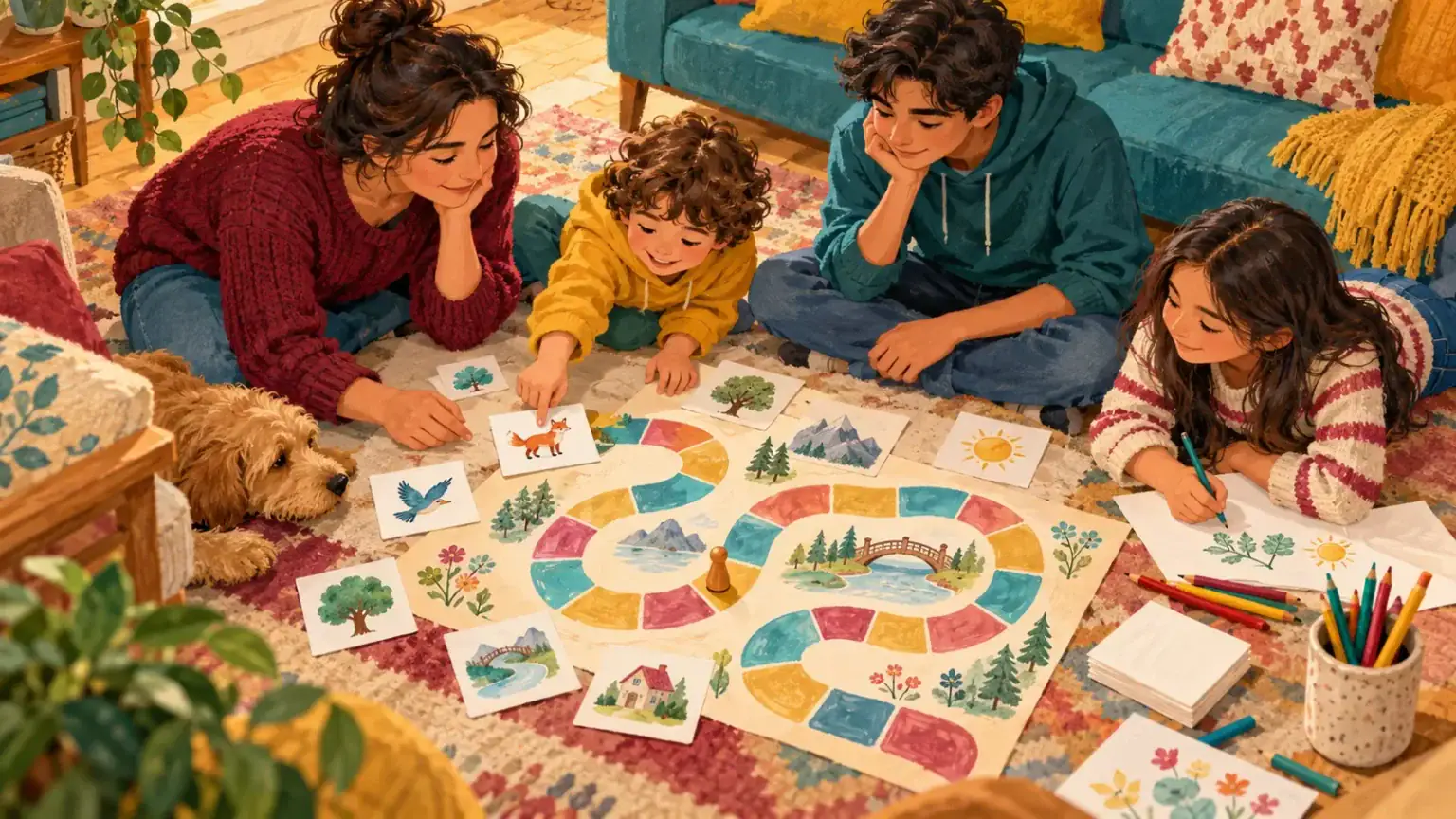
Many printable board games end with one winner and several people waiting for the game to finish. A cooperative story-path game uses the familiar path and turn-taking structure, but everyone builds one story. The group’s goal is to reach the final square with characters, a problem and an ending they created together.
No drawing or storytelling skill is required. Players can speak, point, choose between pictures, use AAC, act out a sound or ask someone else to record their idea.
Materials
- one sheet of paper or card for the path;
- sixteen to twenty-four large squares;
- a die, spinner or number cards from one to three;
- one shared counter;
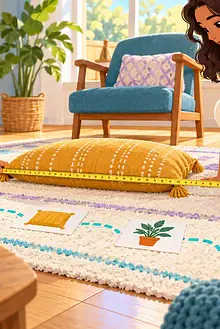
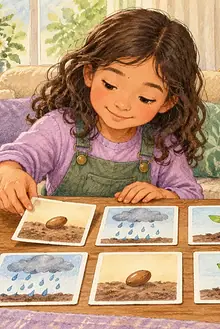
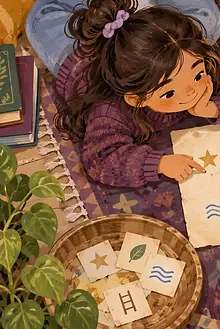
- picture prompts drawn, printed or cut from reused paper;
- optional blank page for recording the finished story.
Use one large counter rather than a separate piece for each player. Keep dice and counters away from children who may mouth small objects; an adult can use a paper spinner or point to numbers instead.
Build the path
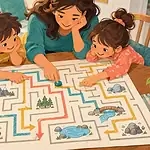
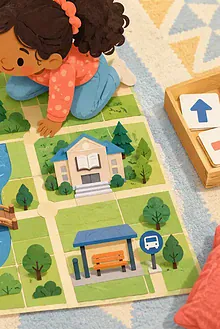
Draw a winding line of squares from “begin” to a picture of home, a celebration or another neutral ending. Add a prompt every two or three spaces:
- Who? a child, animal, robot, grandparent or imaginary creature;
- Where? a kitchen, bus stop, forest, tower or playground;
- Problem? something is lost, the weather changes, a bridge is closed;
- Help? a tool, idea, kind person or new route;
- Feeling? worried, curious, frustrated, relieved;
- Ending? what changes and what the character learns.
Keep prompts open enough for many answers. Avoid assigning a “bad” feeling or behaviour to a particular kind of person, disability, culture or family.
How to play
- Choose the first character together.
- The first player moves the shared counter.
- If it lands on a prompt, that player adds one story detail.
- The next player continues from what already exists rather than replacing it.
- When the counter reaches the end, everyone chooses a final sentence or image.
If a player cannot think of an idea, offer two neutral choices or let them pass. Passing is part of the rules, not a penalty. Nobody is eliminated and the counter never moves backward as punishment.
Support different ages and communication styles
For ages 3–5, use eight to twelve squares and mostly pictures. The adult can repeat the growing story after each turn. For ages 6–9, add simple problem and solution prompts. Older children can introduce a second character, a change of perspective or a rule that the solution cannot involve magic.
A nonspeaking player can select a picture, eye-gaze toward a choice, use a stored AAC phrase or make a sound effect. A child who prefers predictability can preview every prompt before play. A player who finds open choices overwhelming can choose between two cards.
The Harvard Center on the Developing Child describes age-appropriate games and activities as opportunities to practise executive function and self-regulation. Treat this as playful practice, not a test or therapy. The American Academy of Pediatrics likewise places play within healthy development and nurturing relationships.
Keep the story collaborative
Use three group rules:
- build on an idea before changing direction;
- do not laugh at someone’s contribution;
- ask before making another player the character.
If the story becomes frightening or targets a real person, pause: “Let’s move the problem back into the imaginary world.” An adult can set a boundary without taking over the entire plot.
Variations
Mystery path: add picture clues and let the group decide what they mean. Travel version: use a folded half-page board and a number spinner drawn on the corner. Family history version: use fictional prompts inspired by places or objects, without requiring anyone to share a private memory. No-print version: copy the path onto scrap paper and draw simple symbols.
Children who enjoy constructing rules may also like the Give-Only Puzzle. For a week with several ages, see the mixed-age sibling activity plan. The family joke-writing activity offers another way to create together without making a person the target.
End with a short reflection
Ask one optional question: “Which idea changed the story?” “How did we make room for each person?” or “What would the character try next?” Do not turn the reflection into a comprehension quiz.
Save the completed story only if players want to. The value is in the shared making, not a polished product. Print the blank board again, change the picture prompts and the same path can produce a completely different game.