By EdCaptain editorial desk · Published
A number beside a row says “3”. Your child shades three separate squares and wonders why the puzzle does not work. The missing idea is small but important: in a nonogram, that number means three squares touching in one unbroken block.
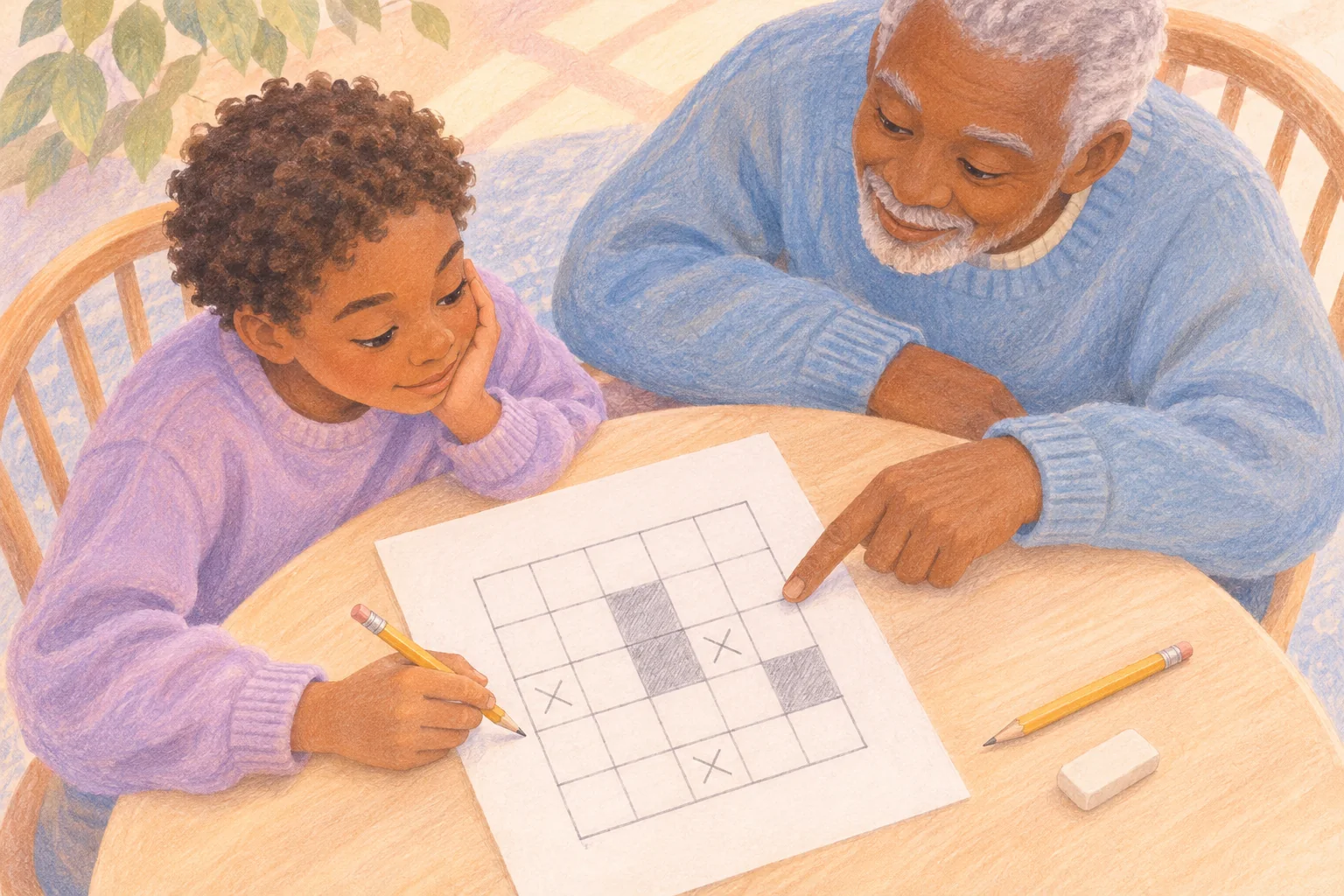
This paper activity introduces that rule with one small grid for ages 8–12. You can solve it together with a pencil, take a break halfway through, or let one person explain while the other makes the marks. There is no timer and no need to download an app.
What you need and how to prepare
Use paper, a pencil and an eraser. Print the puzzle table below, or copy it onto paper as five rows of five squares, with the clues outside. Make the squares comfortably large. Check that the last column and all clues are visible before starting; a cropped printout changes the puzzle.
Keep the answer section covered with another sheet while you play. If printing the whole article, set aside the answer pages. No cutting, counters or colour printing are needed.
Explain the three kinds of square
A nonogram is a picture-logic puzzle. The Washington Student Math Association’s explanation describes how row and column numbers specify consecutive shaded squares, in the order shown. The clues work across a row from left to right and down a column from top to bottom.
- Shaded: you know the square belongs to a filled block.
- X: you know the square must stay empty.
- Untouched: you have not decided yet. This is different from an X.
Each number describes one block. A clue of 3 asks for one block of three, not any three squares. A clue written “1, 1” asks for two separate single shaded squares, with at least one empty square between them. The gap may be longer. A clue of 0 means no shaded squares in that line.
Before using the grid, draw a separate line of five boxes and try the clue 5. Then try 0. These two clear examples establish the marks without asking your child to juggle several rules at once.
The puzzle
The numbers along the top belong to the columns beneath them. The numbers at the left belong to the rows beside them. Commas separate blocks; they do not mean addition or a two-digit number.
| Clues | 5 | 1, 1 | 1, 1 | 1 | 0 |
|---|---|---|---|---|---|
| 4 | |||||
| 1 | |||||
| 3 | |||||
| 1 | |||||
| 1 |
This beginner grid has one solution, checked independently against every row and column clue. The worked route below reaches it without guessing. The pattern looks like a block letter, but let the clues decide the marks rather than drawing the letter you expect.
Take the first few steps together
- Find a whole line. Ask, “Which clue fills exactly five squares?” The first column is 5, so shade every square in that column.
- Find an empty line. The fifth column is 0. Put an X in each of its five squares.
- Return to the top row. Its clue is 4. The first square is already shaded and the last is empty, so shade columns two, three and four. That row is finished.
- Use the little clues. Rows two, four and five each have clue 1. Their first square is already shaded, so mark all their remaining squares X.
- Finish the middle row. Row three needs a block of 3. Its first square is shaded, so the block continues through columns two and three. Mark column four X; column five is already empty.
Now check the columns. Column two has a single shaded square at the top and another in the middle, separated by an empty square: “1, 1”. Column three matches the same clue. Column four has just one shaded square. Every clue agrees.
Give a hint without taking the pencil
If your child stops at the first clue, offer a choice: “Would you like me to explain a clue, point to a useful line, or do one step with you?” A hint does not spoil the activity.
The nonogram.dev rules guide explains why empty-square marks and switching between rows and columns are useful. In this puzzle, try “Which row already has all the shaded squares it needs?” before revealing a particular square.
If two blocks were accidentally joined, look at that line together. Say, “This clue asks for two separate blocks. Where is the gap?” Erase the uncertain marks and restart that line. Avoid turning an ordinary notation mistake into “You weren’t concentrating.”
Make the page fit the player
Ages 8–9: keep the full-column and zero-column examples visible. Read one clue aloud at a time and work as partners. Counting to five may be familiar while the meaning of a run is still new.
Ages 10–12: offer the blank puzzle first and ask the child which clue they would start with. They can explain a deduction orally, point to a line or write a short note; a formal written proof is unnecessary.
For motor access, enlarge the grid or let the child direct an adult who records marks exactly as requested. For visual access, use strong contrast, a larger version and spoken row-and-column descriptions if useful. Do not rely on colour alone to distinguish shaded, empty and undecided. If this format is tiring or inaccessible, switch activities rather than treating completion as a test of ability.
Keep pencils for drawing, not pointing near faces, and use a comfortable working surface. Stop when either partner wants a break. The activity does not promise a developmental gain or measure intelligence.
Answer and a final check
| Row | Column 1 | Column 2 | Column 3 | Column 4 | Column 5 |
|---|---|---|---|---|---|
| 1 | S | S | S | S | X |
| 2 | S | X | X | X | X |
| 3 | S | S | S | X | X |
| 4 | S | X | X | X | X |
| 5 | S | X | X | X | X |
The shaded squares form an F. More important than naming it is checking the runs. Ask, “Which clue made the next step possible?” or “How did an X help us?” A child who explains one useful move has something to share even if you finished the marks together.
For a different kind of deduction, try our beginner matching logic-grid puzzle. If your child wants to invent a puzzle later, our fair puzzle-design guide explains why making an answer key and testing the clues matter. A new nonogram design needs its own solution check; a nice-looking picture alone does not guarantee unique clues.
Sources and further reading
- Washington Student Math Association: how nonogram clues work.
- nonogram.dev: rules and solving methods.
Read our editorial policy.