By EdCaptain editorial desk · Published
Your child suggests a clever new word, but you have never heard it. You reach for a dictionary; they lose interest. A paper word ladder can quickly become a contest over who knows more English instead of the small puzzle you intended.
Start with a shared word bank. In this version for ages 7–12, everyone can see the same six allowed words before play begins. The challenge is finding connections between their written letters, not producing vocabulary under pressure.
Keep the rule narrow
A word ladder connects a starting word to a goal by changing one letter at a time. Every step must still be a word. This established rule is described in Stanford’s word-ladder assignment; the paper game does not require coding.
For today’s puzzle:
- Use only the six words printed below.
- Keep three letters in the same three positions.
- Change exactly one written letter per move.
- Do not add, remove, swap or rearrange letters.
- Do not reuse a word within the same route.
Compare letters, not the number of sounds. A word that rhymes with the last one is not automatically a legal move. First find any valid route; looking for fewer moves can come later.
Prepare the page together
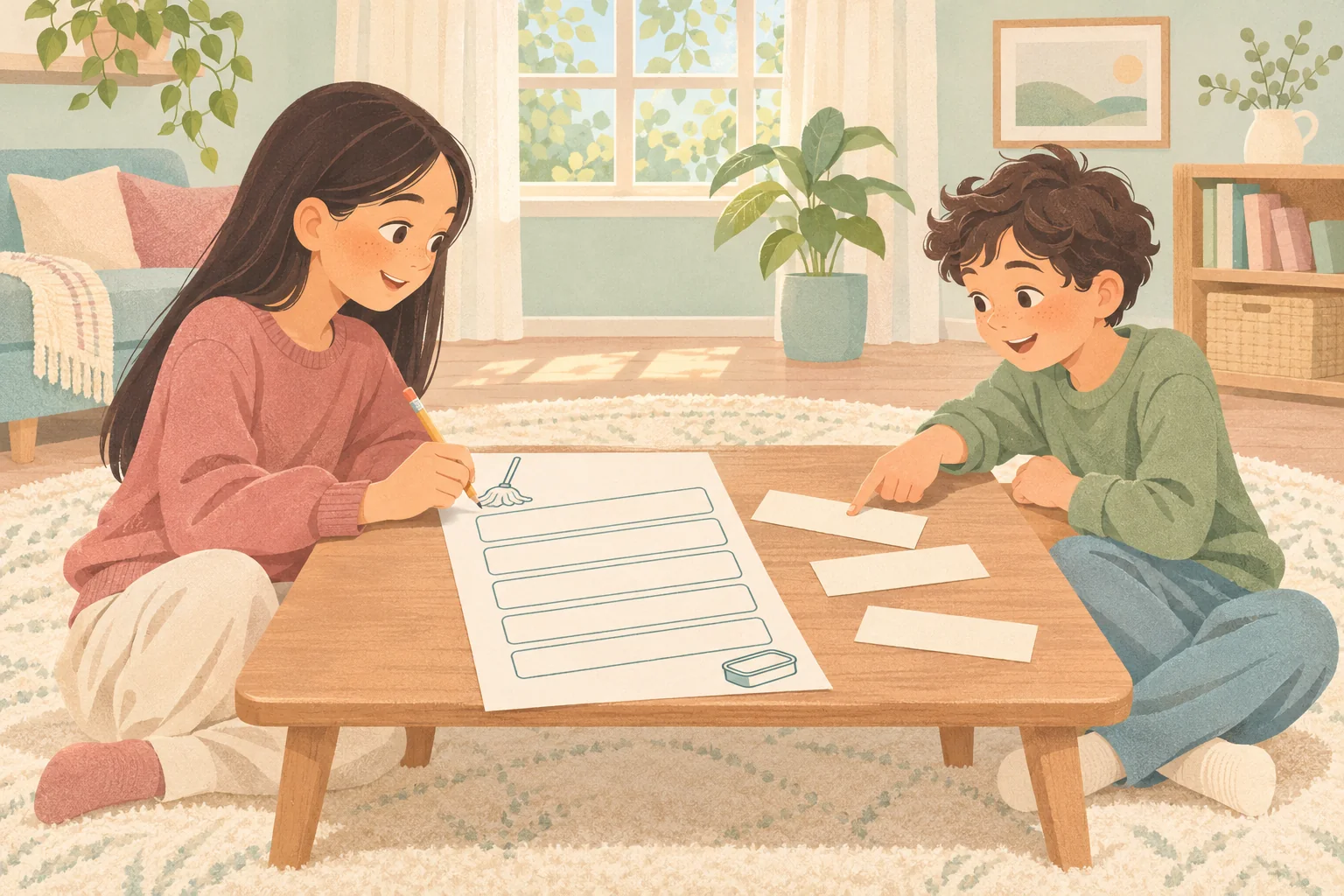
You need paper, a pencil and an eraser. Print the play sheet or copy it in large writing onto scrap paper. No cutting or loose letter tiles are necessary. Keep the answer section covered while you play.
Word bank: MOP, TOP, TIP, TIN, MAP, TAP.
Read all six together and settle their meanings before beginning. A mop is used for cleaning; a top can be the highest part; a tip can be a pointed end; tin is a metal and can also mean a food container in some varieties of English; a map represents places; a tap can be a water fitting or a light touch. Use whichever familiar meaning helps your child recognise each written word.
For this round, the bank is the complete list of allowed words. If your child offers another real word, acknowledge it: “That is a word. Shall we save it for a different round? This page uses these six.” That keeps the boundary clear without declaring their knowledge wrong.
The printable play sheet
Start at MOP and reach TIN. Stop when you arrive, leaving unused lines blank. The five move lines allow room for longer routes as well as shorter ones.
| Move | Word | Which letter changed? |
|---|---|---|
| Start | MOP | No change yet |
| 1 | ||
| 2 | ||
| 3 | ||
| 4 | ||
| 5 |
Play one careful move at a time
- Read the current word. Point to each of its three letter positions. An adult may read it aloud if needed.
- Choose a possible neighbour. Scan the bank for a word that looks almost the same. Ask, “Which two positions stayed the same?”
- Check before writing. Compare the words side by side. Exactly one letter must differ. For example, MOP to TIP changes two letters, so it cannot be one move.
- Record the move. Write the next word and, if useful, note the change. You can underline the new letter rather than write a sentence.
- Continue or back up. Look for the next unused neighbour. If a route stalls, erase a step or try a new route on another line. Reconsidering is part of the puzzle.
Take turns suggesting and checking, rather than assigning one child to do all the writing. A partner can say, “I found a possible next word; can you check the letters?” There is no need to finish before a sibling or beat yesterday’s time.
Offer a hint the player can choose
Try a small choice: “Would you like me to point to a word, tell you which position changes, or show one move?” If they choose the middle option at MOP, you might say, “One possible next move changes the first letter.” Let them find TOP rather than immediately filling it in.
If a word is unfamiliar, explain it directly. Do not hide a vocabulary lesson inside a supposedly fair puzzle. If three-letter comparison is tiring, do just one move together, then stop. Our sound and rhyme games offer a different kind of word play when a written puzzle is not the right fit.
Two checked routes—and an optional challenge
One route is MOP → TOP → TIP → TIN. The changes are first letter M to T, middle letter O to I, then last letter P to N. That is three moves, although four words appear on the page.
Another valid route is MOP → MAP → TAP → TIP → TIN. It takes four moves. All its words are in the bank, each neighbouring pair differs by one letter, and no word repeats. It is a successful answer too.
For a child who wants an extra reasoning challenge, ask whether two moves could ever be enough. Compare MOP with TIN: the first, middle and last positions all differ. One move changes only one position, so at least three moves are needed. The first route achieves three, making it a shortest route. This is a reason to discuss, not a score to impose.
Adjust the support and language
Ages 7–9: read the bank together, keep both compared words visible and accept pointing while an adult records. Underlining the changed letter may be easier than naming its position.
Ages 10–12: invite the child to check a longer route or explain the three-move minimum. They can also list which bank words are neighbours, without needing formal diagrams or computer terminology.
Use large, high-contrast print and generous spacing. A child can dictate, point, type or direct a partner. Do not make handwriting speed part of success. This example uses English spelling; translating the six words will not preserve the connections. In another language, make and check a new small bank with someone who knows that spelling system, or choose another game.
Finish with the useful discovery
Ask, “Which pair was easy to compare?” or “Did the longer route still follow every rule?” Keep a successful sheet if the child wants it. Stop if the activity becomes frustrating; finishing a ladder is not a measure of intelligence or reading ability.
Brain Quest’s paper word-ladder explanation offers another introduction to the familiar game. If your child wants to make their own page, our fair puzzle-design guide explains why the answer needs checking first. Two interesting words are not enough: the allowed words must actually connect.
Sources and further reading
- Stanford CS106B: word-ladder rules and valid intermediate words.
- Hachette/Brain Quest: playing word ladders on paper.
Read our editorial policy.