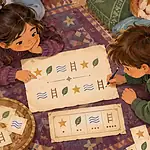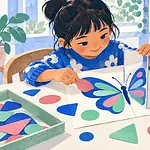
Sequence cards are often presented as a test: put four pictures in the one correct order. Real stories are not always that tidy. A wordless sequence puzzle can invite children to notice cause and effect while allowing more than one defensible arrangement.
The key is to draw pictures that connect without making the child guess an invisible adult script. Players should be able to point to evidence on the card and say, in words or another communication form, why one scene might come before another.
Materials
- one sheet of card or paper;
- pencil, dark marker and optional crayons;
- scissors used with appropriate adult support;
- four envelopes or clips for storing sets.
For players who mouth paper or need larger materials, keep the cards uncut or print them at a larger size. A player can arrange cards by eye gaze or direct another person to move them.
Create a four-card set
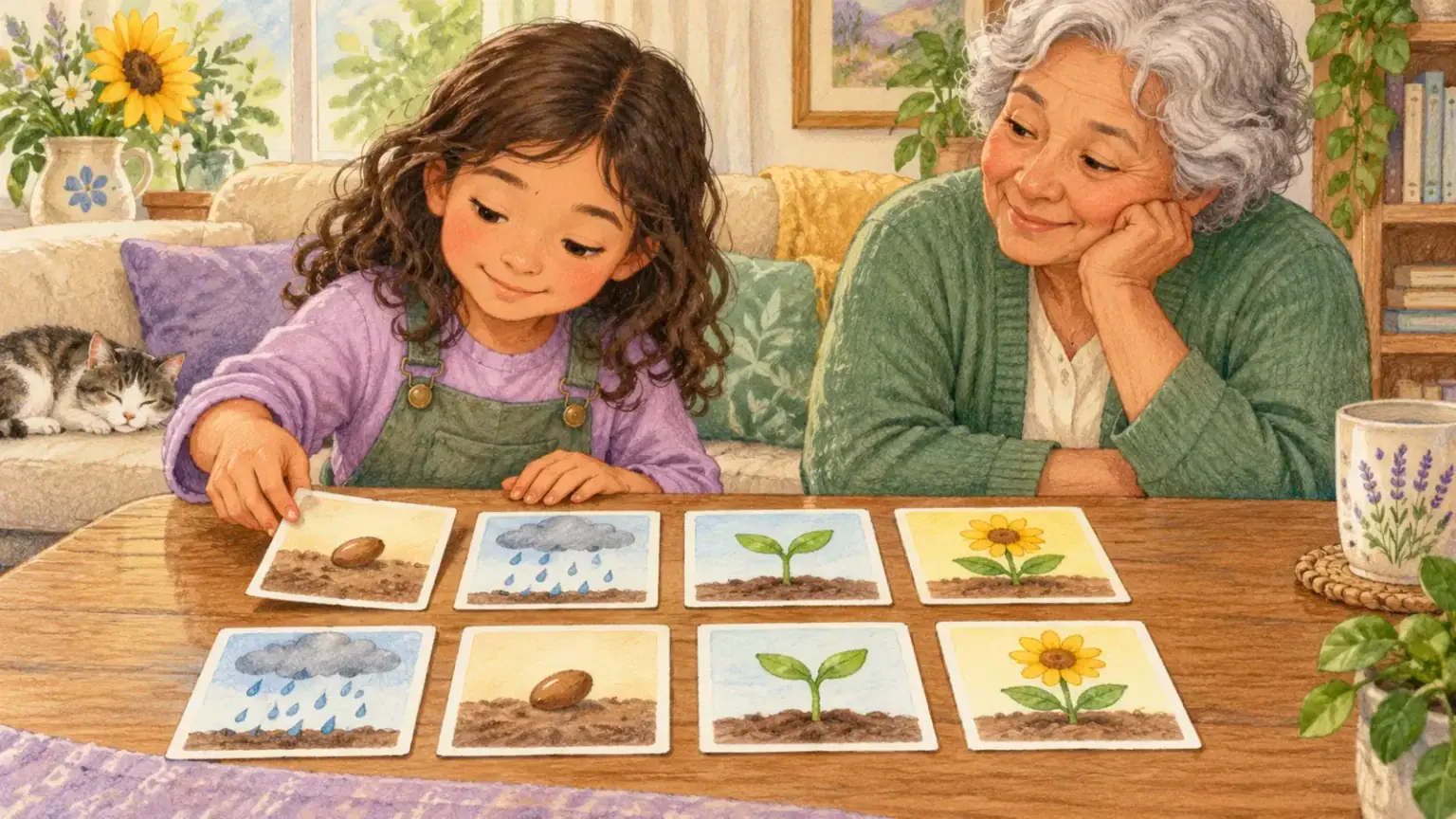
Choose an ordinary fictional event: planting a seed, building a cardboard shelter, preparing for rain or finding a lost mitten. Draw one clear action per card. Include visible clues—dry soil then wet soil, an empty pot then a sprout—but avoid tiny details that determine the “correct” answer only because the adult knows they are there.
Test two orders yourself. If only one order makes sense, that can be the beginner version. If two versions work, keep both and prepare to ask what changes in the story.
Play in stages
- Look at every card without arranging them.
- Name visible objects and actions without interpreting feelings.
- Choose a possible first card.
- Add the remaining cards one at a time.
- Tell, point through or act out the completed sequence.
Instead of “No, that is wrong,” ask, “What on the picture makes that come next?” If the child’s explanation is coherent, accept the sequence even if it differs from yours. If a card truly contradicts the order, point to the evidence and invite a revision.
Use the cards for several kinds of thinking
After the first story, swap two cards and ask what would need to change. Remove one card and invent the missing event. Add a blank card for a new ending. Turn the set face down, reveal one card at a time and predict what might appear next.
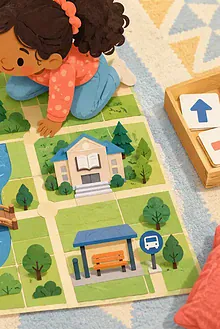
The cooperative story-path game extends this idea into a shared board. For memory variations, see five small memory games.
Adapt by age and ability
For ages 3–5, use three high-contrast cards and repeat the child’s explanation. For ages 6–9, add a problem and solution. For ages 10–12, include a scene that can be interpreted differently and compare two narratives.
A child who does not use speech can select “first,” “next” and “last” symbols in AAC, point, sign or move the cards. Avoid requiring facial-expression reading; actions, objects and settings can carry the sequence. Use culturally familiar scenes or invite the child to design the characters.
Keep routine cards separate
Story puzzles are not the same as visual schedules. A daily routine card tells a child what will happen and should be reliable. A story card invites imagination and may have several answers. Store them separately so a child is not asked to treat an actual medication, school or bedtime sequence as optional fiction.
Reflect gently
Ask one question: “Which card gave you the strongest clue?” “Could another order work?” or “What is happening between these two pictures?” Do not demand a long explanation from a tired child.
The American Academy of Pediatrics describes storytelling, drawing and make-believe as forms of play that can support learning and relationships. Harvard’s play resources also describe games as practice opportunities for attention and working memory. This printable is not an assessment of language, intelligence or development.
Keep the original drawings and make a second set with one deliberate change. Over time, children can become the designers, giving adults a story puzzle that genuinely has more than one route.