By EdCaptain editorial desk · Published
“You already had a turn!” Your child has watched you draw another line after closing a box, and the game suddenly feels unfair. In Dots and Boxes, that extra move is part of the rule. It helps to demonstrate it before either player cares about the score.
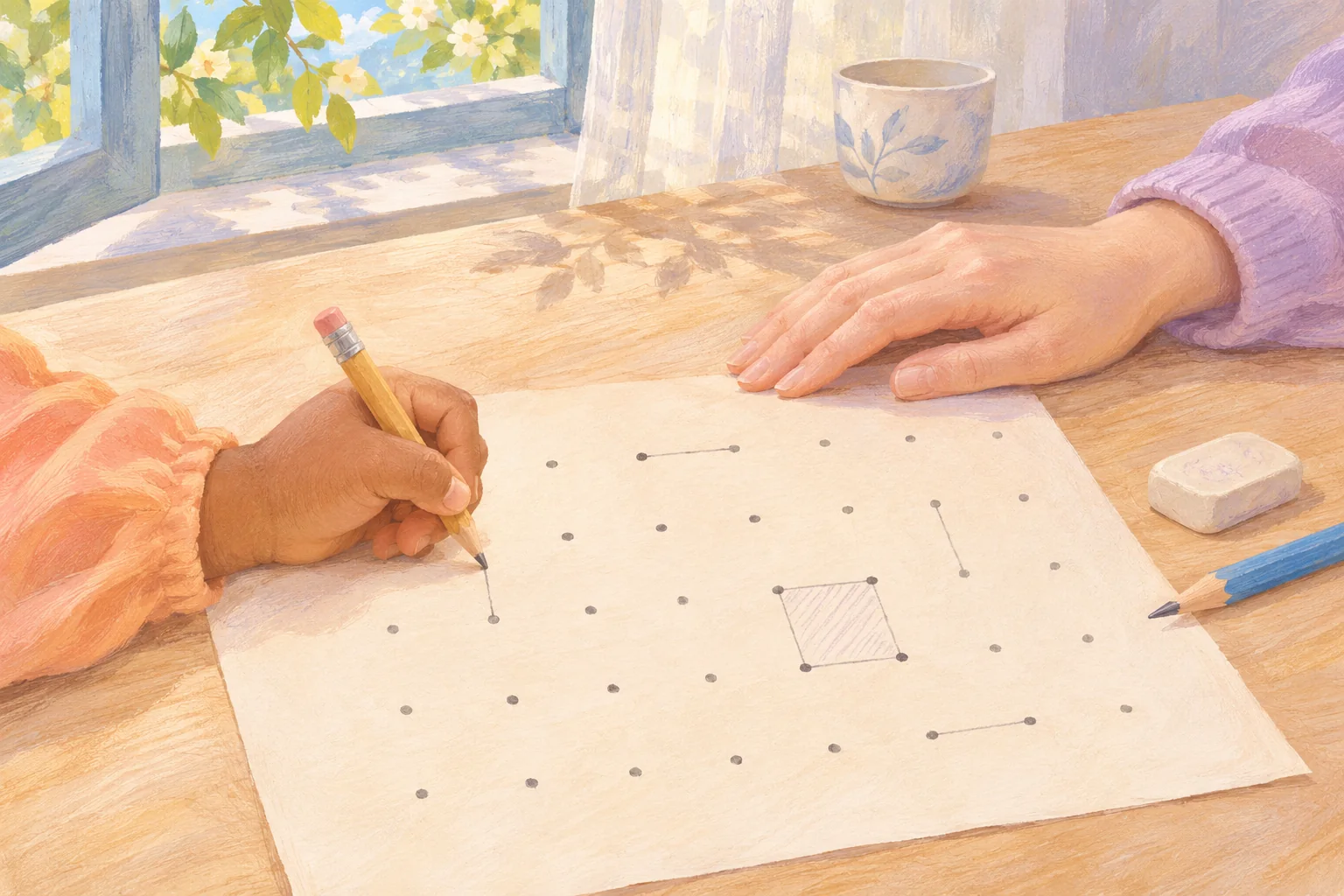
Start with nine dots for children aged 6–12. This makes just four small boxes, enough to see how the game works without filling a whole page. Two players need paper, a pencil each and an eraser; there are no pieces to buy or cut out.
Print or draw the starter board
Use the dot board below, or draw three evenly spaced rows of three dots. Leave generous gaps for a pencil line and a small ownership mark inside each box. The letters and row numbers are optional labels for explaining moves; they are not part of the playing area.
| Row | A | B | C |
|---|---|---|---|
| 1 | ● | ● | ● |
| 2 | ● | ● | ● |
| 3 | ● | ● | ● |
Print two copies if you want a practice board and a fresh game. You can also redraw the dots on scrap paper. Check that all nine dots are visible and the spacing leaves room to connect them clearly.
Choose a small mark for each player, such as a circle and a star. Colour can be an extra cue, but use different shapes too so ownership stays readable without colour. Decide who starts; swap starters for the next round.
Agree on these rules first
The Maths-Resources game instructions describe the basic pattern: connect dots, claim a box by closing its fourth side, and take another turn when you score.
- Draw one new line. Join two neighbouring dots horizontally or vertically. Do not draw diagonally, skip over a dot or redraw an existing connection.
- Check both sides of the line. Did it complete a small box? Only the square between neighbouring dots counts, not a large rectangle around several boxes.
- Claim what you closed. Put your chosen mark inside each small box your line completed. Each is worth one point. Ownership goes to the player drawing the fourth side, whoever drew the other three.
- Move again if you scored. The same player draws another single line. If that line also closes a box, they continue. A line that closes no box passes play to the other person.
- Finish and count. When all connections are drawn, count each player’s marked boxes. More boxes wins; equal totals are a draw.
On this board, there are twelve possible connections and four boxes to claim. The scores together should total four at the end. If the last line completes the board, the game ends—there is no extra line left to draw.
Show the extra move without a score to protect
Call the top-left dot A1, the top-middle B1 and the middle-left A2. On a practice copy, an adult draws three sides of the top-left box:
- A1 to B1;
- A1 to A2;
- A2 to B2.
Invite the child to add B1 to B2. That is the fourth side. They mark the box and then draw one more available line, perhaps B1 to C1. Say, “Closing the box keeps your turn going. This next line did not close a box, so now it passes.”
Then begin the actual game on a blank board. Keep the practice demonstration separate so nobody mistakes the adult’s setup lines for a scored advantage.
What if one line closes two boxes?
Two neighbouring boxes share a side. If both are waiting for that same final side, one line closes both. The player marks both boxes and scores two points. They then take the next move if any lines remain; they do not store two separate bonus moves for later.
To demonstrate, draw the six outside edges around the two top boxes on a spare board: A1–B1, B1–C1, A1–A2, C1–C2, A2–B2 and B2–C2. Leave the middle connection B1–B2 missing. Adding it closes both boxes. The two lower boxes are still open.
Daniel Allcock’s research paper’s short rules introduction confirms that completing at least one box means moving again immediately, until a non-scoring move passes play or the game ends. You do not need the paper’s advanced strategy to play this small version.
Help players notice without choosing for them
Before a move, ask, “Which box would this line touch?” An inside connection can affect a box on either side. Let the player count the existing sides before deciding.
Drawing a third side may give the next player a chance to close that box. That is useful to notice, but it is not a universal instruction to avoid every third side. Keep the first round focused on legal lines and correct turns rather than teaching a supposed guaranteed winning trick.
If someone claims the wrong box, pause and trace its four sides together. Correct the ownership mark before continuing. If a line is hard to see, redraw it clearly without counting it as another move.
Fit the game to the child
Ages 6–9: play the practice setup together, then keep the nine-dot board. Use the spoken check “line, box, same player or swap?” after each move. An adult can read the position labels or point to dots.
Ages 10–12: ask the child to explain a shared-edge capture or compare two possible moves before choosing. Offer a larger board only if they want a longer game; more dots are not automatically more enjoyable.
Enlarge the page and use high contrast if helpful. A player can point to two dots, name them, use their usual communication method or direct a partner who draws the line. Confirm the intended connection before marking it. Speed and handwriting accuracy need not decide whose idea is used.
Use pencils at a comfortable surface and keep their tips away from faces. No small counters are needed. Let either player pause; a short game still counts as play if you stop before all four boxes are finished.
Keep the ending small
Count boxes, check the total and ask one question: “When did the extra-move rule matter?” You can save the board or start a fresh one with a different first player. There is no need for a league table.
If the score is becoming the whole experience, our guide to winning and losing offers ways to pause and reset. For a shared goal instead of two scores, try the cooperative paper maze. Neither activity is a test of intelligence or a promise of developmental improvement.
Sources and further reading
- Maths-Resources: Dots and Boxes rules.
- Daniel Allcock: Best play in Dots and Boxes endgames—rules in the introduction.
Read our editorial policy.