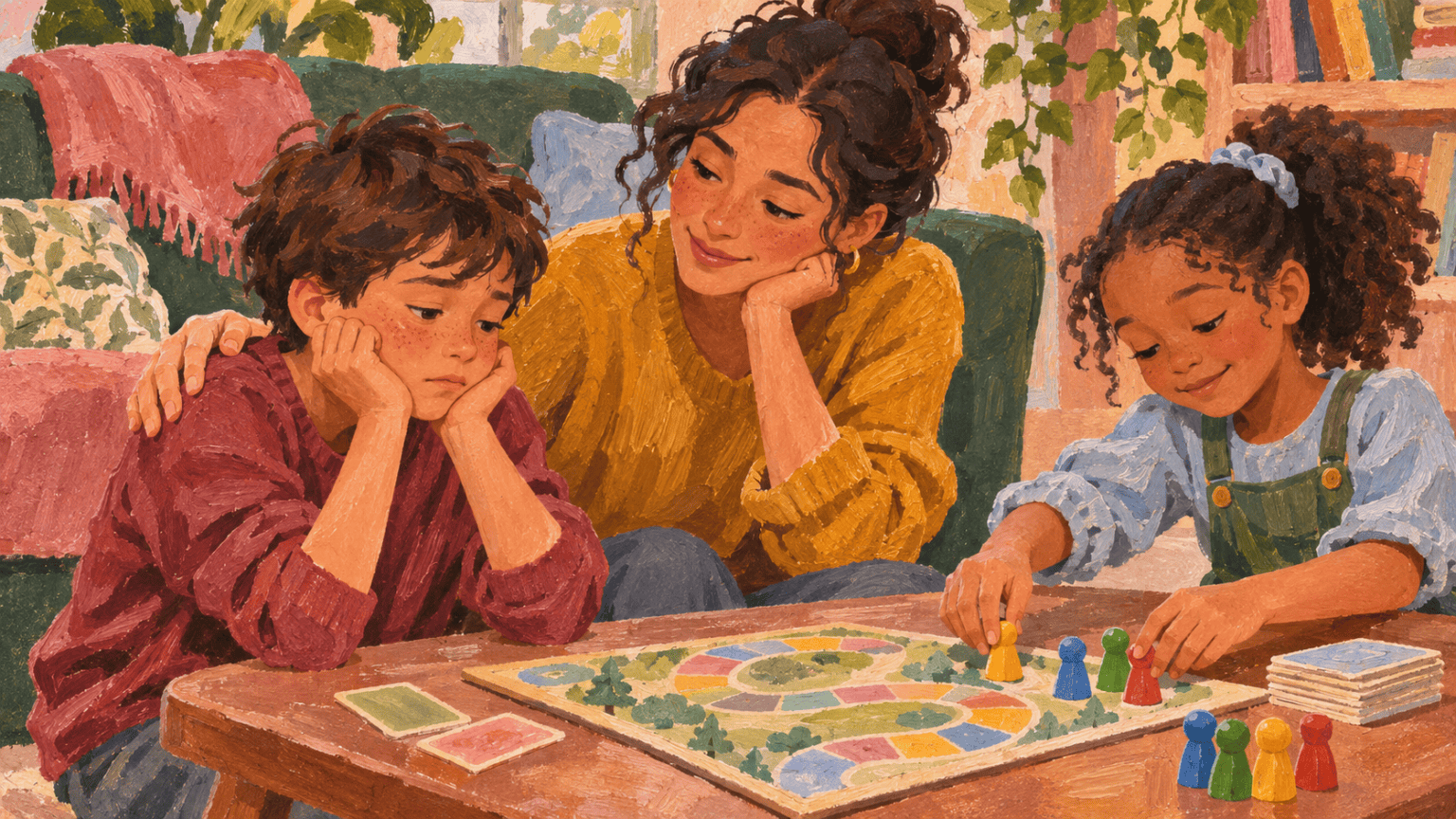
A child who cries after losing is not necessarily spoiled, and a child who celebrates loudly is not automatically unkind. Games combine uncertainty, public mistakes, waiting and a visible result. Temperament, fatigue, hunger, rule complexity and the meaning attached to “being good” can all raise the emotional stakes.
The aim is not to demand a cheerful handshake on command. It is to make competition predictable, keep everyone safe and practise returning to play after disappointment.
Choose the game for the child’s current capacity
Begin with short rounds, clear rules and limited waiting. A game that lasts ten minutes gives the child another chance soon; a ninety-minute defeat can feel enormous. Use open information before bluffing, and avoid games where an eliminated player watches everyone else for a long time.
The AAP highlights board and card games as opportunities for interaction. That opportunity disappears when the game is consistently too complex, too long or used to teach a moral lesson after every move.
Set the emotional rule before the game
Say what is allowed: “You may feel disappointed, ask for a break or say ‘good game later.’ You may not hit, throw pieces, insult someone or change the score.” Ask each player how they want celebrations to look. A small smile or quiet “yes” may be enough in a sensitive group.
Model ordinary mistakes
Let the child see an adult misread a card, make a poor choice and recover without self-criticism. Say, “I missed that. I’ll try a different plan next turn.” Do not lose deliberately and then reveal it. Children need honest play, not a performance that makes their effort meaningless.
Use a pause before a lecture
If emotions rise:
- Stop hands from moving pieces.
- Name the situation briefly: “You wanted that win and the result hurts.”
- Offer water, movement or a quiet two-minute pause.
- Decide whether to resume, finish later or end this round.
- Discuss repair only after bodies are calmer.
AAP guidance recognizes that children vary in how intensely they react and that play can help them name and manage feelings. Avoid diagnosing a child from one game night.
Separate feeling from behaviour
Disappointment is allowed. Knocking the board is not. Ask for a connected repair: gather pieces, check whether anything broke and apologize for a specific hurtful action. Do not require the child to say they are happy about losing.
If the winner taunted, changed rules or dominated decisions, address that too. Sportsmanship is not a one-way demand placed on the losing child.
Adapt the format
Try a cooperative game, adult-child teams, best-of-three rounds or a personal goal alongside the final score. Let a younger player use fewer cards only if everyone understands the rule before play. Write house rules so they do not change whenever one person is close to winning.
EdCaptain’s family teamwork games offer shared-goal alternatives. The guide to sharing without forcing can help when conflict centres on pieces, turns or ownership.
Debrief one useful moment
Ask: “What part was fun? When did it get hard? What should we change next time?” Notice a concrete recovery: “You asked for a pause instead of throwing the cards.” Avoid praising the child only for winning or for hiding disappointment.
Know when to stop practising
If every game ends in distress, step back from direct competition. Choose puzzles, building challenges or pretend play while practising smaller frustrations elsewhere. Seek qualified support if intense reactions happen across daily life, involve danger or cause major impairment—not because a child dislikes losing one board game.
Winning and losing are events in a game, not verdicts on a child. A calm structure helps the family keep the result in proportion and makes returning to the table possible.