By EdCaptain editorial desk · Published
Research-based review · Overall editorial score: 3.6 out of 5
Verdict: Halli Galli is a lively choice for children who enjoy spotting a pattern and responding immediately. It turns counting exactly five fruits into a shared race for a real bell. The same feature limits its family fit: knowing the answer does not help much when someone else always reaches the bell first.
This assessment uses published rules and specifications, without hands-on testing. Likely engagement, family fit and adaptations are editorial judgments about the mechanics. We have not tested the bell, card durability or children’s responses. Read our review methodology and editorial policy.
Quick facts
Version: AMIGO standard Halli Galli, item 01700, designed by Haim Shafir. This review excludes Junior, Extreme and other variants. Manufacturer age: 6+. Players: 2–6. Time: about 15 minutes, the publisher’s estimate. Allow extra for teaching.
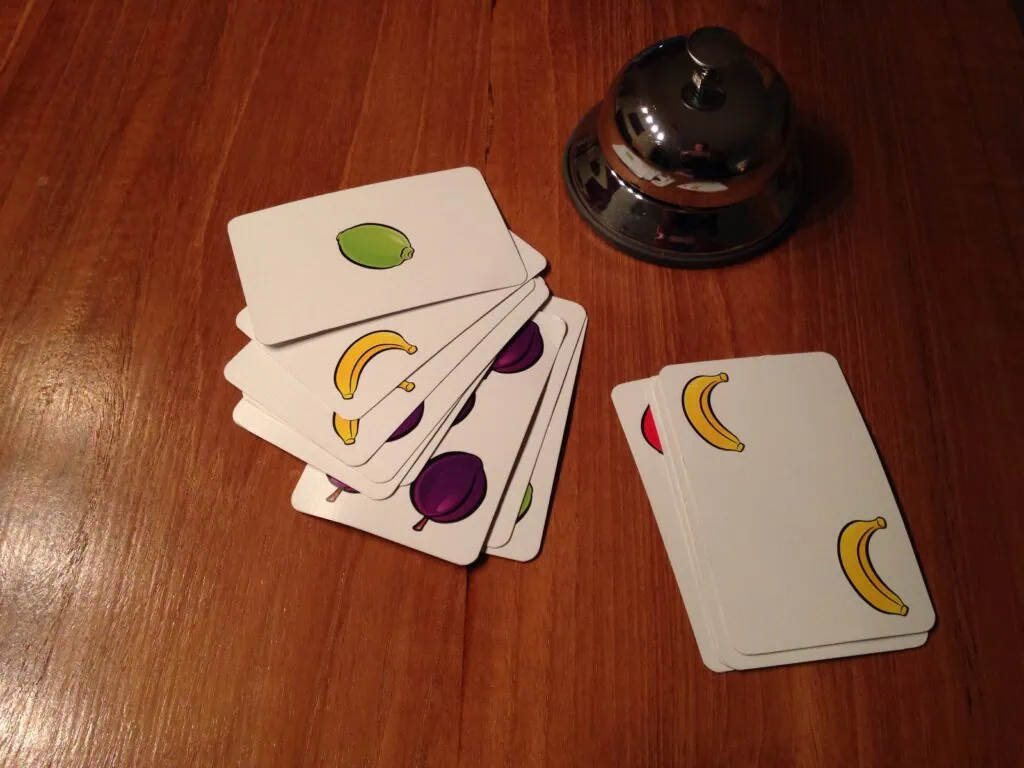
Contents and format: 56 fruit cards, one tabletop bell and instructions. All play uses these physical components; no app, screen or account is required. This is a reaction and counting game with a defined ending, rather than free-form toy play.
Our recommendation: ages 6–12 who enjoy quick competitive play. At 6–9, start with slow counting practice. At 10–12, the interest is likely to be recognising changing totals quickly. An adult can join, but should first check whether the speed difference makes the contest enjoyable for everyone.
Space and care: use a stable table where every player can reach the bell comfortably. The official rules suggest cloth or felt beneath it to protect the table. The linked Amazon listing does not show detailed safety warnings. Check the age label and warnings supplied with the actual set; keep loose components away from under-threes, consistent with CPSC toy-safety guidance. The recommended playing age remains 6+. See our health and safety information.
How the game works
Deal the cards into facedown piles. Players take turns revealing one card onto their own open pile, covering the previous card. Watch only the visible top cards: when they show exactly five of one fruit type, everyone may try to ring the bell. Five mixed fruits do not count, and six of one fruit is too many.
The first correct ring wins all open piles, which go under that player’s draw pile. A mistaken ring costs a card to each opponent. Running out of draw cards does not immediately eliminate a player: they may still ring while their open pile remains. When only two remain, the final collection ends the game; the person with the most cards wins. Follow the supplied rules for the final-two mistake penalty.
The distinctive challenge is updating a total when a new card covers an old one. Seeing three bananas and then two is only useful if both cards remain visible. This makes a good discussion point after practice, without claiming that the game produces measured improvements in maths.
Who it suits, and who might skip it
Try it when a child wants short bursts of energetic table play rather than planning several turns ahead. There is no reading during a turn. Families can explain the rules in Hindi, English or another home language, and count aloud during practice before adding the race.
Skip it for a quiet bedtime game, for players who dislike sudden ringing, or when reaching quickly is uncomfortable. Faster adults or siblings can repeatedly win even when a younger child counts correctly. The penalty can make a hesitant player less willing to try, and elimination means someone may be watching before the others finish.
Do not assume that adjusting the bell’s position creates equal access. Vision, identifying the fruit symbols, processing speed and hand movement all matter. If a player prefers a thoughtful puzzle, a simultaneous speed contest may be the wrong purchase.
Eight editorial ratings
Scale: 1 = poor fit, 3 = workable with trade-offs, 5 = excellent fit for the stated audience. The audience is interested children aged 6–12 in family play. These are research-based editorial judgments, not customer ratings, tested quality claims or developmental measurements.
| Indicator | Score / 5 | Reason |
|---|---|---|
| Age fit | 4 | The 6+ minimum fits counting practice, but reaction speed can create uneven matches. |
| Ease of learning and setup | 4 | One visible target is easy to explain; covering old cards and final-round rules need teaching. |
| Child engagement | 4 | Frequent shared spotting moments could appeal to reaction-game fans; engagement has not been observed. |
| Replay value | 4 | Changing visible combinations offer fresh rounds, although the core challenge stays narrow. |
| Opportunities to practise skills | 4 | Players can compare quantities and update totals; wider learning gains are not established. |
| Quality of family interaction | 3 | The shared bell creates common moments, but repeated wins and elimination can sideline a child. |
| Accessibility and adaptability | 2 | The standard game depends on speed, visual scanning and reaching, with a potentially startling sound. |
| Value for money | 4 | Regular reaction-game players may use it often; a borrowed set is a better trial for uncertain families. |
Calculation: (4 + 4 + 4 + 4 + 4 + 3 + 2 + 4) ÷ 8 = 3.625, rounded to 3.6 out of 5. Each indicator has equal weight.
How to play it meaningfully
A realistic first round: start with two players and a practice display. Find a three-fruit card and a two-fruit card of the same kind. Count them together, then replace one with a different quantity. Let the child explain whether the total still qualifies. Spend about five minutes on this, an editorial estimate, before resetting for a standard game.
Two adult moves: ask, “Which fruit makes exactly five right now?” Then say, “You counted that correctly even though I reached first.” This separates understanding from winning. Keep hands relaxed and agree on a gentle press rather than forceful slapping.
Easier house variation, still ages 6+: remove the race. After each reveal, take turns checking the display and explaining a possible five. This is counting practice with the components, not the standard competitive game. Do not secretly change rules halfway through a scored round.
Harder or more accessible: in practice, older children can explain which covered card changed a total. Avoid adding a faster timer. For someone who dislikes the sound or cannot reach the bell, try a spoken signal and untimed checking instead, with agreement from all players. This changes the game substantially; if speed and sound are its main appeal to the others, choose a different shared game.
If frustration builds: say, “The race is getting annoying. Would you like a slow round, a break or to finish?” Accept stopping. Do not insist on another round to prove the child can lose politely. After an elimination, offer a separate activity rather than assigning them compulsory scorekeeping.
Borrow, swap or try a no-buy alternative
Borrow a complete standard set and try the bell sound before buying. For a separate no-buy activity, draw groups of one to five familiar shapes on scrap-paper cards, turn over two, and look together for totals of five. Leave out the race and penalties. This can meet a family’s counting-play need without reproducing the full commercial game. EdCaptain’s mixed-age board-game trial can help check whether everyone gets meaningful choices.
Check the physical edition
AMIGO Halli Galli · Standard physical fruit-card and bell game
Amazon US ASIN B01N8WWIHT. The listing shows German packaging marked 6+, rather than a guaranteed English-language edition. The publisher’s official English rules are linked below. Choose the standard game, rather than Junior, Twist, Extreme or a replacement bell. Check the seller’s contents, supplied instructions and delivery terms for your location before ordering.
As an Amazon Associate I earn from qualifying purchases.
Check this edition on Amazon US (paid link).
Sources and review basis
Checked 12 November 2026. AMIGO’s standard product page supports the fruit-and-bell format, contents and core play. AMIGO’s official English rules, version 3.0 support age, players, estimated duration, setup, penalties and ending. CPSC safety guidance is linked above. Photo source and reuse terms are linked in its caption. Adaptations and scores are editorial inferences; no Amazon customer reviews inform them.