By EdCaptain editorial desk · Published
Research-based review · Overall editorial score: 3.9 out of 5
Verdict: Kingdomino suits a family looking for a short puzzle with individual choices and little reading. A tempting tile asks two questions: will it fit your landscape, and what choice will it leave you next time? The main trade-off is that a lovely-looking kingdom can score poorly if its connected areas have no crowns.
This review assesses published rules and specifications, without hands-on testing. Likely engagement, family fit and adaptations are editorial inferences from the mechanics. We have not tested component quality, durability or children’s responses. Read our review methodology and editorial policy.
Quick facts
Reviewed version: Blue Orange Kingdomino, standard physical base game, US item 03600, Amazon US ASIN B01N3A4070. Excludes Origins, Duel, Queendomino, expansions and digital versions. The publisher lists ages 8+, 2–4 players and an estimated 15 minutes. Allow longer for teaching and scoring.
Components: 48 terrain dominoes, four starting squares, four buildable castles, eight wooden king tokens and rules. A complete session uses the supplied pieces and can be played entirely away from a screen.
Our age recommendation: ages 8–18 with an interest in spatial puzzles, alongside adults. At 8–9, help with counting and the turn sequence; at 10–12, invite independent planning. Interested teens aged 13–18 can explore tighter layouts and the official larger two-player variant.
Space and safety: each player needs room for a growing grid, plus a shared tile display. Keep loose tokens away from younger siblings and follow the packaging’s age and safety information. The linked US listing warns of a small-parts choking hazard and excludes children under three. CPSC guidance advises keeping small parts away from under-threes. Adult supervision does not lower the 8+ playing recommendation. See our health and safety information.
How the game works
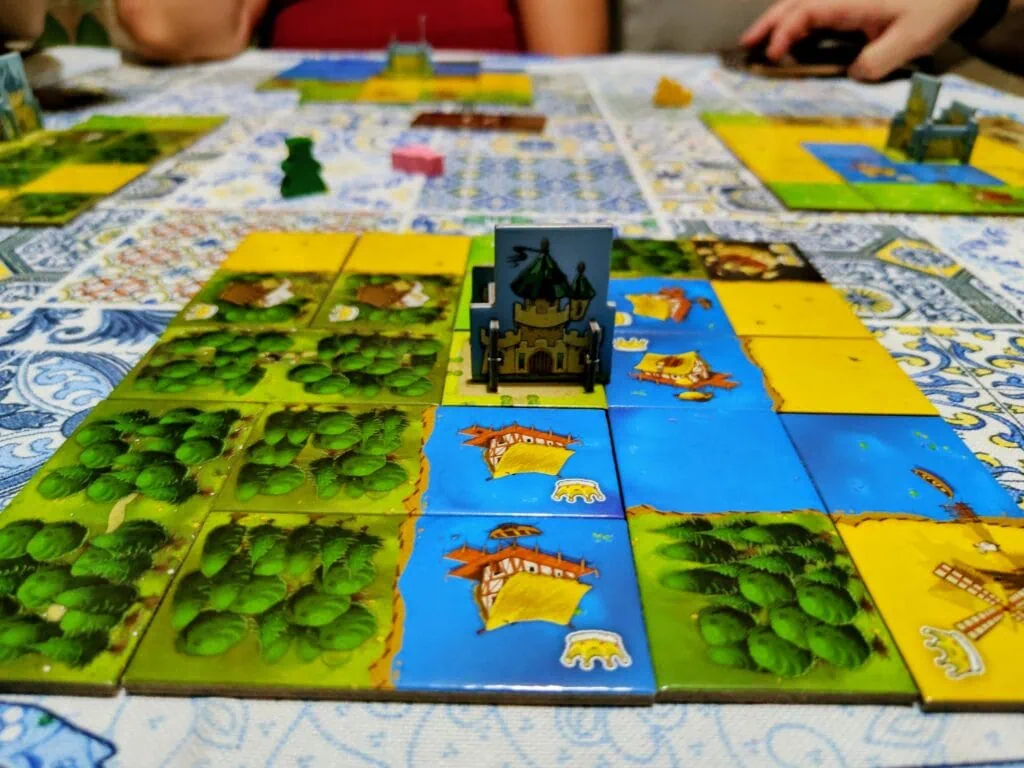
Claim terrain dominoes from an ordered display, then connect each to your kingdom. At least one terrain must match an adjacent terrain, or touch the wild starting square. Keep the kingdom within five squares by five. A domino that cannot legally fit is discarded.
Your claimed tile determines your place in the next selection order. Choosing something valuable now can leave fewer choices later. At the end, each connected terrain area scores its number of squares multiplied by its crowns. An area with no crowns scores nothing; the highest total wins. Two-player play uses two kings each, so follow the rulebook’s player-count setup.
The interesting family decision is often a small compromise: take a crown for an existing forest, or a less valuable tile that leaves more room. A child can make a different plan from an adult without needing factual knowledge or fast reactions.
Who it suits, and who might skip it
Consider it for a child who enjoys arranging shapes but wants more interaction than a solo puzzle. Everyone builds separately while competing for the same tiles. Explain the rules in Hindi, English or another home language: the decisions do not require reading English text. An adult can calculate a final total from the child’s own counted groups without choosing their moves.
Skip it if the family wants a cooperative outcome or a game driven by storytelling. An experienced player may recognise scoring opportunities much earlier, and a tile another player takes can spoil a plan. The artwork is busy: crowns are small, terrain identification requires visual attention, and handling or reaching tiles may be difficult. These barriers deserve a trial with a borrowed set.
Eight editorial ratings
Scale: 1 = poor fit, 3 = workable with trade-offs, 5 = excellent fit for the stated audience. Scores assess interested puzzle players aged 8–18 in family play. They are research-based judgments, not customer ratings or measurements of development.
| Indicator | Score / 5 | Reason |
|---|---|---|
| Age fit | 4 | Ages 8+ can make real layout choices; an adult may need to help with scoring. |
| Ease of learning and setup | 3 | Matching is familiar, but choosing a tile also changes the next turn order. |
| Child engagement | 4 | Building a personal landscape could appeal to puzzle fans; actual engagement has not been tested. |
| Replay value | 5 | Changing tile offers and competing choices create fresh layouts across games. |
| Opportunities to practise skills | 4 | Players compare shapes, reserve space and count scoring groups; learning gains are not established. |
| Quality of family interaction | 4 | A shared tile market gives families choices to discuss, although the result is competitive. |
| Accessibility and adaptability | 3 | No reading is needed during turns, but small crowns and similar terrain colours can be barriers. |
| Value for money | 4 | A short game with varied layouts could earn regular use; ordinary dominoes may already satisfy casual matching play. |
Calculation: (4 + 3 + 4 + 5 + 4 + 4 + 3 + 4) ÷ 8 = 3.875, rounded to 3.9 out of 5.
How to play it meaningfully
A realistic first round: before playing, spend about five minutes, an editorial estimate, placing a few spare dominoes beside a starting square. Show one legal match and one connection that does not match. Count a small crowned area together. Then reset and play one standard game, keeping the rules nearby and leaving optional bonuses out.
Two adult moves: ask, “Where could this fit without closing that gap?” Then offer, “Would you like help counting, or would you rather try first?” Wait before moving any of the child’s pieces. Avoid announcing the mathematically best choice on every turn.
Easier house variation, still ages 8+: try an open teaching game with permission to undo the most recent placement before the next player acts. Keep matching and grid limits. Explain that this changes the competitive rules and is for learning, rather than comparing scores.
Harder or more accessible: interested teens and experienced pairs can use the official Mighty Duel variant, which expands the kingdom to 7 by 7 using all dominoes. For access, a partner can place pieces exactly where directed and describe terrain and crowns aloud. Good lighting and a plain table covering can help, but check that the illustrations are distinguishable before buying.
If frustration builds: acknowledge the specific problem: “You wanted that lake tile and it has gone.” Offer thinking time, a practice restart agreed by everyone, or stopping. A child need not finish a disappointing kingdom to earn the next game.
Borrow first or try a no-buy alternative
Borrow or swap a complete base set before buying if the family is unsure about competitive puzzles. With ordinary dominoes already at home, try a separate challenge: build a connected layout inside a hand-drawn boundary and explain the choices. It will not reproduce Kingdomino’s terrain market or scoring, but can reveal whether arranging pieces is enjoyable. For a family trial, EdCaptain’s mixed-age board-game activity helps check that each person has meaningful choices.
Check this edition on Amazon US
Blue Orange Kingdomino · Standard physical base game
Model 03600; ASIN B01N3A4070. Select the standard “Single” set rather than an expansion, Origins, Duel or New Edition. The listing’s language field says French; check the supplied instructions before ordering. Official English rules are linked below. This is the United States marketplace; check seller and delivery terms for your location.
As an Amazon Associate I earn from qualifying purchases.
Check this edition on Amazon US (paid link).
Sources and review basis
Checked 12 November 2026. Blue Orange US product information supports the standard game, item number, age, players and publisher time estimate. Official standard rules support components, placement, scoring and variants. Blue Orange’s New Edition page distinguishes the refreshed artwork. Amazon US’s standard physical edition listing confirms model 03600, the playable components, minimum age and small-parts warning. Its language metadata is noted above rather than assuming English packaging. Photo provenance and licence are linked in the caption. No Amazon customer reviews inform this assessment.