By EdCaptain editorial desk · Published
Research-based review · Overall editorial rating: 3.8 out of 5
Verdict: ThinkFun Rush Hour is a useful option for a child aged 8 or over who wants a puzzle they can work on at their own pace. The clear goal gives each attempt a purpose, and nobody has to lose to a sibling. Its main limits are a fixed set of challenges and the need to copy small, coloured diagrams accurately.
This assessment uses published product information and rules, not hands-on testing. Family-fit judgments, adaptations and scores below are editorial inferences from the mechanics. Actual engagement, durability and build quality have not been tested. Read our review methodology and editorial policy.
Quick facts
Edition: ThinkFun Rush Hour standard physical 40-challenge set, Amazon US ASIN B00000DMER. This review does not cover Junior, Deluxe, expansion-only packs or digital versions.
Age: manufacturer minimum 8 years. Our recommendations cover ages 8–18: beginner support for ages 8–9, independent progression for ages 10–12, and advanced/expert puzzles for interested teenagers.
Players: one official player; two people can discuss a puzzle as an informal shared variation. Time: allow about 5–15 minutes for a first session (editorial estimate), with permission to leave a puzzle unfinished. Difficulty can make a single challenge much longer.
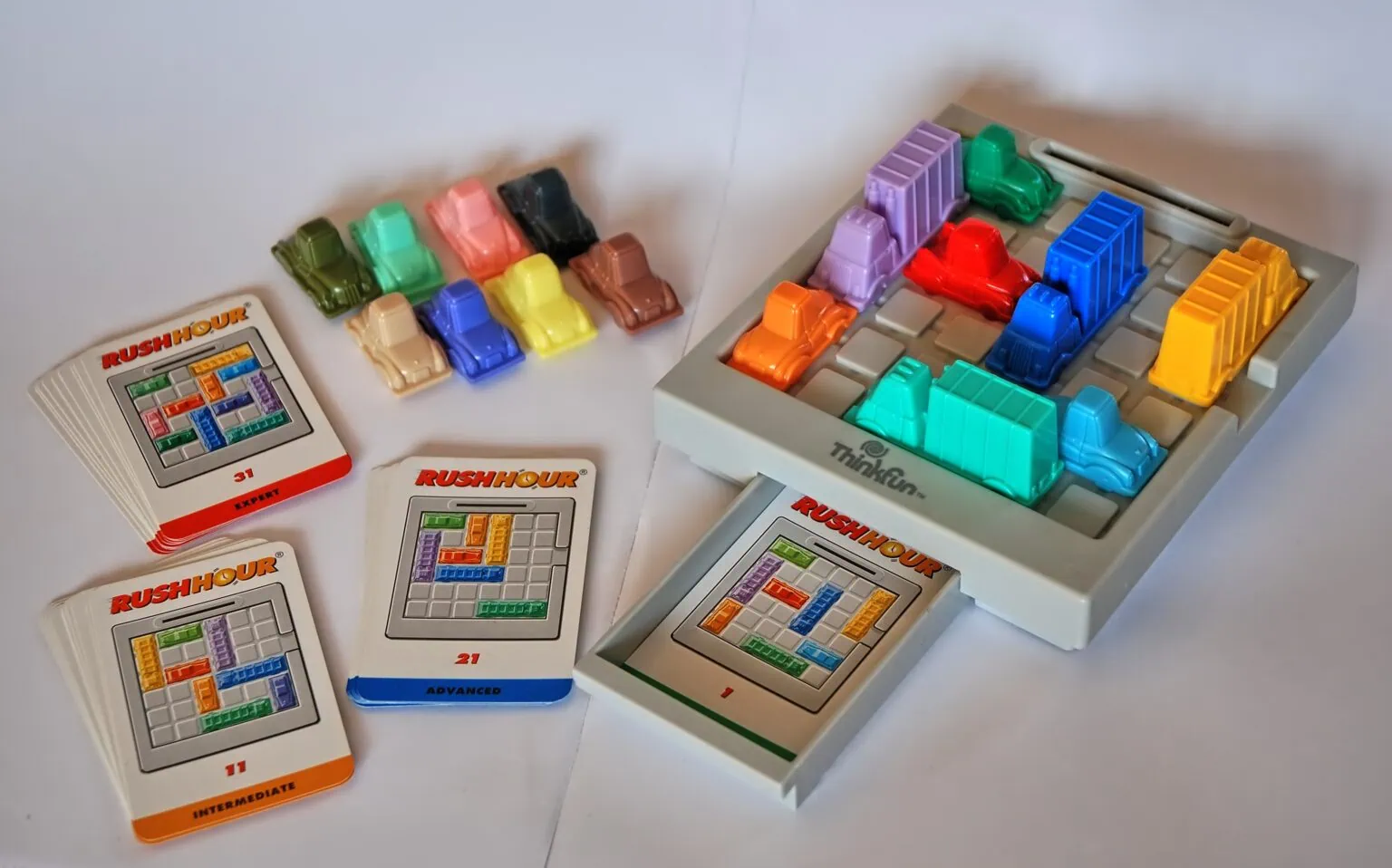
In the linked set: traffic grid with card storage, 40 challenge cards with solutions, 15 blocking vehicles, one red escape car and a storage bag. All gameplay uses these tangible pieces; no app, account, battery or screen is needed.
Warnings: the linked listing carries a small-parts choking warning and excludes children under 3. The playing recommendation remains 8+, not 3+. Keep the set and loose pieces away from younger siblings and follow the supplied packaging instructions. See our health and safety information.
How the game works
Choose a challenge and copy its layout onto the grid. Clear a route for the red car to reach the exit by moving the obstructing vehicles. Each vehicle travels only along its existing line: it cannot turn, slip sideways or jump over another piece. Keep pieces on the board during the attempt. A printed solution is available on the reverse of the challenge card.
The interesting decision is often to move something away from where you ultimately need it. An apparently helpful move may close another route. That makes Rush Hour more than pushing the red car towards a gap: the child has to consider which space must become available first. This is our interpretation of the puzzle structure, not a claim that playing improves school performance.
Who it suits—and who might skip it
Consider it for a child who enjoys solving something alone, dislikes racing a timer, or wants a short table activity while another family member finishes homework. Instructions can be explained in Hindi, English or another home language; ongoing play relies mainly on the layout rather than reading sentences. A stable table is more practical than a moving vehicle, where loose pieces may scatter.
For ages 8–9, an adult can check the starting arrangement and then step back. Ages 10–12 can choose their own level and decide when to ask for a hint. Teenagers aged 13–18 who enjoy spatial puzzles can work on advanced or expert cards and describe a plan before moving. Interest matters: a teenager who wants lively group conversation may get little from this format.
Skip it as the main choice for a party or for several children who each want an active turn. It also needs caution as a purchase for someone who finds small visual layouts tiring or precise sliding movements difficult. There is no time pressure, but that alone does not make the game accessible. The finite card set also makes swapping or borrowing particularly sensible once its solutions become familiar.
Editorial ratings
Scale: 1 = poor fit, 3 = workable with trade-offs, 5 = excellent fit for the stated audience. Scores assess the standard set for interested players aged 8–18. They are research-based judgments, not customer ratings or measured developmental results.
| Indicator | Score / 5 | Reason |
|---|---|---|
| Age fit | 4 | Ages 8+ can start with beginner cards; older puzzle fans have harder levels, but matching a crowded diagram may need help. |
| Ease of learning and setup | 4 | One movement restriction is easy to demonstrate; each new card still needs accurate placement. |
| Child engagement | 4 | A visible escape goal may draw in puzzle lovers; this is a prediction from the mechanics, not observed play. |
| Replay value | 3 | Forty layouts give progression, but remembered solutions reduce the novelty of repeat attempts. |
| Opportunities to practise skills | 5 | Each puzzle invites planning, checking constraints and undoing an unsuccessful move; transfer beyond play is not established here. |
| Quality of family interaction | 3 | A shared puzzle allows discussion, but one board offers little independent action for several siblings. |
| Accessibility and adaptability | 3 | No speed or reading-heavy turn is required, but small diagrams, colour matching and sliding pieces create barriers. |
| Value for money | 4 | Likely worthwhile for regular solo puzzle use or a family lending circle; borrowing is better if interest is uncertain. |
Calculation: (4 + 4 + 4 + 3 + 5 + 3 + 3 + 4) ÷ 8 = 3.75, rounded to 3.8 out of 5. Each indicator has equal weight.
How to play it meaningfully
First round: choose one beginner card together, rather than beginning with an impressive-looking expert layout. Let the child place the pieces; check the exit and starting positions before play. Demonstrate one legal forward-and-back slide, then return the piece. Offer about ten minutes as a flexible first-session estimate, without making completion the condition for stopping.
Two helpful adult moves: ask, “Which vehicle is directly blocking the red car, and what space would it need?” Then wait. If the child asks for more help, say, “Would you like one hint, to look at the solution together, or to leave this for later?” Avoid moving pieces while the child is still considering a plan.
Easier variation: keep a beginner layout and use the printed solution to demonstrate its first move, then let the child continue. This is supported play, not an independent solve; it does not lower the manufacturer age minimum.
Harder variation: on a fresh advanced card, an older child can describe the next two intended moves before trying them. Avoid adding a stopwatch unless the player actively wants one. For access, keep the card well lit and close to the board; a partner can place and slide pieces according to the player’s spoken, pointed or otherwise communicated choices. This preserves decision-making, although it does not remove every visual barrier.
If frustration rises: check that the original layout was copied correctly before offering strategy advice. Say, “We can save this attempt or put it away.” A quick record on paper of the card number is enough to return to the original challenge later. Let stopping be a valid end; there is no need to finish one more card.
Borrow, swap or try a no-buy alternative
Borrow a complete set first if possible, checking that the cards, red car and blocking vehicles are present. A family swap lets another child meet the puzzles fresh. If the appeal is planning rather than cars, use a familiar household task: choose three objects that fit inside a small box, predict their arrangement, then test and revise it. This is a different spatial challenge, not a substitute set of Rush Hour puzzles.
For a shared activity with materials already at home, try the paper-and-cup bridge example in EdCaptain’s Learning by Doing. Keep the same useful rhythm: make a plan, try it, notice what happened and change one thing.
Check this edition on Amazon US
As an Amazon Associate I earn from qualifying purchases.
Check this edition on Amazon US — ThinkFun Rush Hour, standard physical 40-challenge playable set (ASIN B00000DMER). This link is for the US marketplace. Check the selected style and contents before ordering; it should include the grid and vehicles, not just extra cards. Local borrowing or buying may be more practical outside the US.
Sources and edition notes
Sources checked 11 November 2026. Product facts are separated above from our judgments. Packaging and artwork have changed across releases; the licensed photo shows an earlier standard set and is not a photo of a purchase from the linked listing.
- ThinkFun/Ravensburger: current standard Rush Hour product specifications — age, solo format and 40-challenge structure; current packaging article 76582.
- ThinkFun Rush Hour #5000 instructions, hosted by Manualzz — movement restrictions, setup and solution cards for the standard game.
- School Specialty: Rush Hour game contents — independent cross-check of the standard set and age recommendation.
- Welt-der-Form: original game photo and licence record — earlier standard physical components.
Report an error or suggest an improvement
Was this useful?