By EdCaptain editorial desk · Published
Research-based review · Overall rating: 4.0 out of 5
Verdict: Connect 4 is a useful choice for a parent and child who want a short game with no reading and no race against a clock. Taking turns to drop discs is easy to explain; noticing what the other person could do next gives it staying power. Its biggest limitation is the experience gap: a confident adult can make a beginner feel defeated very quickly.
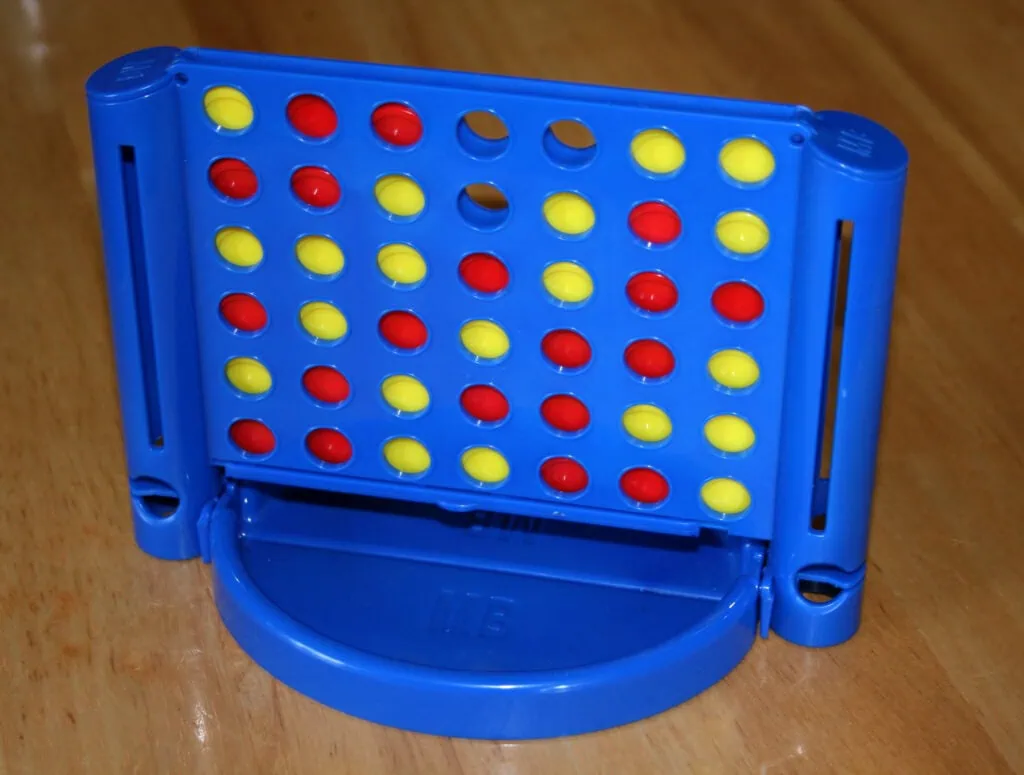
This review covers Hasbro’s physical Connect 4 Classic Grid, model A5640, matched to Amazon US ASIN B00D8STBHY. It draws on published rules and product information, not firsthand testing. Ratings, likely family fit and adaptations are editorial judgments about the mechanics. No screen, app or battery is needed for complete play.
Quick facts
- Edition: Hasbro Connect 4 Classic Grid, A5640; a playable physical set, rather than Connect 4 Shots, a travel edition or a digital game.
- Ages: Manufacturer minimum 6+. This review recommends participation for ages 6–18 and adult partners; younger beginners within that range may need help spotting diagonal lines.
- Players: Two. For a family of four, rotate pairs after each game rather than promising everyone a simultaneous turn.
- Time: Allow an estimated 5–15 minutes per game, plus a demonstration and adult assembly before first use. This is a planning estimate, not a manufacturer duration.
- Contents: Grid, two legs, slider bar, 21 red discs, 21 yellow discs and instructions, according to Hasbro’s A5640 page.
- Warnings: Hasbro requires adult assembly and says to keep small assembly parts out of children’s reach. The linked US listing carries a small-parts choking warning for under-threes. The recommended playing age remains 6+, not 3+. Follow the supplied pack’s instructions and keep loose pieces away from younger siblings.
How the game works
Two players choose different disc colours. On a turn, drop one disc into an available column; it falls to the lowest empty space. Alternate turns, trying to connect four of your own discs across, up and down, or diagonally. The first player to do so wins; a filled grid without a winning line is a draw. Reset with the release mechanism described in your edition’s instructions. See Hasbro’s A5640 instructions page.
Gravity makes the puzzle more interesting than simply placing a counter anywhere. A disc may block an immediate threat while also creating a landing space for the opponent above it. That is the useful parent question here: can a simple two-person game offer decisions worth discussing? Yes, provided discussion leaves the child’s next move to the child.
Who it suits, and who might skip it
For ages 6–9, use an untimed demonstration and name all three line directions. Ages 10–12 can look for moves that create two threats at once. Teenagers aged 13–18 may prefer a brief best-of-three match with another experienced player, alternating who starts. The game can bridge a child and grandparent who share little written language: explain turns in Hindi, English or whichever language feels natural at home.
Choose it for a small household wanting face-to-face play without a long rules lesson. Skip it for a party, a child seeking cooperative play, or a family wanting stories and pretend roles. Its two-player limit is real. Unlike a luck-heavy game, a weaker player gets little help from chance, and a run of quick losses can overwhelm the appeal.
The upright grid and discs need a stable surface and a comfortable viewing height. They do not establish that this particular set is durable or easy to grip; those qualities have not been tested here. Borrowing a copy is especially helpful if reaching, seeing or handling the grid may be difficult.
Eight editorial ratings
Scale: 1 = poor fit, 3 = workable with trade-offs, 5 = excellent fit for the stated audience. Scores assess likely fit for families with children aged 6–18. Engagement is a prediction from the turn structure, not an observation of children playing.
| Indicator | Score / 5 | Reason |
|---|---|---|
| Age fit | 4/5 | Ages 6+ can follow one-disc turns; anticipating an opponent may still need a shared demonstration. |
| Ease of learning and setup | 5/5 | One placement rule and a visible target keep the explanation short once an adult has assembled the grid. |
| Child engagement | 4/5 | Each disc immediately changes the shared position; repeated losses to a stronger player may quickly reduce interest. |
| Replay value | 4/5 | Different placements create new problems, although experienced players may find familiar openings repetitive. |
| Opportunities to practise skills | 4/5 | Players scan lines and compare possible next moves; these are opportunities within play, not proven learning gains. |
| Quality of family interaction | 4/5 | Alternating turns protects each player’s decision, but direct blocking can feel personal unless adults keep the tone light. |
| Accessibility and adaptability | 3/5 | No reading or timer is required; colour discrimination, visual scanning and reaching the top slots can remain barriers. |
| Value for money | 4/5 | Likely useful for repeated two-person breaks; less useful for larger groups or a family that already owns a similar four-in-a-row set. |
Overall: 4.0/5. All eight indicators carry equal weight: (4 + 5 + 4 + 4 + 4 + 4 + 3 + 4) ÷ 8 = 32 ÷ 8 = 4.0. This is an editorial calculation, not a customer rating.
How to play it meaningfully
A realistic first round: With a child aged 6+, let the adult assemble the set and show how a disc falls. Together, make and identify a horizontal, vertical and diagonal four, then empty the grid. Play one untimed game, checking for a win after each turn. Agree beforehand that one game is enough; a rematch is optional.
- Say: “Before you drop it, shall we look for any line of three?” Point only if the child wants help; avoid directing every move.
- Do: Ask, “Would you like a clue, or your own thinking time?” Wait for the answer. A helpful adult need not become the child’s second opponent.
Easier variation, still ages 6+: Play an open coaching round in which either player can ask to take back their most recent move before the next disc is dropped. Agree the rule first and allow it equally. Keep the normal four-in-a-row goal so the practice transfers to the standard game.
Harder variation: For confident older children and teenagers, pause at one chosen position and each identify two possible moves, including the opponent’s strongest reply. Then continue normally. Do not require an explanation on every turn; that can turn a quick game into a lesson.
Access adjustment: Number the columns 1–7 on a separate paper strip. A child can point, speak or use their usual communication method to choose a column while a partner drops the disc exactly where requested. Adjust the table height and lighting. If colours are hard to distinguish, test whether the two disc sets are reliably recognisable before playing; the standard unmarked pieces offer no guaranteed non-colour distinction. Choose another game if the position remains inaccessible.
If a child gets frustrated or wants to stop: Say, “Being blocked is annoying. Would you like a shared practice turn, or shall we pack away?” Accept stopping without demanding a final round. If they continue, discuss one position rather than every missed chance. EdCaptain’s guide to handling winning and losing offers further practical ideas.
Borrow, swap or try a no-buy alternative
Borrow a complete set or swap with another family before buying. Check that it has both colours, all 42 discs and working support and release parts. If you already own another playable four-in-a-row set, this review gives no reason to replace it.
For a no-buy taste of line-making strategy, draw a three-by-three noughts-and-crosses grid on scrap paper. Take turns marking X or O; three in a row wins, and a full grid without a line is a draw. This is a different, simpler game with no gravity rule, but it can reveal whether two-person blocking play appeals before a purchase.
Check the physical edition
Amazon US marketplace: Hasbro Connect 4 Classic Grid, model A5640, ASIN B00D8STBHY. The listing was checked for the physical grid, support parts and 42 coloured discs. Check the supplied edition and age label when ordering, particularly outside the US.
As an Amazon Associate I earn from qualifying purchases.
Sources and review basis
Checked 11 November 2026. Manufacturer specifications and the exact US listing support the product facts; the ratings, time estimate and family suggestions are editorial analysis. No Amazon customer reviews were used.
- Hasbro: Connect 4 A5640 instructions and contents.
- Hasbro: A5640 product specifications and adult-assembly warning.
- The Amazon US edition linked above supports the model and ASIN match, physical contents and listing warning.
- The image source and licence are linked in its caption; the photograph shows an earlier physical version, not the current packaging.
Read our editorial policy, review methodology and health and safety information.
Report an error or suggest an improvement
Was this useful?