By EdCaptain editorial desk · Published
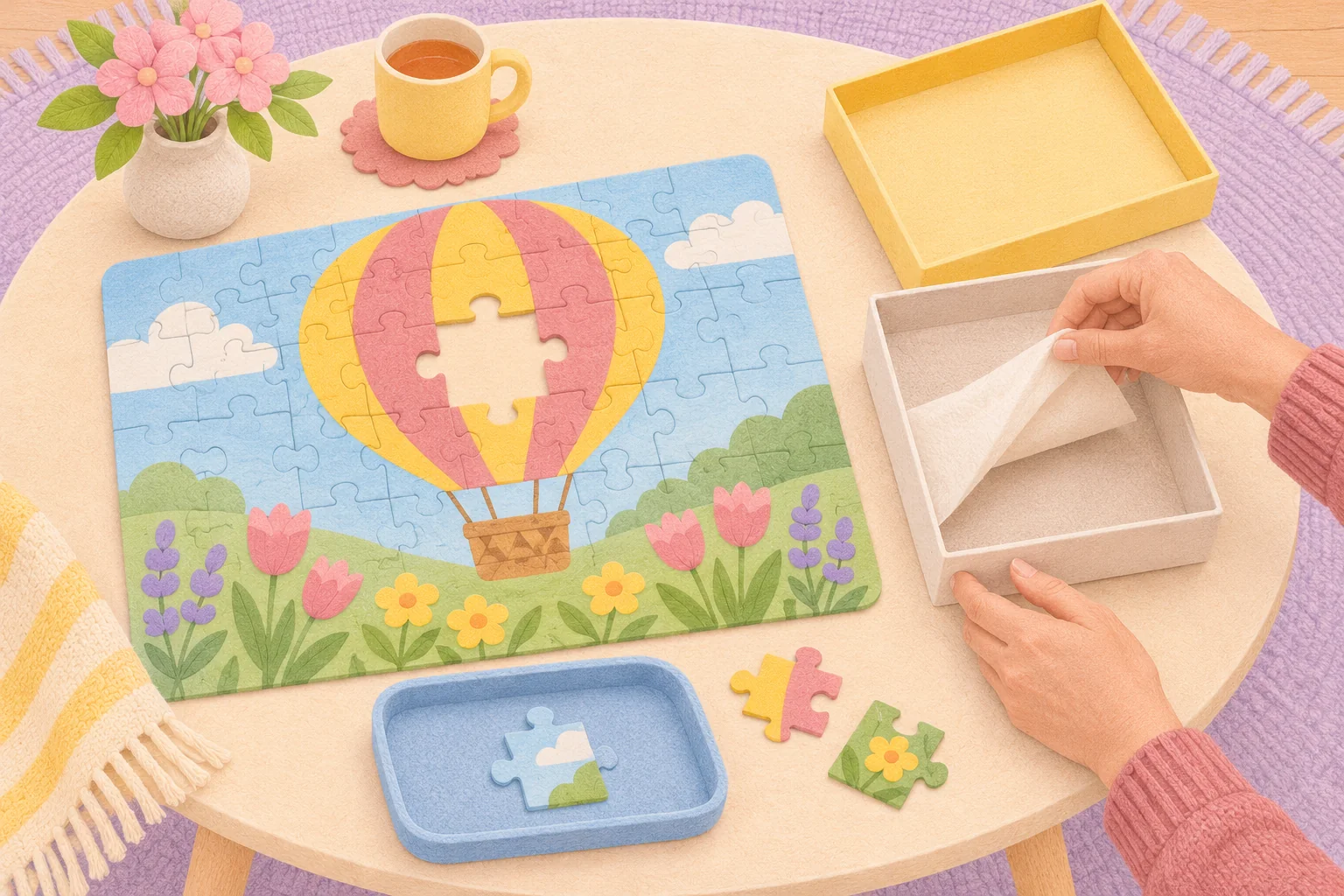
Leave the puzzle in place for a moment. Before tipping out another box or promising to order the missing piece, separate what you know from what you suspect: there is a gap, but you may not yet know whether the piece is elsewhere, mixed into another set or absent from the original box.
For caregivers, the useful next steps are a contained search, a clear record of the exact puzzle and a realistic support request. This guide concerns an ordinary jigsaw; wooden, three-dimensional and specialist puzzles may have different parts and replacement arrangements.
Make the first search small and systematic
Choose one place to collect pieces from this puzzle. Keep the assembled section steady and use a shallow tray for anything loose. Opening several puzzles at once makes a small mystery harder to solve.
Try this sequence:
- Check the box, lid and underneath any poster, folded insert or sorting tray.
- Look around the working surface, including the edge of a puzzle mat and nearby floor.
- Check the places the puzzle actually travelled: a storage board, a sofa seat or the shelf used at bedtime.
- Ask other household members whether they moved a loose piece, without assuming who lost it.
- Stop after a manageable search and keep any unresolved pieces separate.
Adults should handle heavy furniture and awkward spaces. Do not ask a child to reach behind appliances or search through rubbish. Keep small pieces and packaging away from babies and toddlers while you work.
If you find a possible piece, compare the picture, size and shape gently. Do not force it into the gap. Check nearby joins too: something that looked right earlier may need another look. You can say, “We’re checking the puzzle, not finding someone to blame.”
Identify the puzzle before asking for a remedy
Keep the original box and any inner packaging while the question is unresolved. Photograph the front and the product information, including the maker, title, piece count, product number or barcode. Keep any batch or control code you can find; do not invent one if it is missing.
Take one clear photograph of the assembled puzzle and another showing the gap and surrounding pieces. The support team needs the product and the problem, not a picture of your child or the room. Crop out unrelated personal details.
Find the receipt or order record if available and note where and when the puzzle was bought. Also record whether it was new, second-hand, borrowed or already used by the family. Those circumstances may affect the options, but you do not need to decide the policy yourself before asking.
Describe uncertainty honestly: “We finished assembling it today and one space remains. We have checked the box and work area. We do not know when the piece went missing.” Do not turn an accidental loss into a claimed manufacturing defect to fit a form.
Why another identical-looking box may not help
Ravensburger’s replacement-parts guidance explains that manufacturing cutters can change, producing differences in piece shapes even when the printed image is the same. Its support options differ between puzzle ranges and countries.
The practical implication is simple: buying another box with the same picture is not a reliable way to obtain one fitting piece. Ask the manufacturer about the exact product before spending money or mixing two sets.
Keep the cases and pieces separate if you already own duplicate copies. Similar colours or an almost-fitting tab do not establish that the piece belongs to this cut. Forcing a mismatch can damage an otherwise usable puzzle without resolving the original gap.
Ask what “replacement” means
A replacement service might supply an individual part, a whole puzzle, another design from an available selection, or a different response under the seller’s policy. Those outcomes are not interchangeable.
For example, Buffalo Games’ FAQ says it does not replace individual missing puzzle pieces. It describes a missing-piece process using a limited selection of replacement puzzles. That is different from promising the exact lost piece or the same artwork.
Use the maker’s current support page for your country. Buffalo’s contact page, for instance, separates missing or defective puzzle-piece enquiries from other product support. A form headed “replacement” still needs to be read alongside its policy.
A focused message could be: “This is the puzzle title and product number. One piece is missing; the photographs show the location. It was bought from this seller on this date. Is any remedy available for these circumstances, and would it be a piece, a complete puzzle or an alternative design?”
Ask what evidence is required, whether the original must be returned, and whether any cost applies. Keep the reply and case reference. Do not discard the box or post pieces away until you have instructions. Eligibility and availability need confirmation; another family’s successful request is not a guarantee.
Choose an honest ending if the piece cannot be supplied
You can keep the puzzle as it is, put it aside while support replies, or decide that it no longer suits the family. Ask what the child values: the picture, the shared time or the satisfaction of fitting the final piece. You need not buy another puzzle immediately to acknowledge disappointment.
Do not present the incomplete set as complete when lending, selling or donating it. Tell the recipient where the gap is and let them choose. If a piece is damaged rather than simply absent, our damaged-toy decision guide covers the separate question of whether a repair is appropriate.
There is no need to improvise a tiny substitute with glue, pins or other added materials for a child’s set. A photograph of the nearly finished image can preserve the family’s work without claiming that the puzzle itself has been restored.
Pack the next session so it stays one puzzle
Return loose pieces to a suitable closed container inside their own box. Keep the title or a picture with any separate sorting tray. Check the work area before vacuuming or clearing the table, and agree where an unfinished puzzle will wait.
Our toy-storage and rotation guide can help keep complete choices together without removing a child’s favourite project. The aim is an easier next session, not a household rule that nobody may ever lose anything.
Sources and further reading
- Ravensburger: piece-fit limits and replacement enquiries
- Buffalo Games: missing-piece and replacement-puzzle information
- Buffalo Games: finding the appropriate product-support form
Read our editorial policy and review methodology.