By EdCaptain editorial desk · Published
General educational guidance. No qualified clinical review is recorded for this article. Health and safety information.
Your child wants to make their own move, but somebody has to read their cards aloud. Everyone now knows what they hold. Or the cards are accessible in braille, yet placing them flat on the table to read makes the faces visible to the other players.
For a blind or low-vision child aged 6–12, access to a card game includes knowing which information is public and which belongs only to them. A helpful adaptation should let the child obtain the information and decide what to do with it. Reading a card is different from choosing the move.
Check what the game asks players to keep private
Choose a game your child wants to play, using the actual edition’s age label, warnings and rules. This guide is about checking access; it does not establish the age suitability of a particular boxed game.
Before dealing, divide the information into two groups. Public information might include whose turn it is, the card just played or the shared score. Private information might include the cards in a player’s hand or a face-down choice. Some games have no private information at all.
Ask, “Which parts do you want to read yourself, and where would help be useful?” Do not assume that a child uses braille because they are blind, or that larger print is comfortable because they have some vision. Start with the reading methods they already use.
Find a readable format before changing the rules
Hadley’s card-game guidance describes large-print, high-contrast and braille cards, as well as holders that can make handling easier. A larger card can still be difficult to grip or fit into a holder, so check both reading and handling.
For visual reading, try the child’s usual magnification and a position that avoids glare. Let them choose a comfortable distance. Do not require holding cards close to prove they can see them, or remove useful vision to practise another method.
The American Council of the Blind describes adding braille labels to game cards. If your family takes that route, involve someone who can verify the braille and agree any abbreviations with the child. Random raised dots do not become readable labels. Each label needs to communicate the information the rules actually use, not just the easiest part to name.
Test a few cards before preparing a whole deck. Can the child distinguish them reliably? Are the labels secure, the edges smooth and the cards still manageable? Adults should handle cutting or other craft work. Avoid loose magnets, staples or detachable tiny decorations, and keep game parts away from children who mouth objects.
Check privacy from the other seats
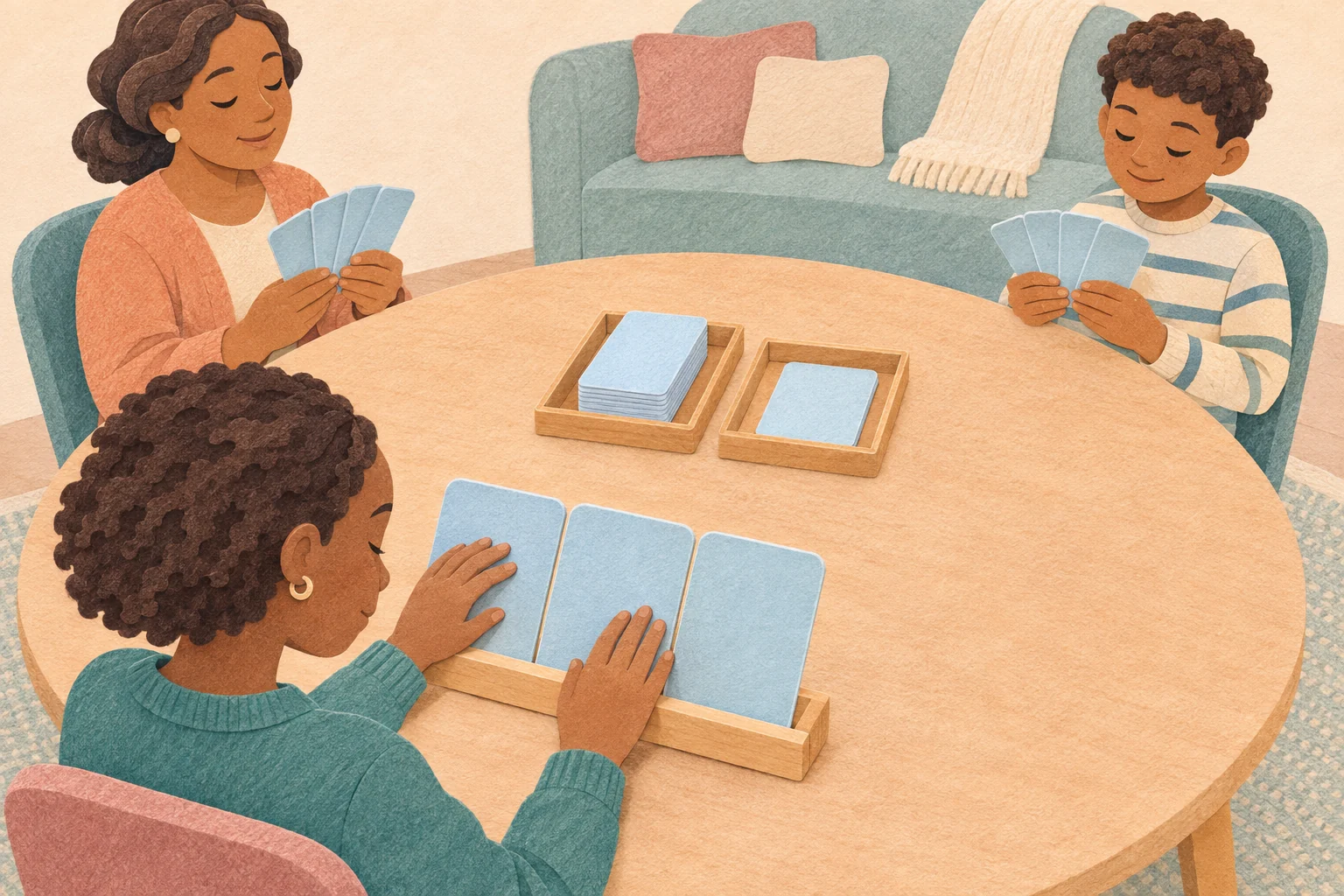
Hadley points out that braille cards laid face up can be seen by other players. Its guidance includes checking cards on the lap when holding and reading together is difficult. Use that only if the position is comfortable and practical for your child; there is no need to insist on it.
A stable holder angled towards the child may be another option. The University of Nevada, Reno includes card holders among game adaptations. Check the actual viewing angles rather than assuming a holder hides the faces. A sibling sitting beside the child may see more than someone opposite.
With the child’s agreement, use a few sample cards to check the setup before the real hand is dealt. Tell them if a face is visible and adjust the seat, angle or spacing together. If tactile reading requires more space, provide it without crowding the child.
Also inspect the backs and edges of adapted cards. A visible label or a distinctive bump, shape or thickness might identify a card before it is drawn. If the modification gives away information, it needs a different design or a different way to play. Do not blame the child for noticing information the deck makes available.
Rehearse one turn without scoring
You need the suitable game, a small sample of readable cards, the chosen holder if used, and a clear reachable place for the draw and discard piles. No new purchase is required if the existing materials work.
- Find the information. Let the child check a sample hand in their chosen format and position. Wait rather than naming the cards for them.
- Make the choice. Ask whether they have what they need to decide. Offer help only as agreed; do not recommend a move unless invited.
- Share the public action. The player announces the card they played, or uses their usual communication method. Someone can also announce that the turn has ended.
- Reset the space. Check that the piles remain distinguishable and within reach. Ask whether anything accidentally revealed a private card.
Hadley recommends announcing played or discarded cards and completed turns. Those announcements can give everyone access to the shared game without exposing the contents of a private hand.
Agree exactly what a helper does
If the child wants a reader, decide who can do that without competing against them. An adult outside the game might quietly identify a card, using a communication method the child can access. The reader should not silently sort the hand into their preferred order or select the strongest move.
A useful agreement is: “Tell me what the card says. I’ll decide whether to play it.” A child can also ask for advice, but that is a separate request. Our guide to directing help offers more ways to explain the support wanted.
If private reading is unavailable, discuss playing an open-hand version with everyone’s cards visible, choosing teams or selecting another game. Make the change explicit for all players. It changes the experience, so the child should have a say rather than being told the adaptation is automatically just as enjoyable.
Match the trial to the child
Ages 6–9: keep the sample small, use a familiar rule and let an adult check labels and seating beforehand. The child can choose a simple request such as “Please wait while I read” or “Tell us what you played.”
Ages 10–12: invite the child to compare positions, identify what a card label must include and help set the reader’s role. They may want a discreet way to request help when friends join. These options are not deadlines for independent reading or play.
Perkins recommends exploring game materials, trying a practice round and following the child’s feedback. After this trial, ask, “Could you find out what you needed without giving away your cards?” and “Did you get to make your own choices?” Fix one barrier before adding more rules.
For the wider choice of a game that suits several children, see our mixed-ability board-game guide. A game worth returning to gives your child a real route to information, a manageable way to use it and ownership of their turn.