By EdCaptain editorial desk · Published
General educational guidance. No qualified clinical review is recorded for this article. Health and safety information.
Your child has chosen a notebook. At the counter, the shopkeeper asks you what they want, names a price your child cannot see and puts the change somewhere without saying where. The purchase may be finished, but your child has missed much of how it happened.
A small shopping trip can give a blind or low-vision child aged 6–12 a useful role in choosing, asking and paying. Start with one part of one purchase, with a trusted adult alongside. The goal is participation and understanding, not a test of speed or readiness to shop alone.
Choose a purchase that already makes sense
Use an ordinary errand if possible: a pencil, a household item or something your child has already planned to buy. Agree the spending limit beforehand. There is no need to offer pocket money, buy a treat or disclose private family finances to make the learning worthwhile.
Ask, “Which part would you like to do?” Your child might ask the price while you pay, identify the prepared coins, or collect the item and receipt. APH FamilyConnect includes real purchases among community learning opportunities for grade-schoolers. Handling every step independently is not a prerequisite for joining in.
Choose a manageable time and familiar shop. Stay with your child and use their usual mobility support. If you are working on routes or unfamiliar environments, follow the orientation and mobility specialist’s plan. This guide does not teach cane techniques or independent street travel.
Make the price accessible before deciding
Explain what is for sale and what the stated price buys: one item, a pair or a whole packet. Offer a closer view, magnification or a spoken description according to your child’s preferences. Do not assume a large sign is readable, or that a child who can see the product can read its small price label.
Try: “This is one notebook. The price is for the whole notebook, not each page.” If there are two suitable choices, describe both without quietly choosing on the child’s behalf. Check the total payable before handing over money, including any charges that apply locally.
The Consumer Financial Protection Bureau recommends comparing prices and features and slowing down spending decisions. For this trip, one comparison is enough. Your child can also decide not to buy. Access to the information matters even when the answer is “We’ll leave it today.”
Prepare a simple wallet system
Perkins identifies cash recognition, wallet use and understanding costs as everyday skills that may need explicit teaching. Pick a method your child can use consistently, rather than expecting them to learn from watching you pay.
APH’s cash-handling guidance describes organised wallet compartments and tactile information. Use the actual currency where you live: coin edges, sizes and banknote features differ between countries and editions. Do not teach “the biggest coin is worth the most” as a rule. Check denominations with a reliable local reference or a trusted adult before practice.
For a first attempt, put only the small amount needed in an easy-to-open compartment. Agree a separate place for returned money. A divided purse, accessible labels or a familiar arrangement may help; ask the child what is usable. You do not need a specialist wallet to begin.
If physical handling is difficult, let the child direct you: “Please take the money from this section.” If you use a currency-identification tool, check that it supports the current local currency and verify the amount together. Do not rely on an unfamiliar camera result as the only check.
Rehearse the exchange at home
You need the chosen item or a similar safe object, the purse, a few correctly identified coins or notes, and a stable tray. Use the child’s preferred format for the price: speech, braille, accessible text or large print. Keep real coins out of mouths and away from younger children; an adult should supervise and put them away afterwards.
- Name the item and price. Let the child request the information rather than expecting a guess from touch or appearance.
- Find the payment. Let them open the prepared compartment, with help if wanted. Explain whether you are paying the exact amount or expecting change.
- Agree where things go. Practise placing money on the tray and having the seller describe where the item, change and receipt are returned.
- Check and put away. Together, confirm what was paid and returned. Let the child close the purse and locate the purchase before ending the exchange.
Keep the rehearsal brief. If the child wants another turn, switch roles or change just one part, such as asking for the price again. Avoid turning every practice into a harder arithmetic exercise.
At the counter, give the child time
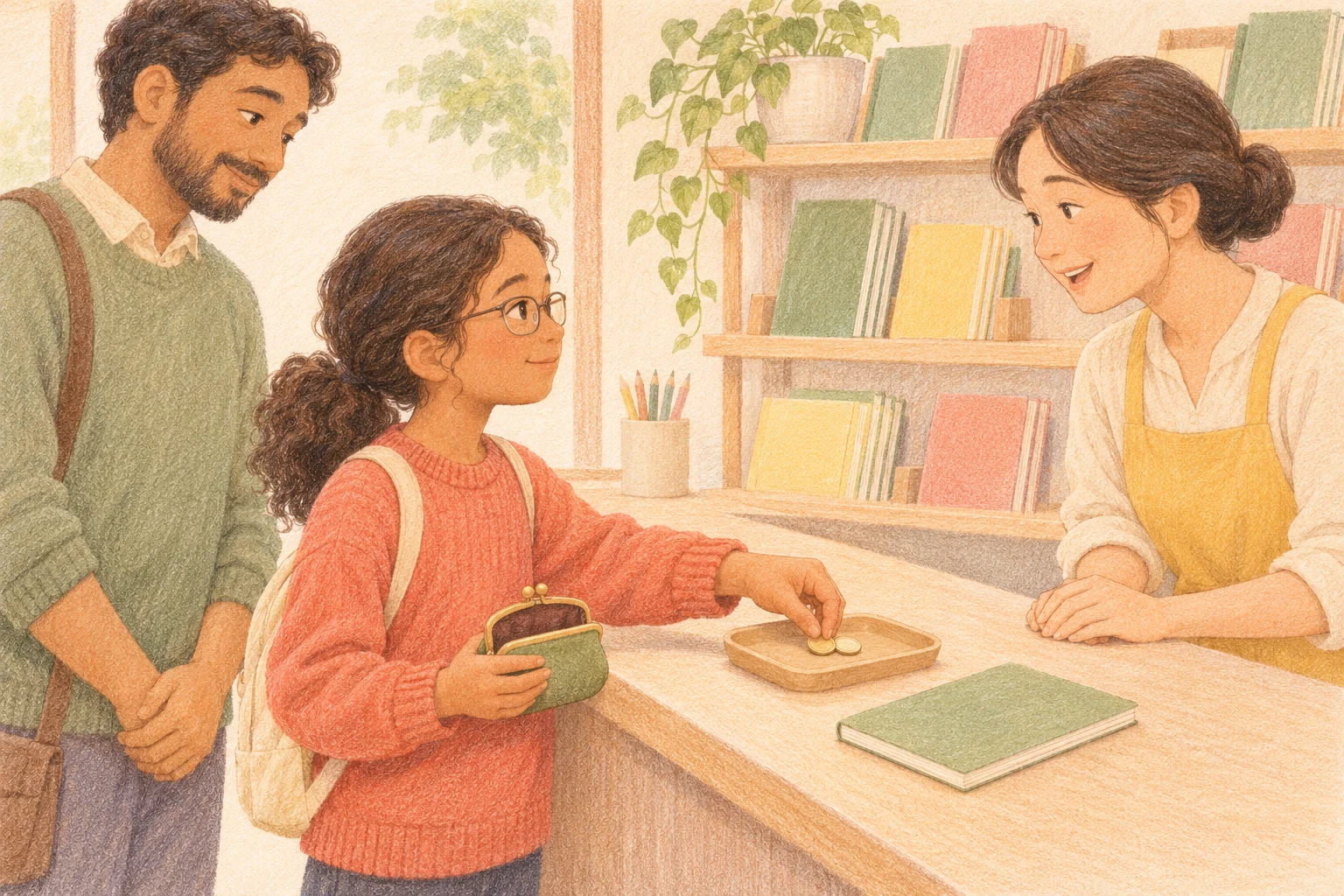
Help staff address the child directly: “She is buying the notebook. Please tell her the total.” Your child might use: “Please say where you put my change,” or “Could you count it out with me?” A communication card or AAC message can carry the request too.
Ask before taking their hand or rearranging their belongings. If the counter is too high, find a safe accessible place with staff rather than lifting the child onto it. Keep cash, bags and access tools within reach without obstructing other people.
If a queue builds, you can ask to finish the exchange in a less pressured spot. Do not remove the child’s role simply because someone is impatient. For more ways to direct assistance, see helping a blind child ask for the right kind of help.
Adjust the role, not the child’s dignity
Ages 6–9: try one clear job, such as asking the price or handing over an amount you have checked together. You remain responsible for verifying payment and change. A short successful exchange is enough.
Ages 10–12: if useful, compare two prices, choose which information to request or work out the expected change together before reaching the till. A child who needs the simpler role should keep it. Age does not create a deadline for independent money handling.
If the shop accepts only electronic payment, your child can still choose the item, ask the total and confirm the purchase while you operate your payment method. Explain what happened without sharing PINs or passwords. Learning cash skills does not require opening an account or buying a device. Our digital-access guide covers learning tools through one useful task at a time.
Review one helpful change
After leaving the counter, ask, “What helped you know what was happening?” and “What should we change next time?” Perhaps the purse opened easily but the price was rushed. Save that observation and repeat the familiar role before adding another.
If no purchase happened, you can still notice a useful action: requesting an accessible price, choosing to wait or telling an adult that the counter arrangement did not work. The next trip can build on what the child actually experienced.