When mornings are rushed, doing a task for a child can feel efficient. Repeated often, however, that help can hide the sequence the child needs to learn. Blind and low-vision children may not pick up every grooming or dressing step by watching other people. They deserve explicit teaching, time to practise and tools arranged so they can act without guessing.
Choose one task that matters now: brushing teeth, washing hands, selecting clothes, combing hair or packing a hygiene kit. Do not redesign the whole morning at once.
Observe before you teach
Ask the child to show what they already do. Notice where the process breaks down. Is the toothpaste hard to identify? Does the child lose track of clean and worn clothes? Is a mirror giving useful information, causing glare or adding nothing? The barrier may be organization, access to information, motor planning or simply insufficient practice.
Ask, “Which part would you like to do by yourself?” That answer sets a meaningful starting point. A specialist teacher, occupational therapist or habilitation professional can help when a task involves complex access, motor or safety needs.
Make the environment readable
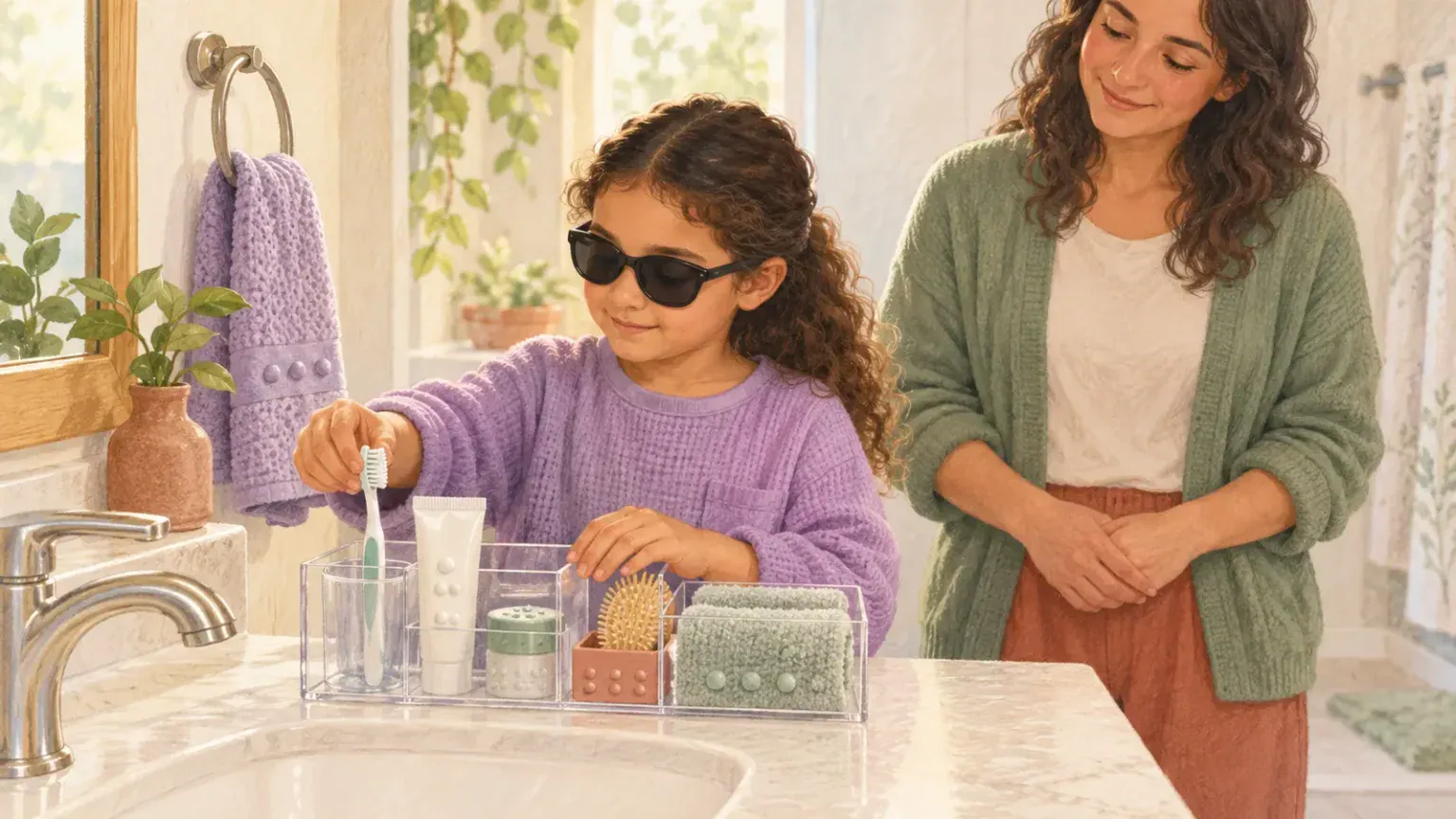
- Give each item a consistent home. A divided tray often works better than a crowded drawer.
- Use labels the child can independently read: braille, raised shapes, large print, strong contrast or an accessible audio label.
- Separate similar containers. Choose products by function and accessibility, not by decorative appearance.
- Use a stable non-slip surface and keep sharp, hot or hazardous items outside unsupervised practice.
Do not change the arrangement without telling the child. Consistency is an access feature, not rigidity for its own sake.
Teach the sequence through doing
Break the task into a small number of observable steps. For toothbrushing: find the brush, add an agreed amount of toothpaste, brush each area using a consistent pattern, rinse as appropriate, clean the brush and return everything. Explain what “finished” feels or smells like instead of saying, “That looks fine.”
Use hand-under-hand support when helpful: the adult places their hand beneath or beside the child’s so the child can follow the movement and withdraw. Ask before touching. Hand-over-hand control can make a child passive and should not be the automatic method.
Give one cue, then wait. Silence can feel long to an adult while a child is locating, checking and planning. If the step is still stuck, offer a choice: “Would a verbal clue or touching the tray help?”
Fade help deliberately
Move from demonstration to a full verbal cue, then a short reminder, then a natural cue such as the packed school bag by the door. Track the level of help rather than demanding speed. A child who completes a routine slowly but independently has achieved something different from a child rushed through it by an adult.
Offer specific feedback: “You kept the clean shirt in the left section, so you found it without searching.” Avoid constant praise for ordinary disability-related tasks; respectful, useful feedback is enough.
Respect privacy and age
As children grow, personal care becomes private. Teach family members and school staff to knock, explain their role and ask permission before assisting whenever possible. Older children should help choose products, hairstyles and clothing. Accessibility does not erase taste.
Our guide to safe independence at home uses the same principles of predictable routes and graduated support. Everyday play for young blind and low-vision children shows how real objects build understanding, and the inclusive school plan can carry self-care goals across settings without sacrificing dignity.
Practise when nobody is late. Let the child make small mistakes that are safe to correct. The aim is not a perfectly tidy tray or an adult-approved appearance; it is growing ownership of the child’s body, belongings and routine.
Generalize without constantly moving everything
Once a routine is secure in one place, practise a small variation: a travel toiletry bag, a different tap or clothes stored in a hotel drawer. Explain what stays the same and what must be checked. This helps the child use a strategy rather than memorize one bathroom. For school or overnight visits, let the child help prepare an accessible kit and decide what information to share with adults. Label personal items discreetly and protect privacy. If a task suddenly becomes harder, check for changes in vision, pain, motor skill, equipment or the environment before assuming the child is refusing.