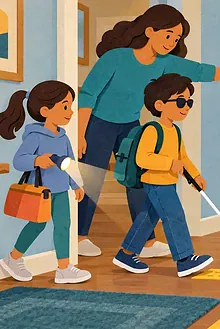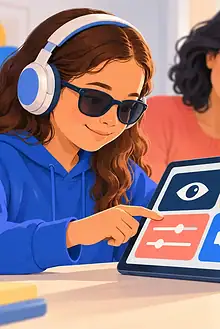
Young children build concepts by doing: lifting a cup, finding where a spoon goes, crawling under a chair, pouring water, and hearing what happens when a block falls. A blind or low-vision child needs the same rich experiences, but some information that other children gather at a glance may need to be made touchable, audible, close, or explicitly named.
The aim is not a special exercise for every minute. It is ordinary play with enough time, access, and precise language for the child to form their own understanding.
Begin with real objects and real purposes
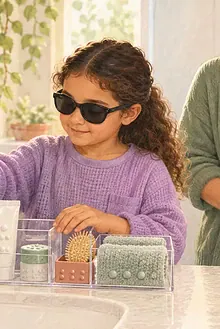
A toy cup can be useful, but drinking from, washing, stacking, and putting away a real cup gives the word “cup” depth. Build small play collections around routines: spoon, bowl, cloth, and container for mealtime; sock, shoe, brush, and bag for getting ready; leaf, smooth stone, seedpod, and watering cup for outdoors.
Choose objects that are safe for the child’s age and do not create choking, sharp-edge, allergy, or strangulation hazards. Supervise water play directly. Let the child explore with hands, feet, mouth, hearing, smell, movement, and available vision as appropriate rather than repeatedly placing their hands on an object.
Offer, wait, and follow the child’s lead
Place an interesting object within accessible reach, make a gentle sound with it if that helps orientation, and wait. The child may pause to listen or map the space before moving. Too much hand-over-hand direction can turn exploration into compliance.
If help is needed, offer your hand underneath the child’s hand or invite them to touch what you are doing. Ask before moving their body. Notice preferences: rough or smooth, moving or still, quiet or resonant, familiar or new. Choice is communication.
Use exact words during action
Words such as “here,” “there,” and “this” carry little spatial information. Say, “The ball is beside your left knee,” “Your spoon is inside the cup,” or “We are going under the table.” Link the word to the child’s action and repeat it naturally across routines.
Perkins School for the Blind highlights foundational concepts such as more/less, stop/go, big/little, above/below, and in front/behind. Do not teach them only as flashcards. Experience “under” by crawling under a blanket tent; compare a large bowl and a small cup; stop and go during a favourite movement game.
Create a simple accessible play space
- Define the area with a mat or tray so objects do not disappear across the room.
- Use contrast and uncluttered backgrounds if the child uses vision.
- Keep a few objects in predictable places, then rotate them slowly.
- Use containers so the child can practise finding, taking out, and putting in.
- Leave clear space for reaching, rolling, crawling, standing, or supported movement.
For children with additional motor needs, work with physical or occupational therapy and vision professionals on positioning and reachable placement. “Accessible” should not mean the adult performs the play.
Make books active and touchable
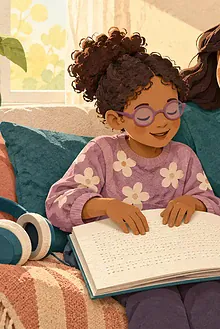
Choose sturdy books with simple images, clear contrast, textures, or objects connected to the story. Pair the page with the real thing: hold a spoon when the character stirs, feel rain safely at the doorway, or make the rhythm in the story together. Describe pictures without testing: “The dog is under the table,” not “What is this?” on every page.
If the child uses or may use Braille, ask the vision-education team how to support early tactile literacy without attaching random raised shapes that do not teach Braille accurately.
Invite movement without forcing it
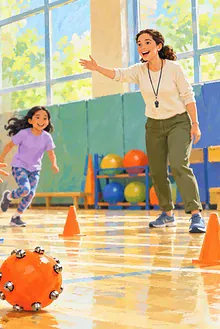
Place a motivating object along a safe, known route. Name landmarks and celebrate problem-solving rather than speed. Simple games—rolling a ball with a bell secured inside, finding a caregiver’s voice, pushing a box, or moving between two textured mats—can combine communication, spatial concepts, and movement.
Qualified orientation and mobility support can help families build safe exploration from infancy onward. Teach Daily-Living Skills One Useful Step at a Time offers a general way to break routines into manageable practice. Learning by Doing has more ideas for turning everyday experience into learning.
Reflect without turning play into a test
Afterward, name what happened: “You found the cup, put the spoon inside, and carried both to Dad.” For an older preschooler, ask one open question or offer objects to retell the sequence. If the child disengages, treat that as information—change the pace, position, sound, texture, or activity.
Blind children do not automatically develop “better” other senses. They learn to use available sensory information through meaningful experience and skilled support. Patient, child-led play gives those experiences room to accumulate.