A child can spend half an hour cooking, building, travelling or playing and still carry very little learning away from the experience. Doing something is not magic by itself. The useful part often comes when a child notices what happened, connects it with something already known, explains an idea and gets another chance to try.
- Start with something that matters to the child
- Use a four-part loop: try, notice, talk, try again
- A worked example: build a tiny bridge
- what changes by age?
- Support without taking over
- Make room for different bodies and senses
- When an experience is upsetting
- Five questions that help learning travel
- A small finish is enough
- Sources and further reading
That does not mean turning every family moment into a lesson. Nobody wants a quiz while making rotis or packing a school bag! Choose an occasional moment that already has the child’s attention, then help them think without taking over.
Start with something that matters to the child
A meaningful task has a real purpose, a visible result or a question the child genuinely wants to answer. It might be measuring atta for rotis, fixing a loose toy wheel, comparing two routes to the market, growing coriander from seed or building a bridge from cups and craft sticks.
Keep the goal modest. “Learn engineering” is too large. “Build a bridge that carries one toy car” gives the child something clear to test. For a toddler, the goal might simply be filling, emptying and noticing which container holds more.
UNICEF describes playful learning as active, meaningful, socially interactive and iterative. In everyday language, children are involved, the activity connects with their world, someone responds to their ideas, and they can change what they do after seeing what happens.
Use a four-part loop: try, notice, talk, try again
1. Try
Let the child make a prediction or choose a first move. Ask, “Which cup should go underneath?” or “What do you think will happen if we add more water?” A baby may reach, look or vocalise instead of answering with words. That response still counts.
Offer only the help needed for a safe start. If an adult plans every step, holds every object and corrects every wobble, the child experiences the adult’s solution rather than their own.
2. Notice
Pause after something happens. Draw attention to useful evidence without announcing the answer: “The middle dipped when the car reached it,” or “This dough feels stickier than the last bowl.” Invite the child to look, listen, touch or measure in a way that suits them.
Noticing can be quiet. Some children need a few seconds before they speak. Others may point, draw, demonstrate, type or use AAC. The aim is attention, not a performance.
3. Talk
Choose one question that asks for an explanation, not a string of questions that feels like an oral test. The US Institute of Education Sciences recommends deep explanatory questions because they encourage learners to explain their thinking and support deeper understanding.
- What changed?
- How do you know?
- Why do you think that happened?
- What part was easier or harder than you expected?
- Can you show me what you mean?
Listen to the answer before adding your own explanation. A child’s idea may be incomplete, but it tells you what they noticed and what connection they are making.
4. Try again
Give the child a chance to use the new idea. Change one thing and test again. Add another support to the bridge, use less water in the dough, move the plant closer to light or take a different route home. The second attempt turns the conversation into action.
Trying again does not have to mean “fixing” a failure. It can mean testing whether the same idea works in a new situation.
A worked example: build a tiny bridge
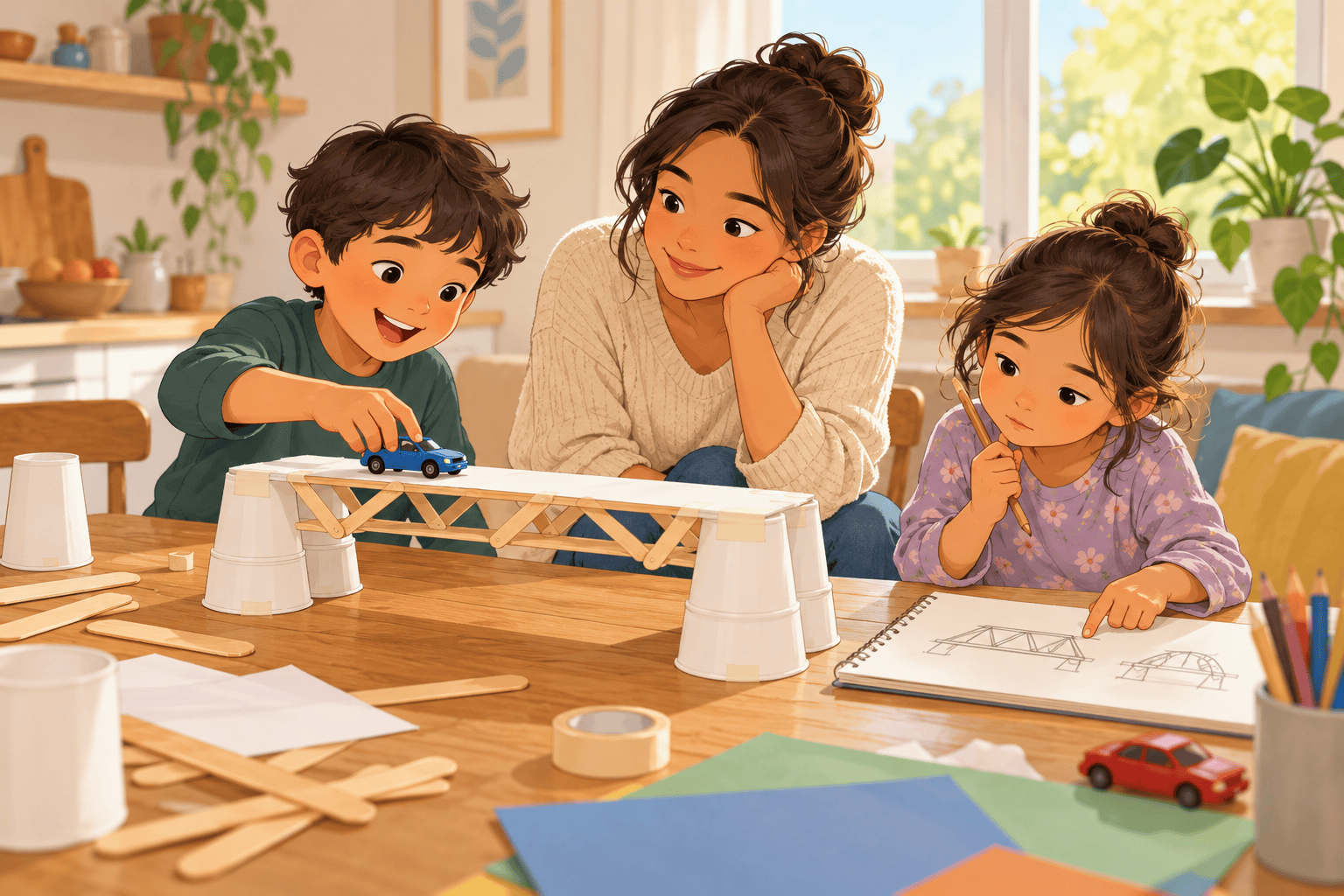
Place two sturdy cups on a table and offer paper, cardboard or craft sticks. Ask the child to make a bridge that can hold a toy car. Keep small parts away from babies and toddlers, and supervise the activity.
First, let the child build. Then test the bridge once. Notice together where it bends, slips or stays firm. Ask one question, such as “What could make the middle stronger?” Let the child choose one change and test again.
A younger child can stack large safe objects and explore “on”, “under” and “across”. An older child can compare designs, limit the materials or record how much weight each version holds. A teenager can work within a budget, calculate spans or explain why a triangular support behaves differently.
The learning is not the finished bridge alone. It is the cycle of acting, reading the evidence, explaining and revising.
what changes by age?
- Ages 0–2: Follow the child’s attention. Name what they touch or watch, pause for their response and repeat simple actions. Back-and-forth interaction matters more than a formal question.
- Ages 3–5: Use short predictions, sorting, pretend play and visible cause and effect. Ask one question at a time and accept gestures or demonstrations.
- Ages 6–9: Invite the child to explain what changed, draw a quick record or compare two attempts.
- Ages 10–12: Ask the child to choose a strategy, change one variable and use evidence to defend the next step.
- Ages 13–18: Let the young person define more of the problem, find information, monitor progress and decide what they would transfer to another task.
These are flexible starting points, not tests or deadlines. Match the support to the child in front of you, including their communication style, interests, experience and access needs.
Support without taking over
When a child gets stuck, move through small prompts before showing the solution:
- Restate the goal: “The bridge needs to carry the car.”
- Point to evidence: “Where did it bend?”
- Offer a choice: “Would you rather add a support or change the top?”
- Model one small step only if needed.
- Step back as soon as the child can continue.
Harvard’s Center on the Developing Child describes this gradual support as scaffolding: adults help children complete challenging tasks, then reduce help as children become ready to manage more of the process.
But frustration is information too. A break, a smaller challenge or a different day may be the best next move. Persistence does not mean pushing through distress.
Make room for different bodies and senses
More sensory input is not automatically better. A noisy, sticky or crowded activity may help one child engage and make another child shut down. Offer choices: gloves or a spoon for messy materials, a quieter space, larger objects, high-contrast materials, captions, visual instructions or a seated version.
Do not remove vision with a blindfold or restrict movement simply to make an activity feel dramatic. If a child has sensory, mobility, hearing, vision or communication differences, ask what makes participation comfortable and useful. Keep the learning goal, but change the route.
When an experience is upsetting
Children can learn from difficult moments, but adults should not rush to extract a lesson while a child is frightened, ashamed or overwhelmed. Safety and connection come first. Help the child settle, listen without forcing details and return to reflection later, if the child is willing.
If an experience causes persistent distress, sleep changes, strong avoidance or difficulty functioning, seek support from an appropriately qualified local professional. A family learning conversation is not a substitute for mental health or safeguarding care.
Five questions that help learning travel
Use one or two of these after an activity. You do not need all five.
- What did you expect?
- What actually happened?
- What helped you notice that?
- What would you keep or change next time?
- Where else could this idea be useful?
For a quick group reflection, EdCaptain’s Closing Circle offers two simple prompts. When a task goes wrong, Help Your Child Learn From a Wrong Answer gives a calmer way to inspect the attempt. Families with mixed ages can also adapt one shared activity for different children.
A small finish is enough
The best ending may be one sentence: “You noticed the centre needed support, changed the design and tested it again.” That names the learning without turning a good family moment into a lecture.
Try, notice, talk and try again. It is a small rhythm, but it can help children see that learning is something they do with ideas and evidence, not something that happens only when an adult gives the correct answer.