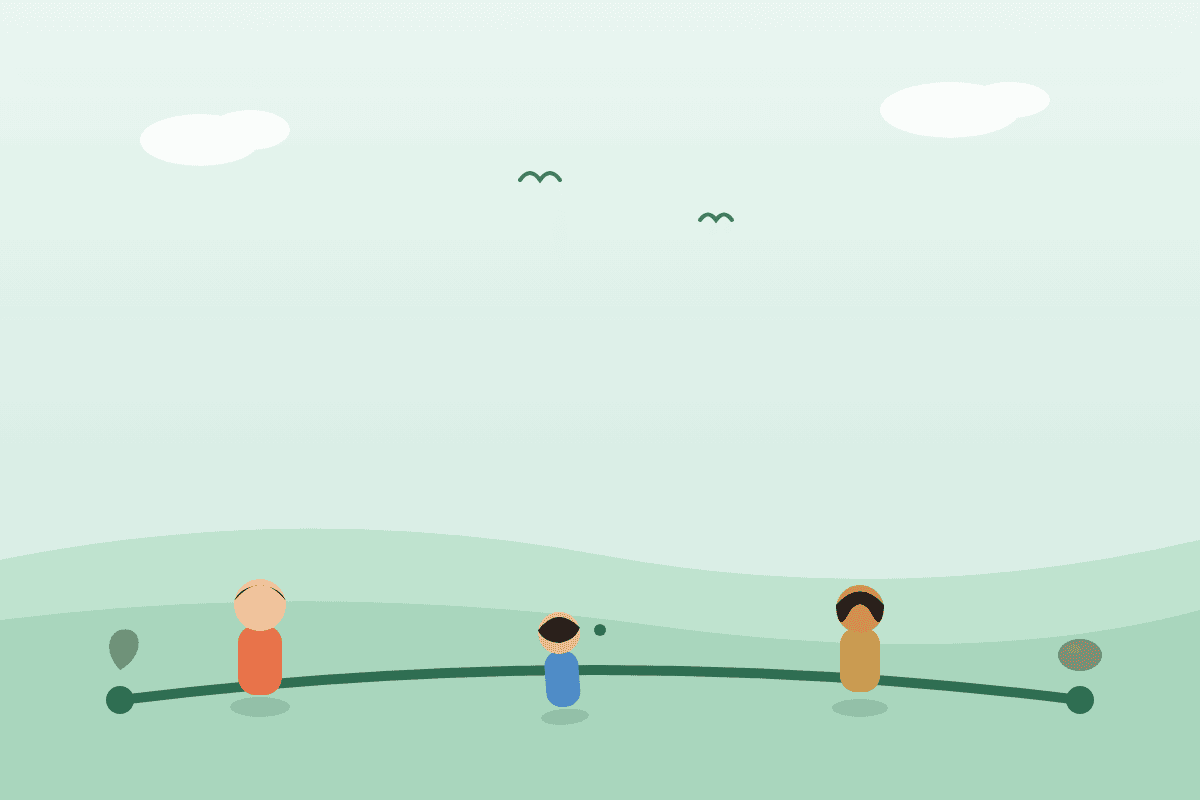
Most families argue about the same handful of things on repeat: whether screen time before homework is fair, whether the dog sleeps on the bed, whether nine o’clock really counts as late. The arguments rarely move anywhere, because everyone is defending a position instead of actually looking at it. There is a simple, almost embarrassingly low-tech activity that breaks this pattern, and it comes from classrooms rather than therapy offices: a line on the floor.
Educators call it a value line, a human barometer, or ‘take a stand.’ Harvard’s Graduate School of Education uses a version called Perspective Detectives to teach children what it feels like to hold a different opinion from the people around them. The mechanics are almost too simple to count as an activity, which is exactly why it works with children who roll their eyes at anything that smells like a lesson.
How it works
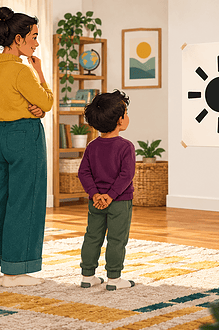
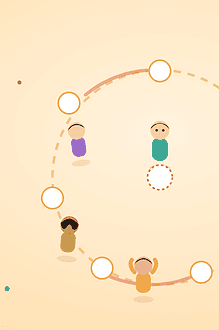
Pick an open stretch of floor, a hallway, or a garden path. One end means ‘I completely agree,’ the other end means ‘I completely disagree,’ and the middle is neutral. You can mark the ends with a shoe or a cushion if you want something to look at, but you do not need props.
Call out a statement. Keep the first few low stakes and a little silly, because the game works best once everyone has felt what it is like to stand somewhere and defend it. Good starter statements for a family:
- Pineapple belongs on pizza.
- Mornings are better than evenings.
- It is fine to re-read a book you already finished instead of starting a new one.
- Dogs are better pets than cats.
Everyone walks to the spot on the line that matches how they feel, including the grown-ups. Nobody is allowed to stand exactly in the middle unless they genuinely have no opinion at all, which turns out to be rarer than people expect.
Once everyone has picked a spot, go around and ask each person why they stood where they did. This is the part that actually does the work. Hearing your eight-year-old explain, in full seriousness, why mornings are objectively better than evenings because ‘the day has not had time to go wrong yet’ is funnier and more revealing than any direct conversation would have produced.
Moving into real questions
Once the family has the rhythm, you can use the same line for the questions that actually matter in your house:
- A bedtime of nine is fair for a ten-year-old.
- Everyone should have to try a new food at dinner once a week.
- It is okay to read your sibling’s texts if you are worried about them.
- Screen time should be earned, not given.
The same structure that made the pineapple question fun now does something more useful: it separates the opinion from the person holding it. A child who would normally dig in and defend a position in an argument gets to simply stand somewhere, explain their thinking without being interrupted, and then watch everyone else do the same. Nobody has won or lost by the time the activity ends, which is unusual for a family disagreement and worth noticing out loud.
A genuinely good round includes asking two follow-up questions after everyone explains their spot: ‘Did anyone’s reason surprise you?’ and ‘Did hearing someone else’s answer move you even a little?’ Children rarely admit to changing their mind on the spot, but you can watch some of them edge half a step down the line while nobody is looking, which is its own kind of answer.
Adjusting it by age
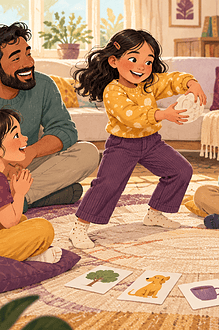
With children aged six to nine, keep the line to three spots rather than a full gradient: agree, disagree, and not sure. Teach the words ‘agree’ and ‘disagree’ explicitly before you start if they are new, and let the child suggest the statements sometimes. Kids this age enjoy ruling on silly debates (cereal for dinner, socks with sandals) nearly as much as serious ones, and the silly rounds are doing real work even though they do not look like it.
With ten- to twelve-year-olds, you can use the full line and ask them to talk, one on one, with someone standing at the opposite end. Ask what it felt like to hear a view they did not expect, and whether they noticed themselves getting defensive. This is also the age where kids start enjoying the challenge version: stand where you actually believe, then walk to the opposite end and argue that position as convincingly as you can. It teaches the difference between defending an opinion and understanding one, which is a skill most adults are still working on. For more structured practice at this kind of back-and-forth, Family Debate Night makes a good follow-up activity.
Teenagers tend to resist anything that feels like a classroom exercise, so skip the floor-walking with this age group and instead ask them to rank where they would stand on a scale of one to ten, out loud, before explaining. The format matters less than the habit it builds: stating a position, hearing a different one, and treating the gap between them as interesting rather than threatening. If disagreements in your house tend to turn sharp rather than curious, it is worth pairing this activity with a look at how to help your child disagree respectfully in everyday conversation too.
Why it is worth doing on a normal Tuesday
Perspective-taking, the ability to genuinely consider how a situation looks from someone else’s position, does not arrive automatically with age. It is a skill children build through repeated, low-stakes practice, and the same instinct that makes this line activity work shows up in The Good Listener Test, another small exercise built around noticing how it actually feels to be heard. Pediatric guidance from the American Academy of Pediatrics notes that play, including simple group games, helps children build empathy and practise the back-and-forth of real social interaction in a way that direct instruction cannot replicate. A line on the floor is not a therapy tool and will not resolve a serious family conflict on its own, but as a regular, low-pressure habit, it gives children, and the adults modelling it alongside them, repeated, physical practice at a skill that otherwise only gets exercised in the heat of an actual argument, when it is hardest to learn anything.
A few ground rules worth setting once
Agree in advance that nobody gets mocked for where they stand, including the parent who admits they still sometimes sneak the dog onto the bed. The whole activity depends on it being genuinely safe to hold an unpopular position in your own family, even about pizza toppings. If a statement turns out to touch a real sore spot, a recent sibling fight, a sensitive school situation, it is fine to stop, sit down, and talk normally instead. The line is a tool for opening a conversation, not a replacement for one.
Keep a notebook of the best statements your family comes up with. Within a few rounds, your own kids will start proposing the questions, and that is usually the sign that the real goal, getting everyone a little more curious about how other people see the world, has quietly taken hold.
Sources and further reading: Perspective Detectives, Harvard Graduate School of Education SEL Kernels; The Power of Play: How Fun and Games Help Children Thrive, HealthyChildren.org (American Academy of Pediatrics).