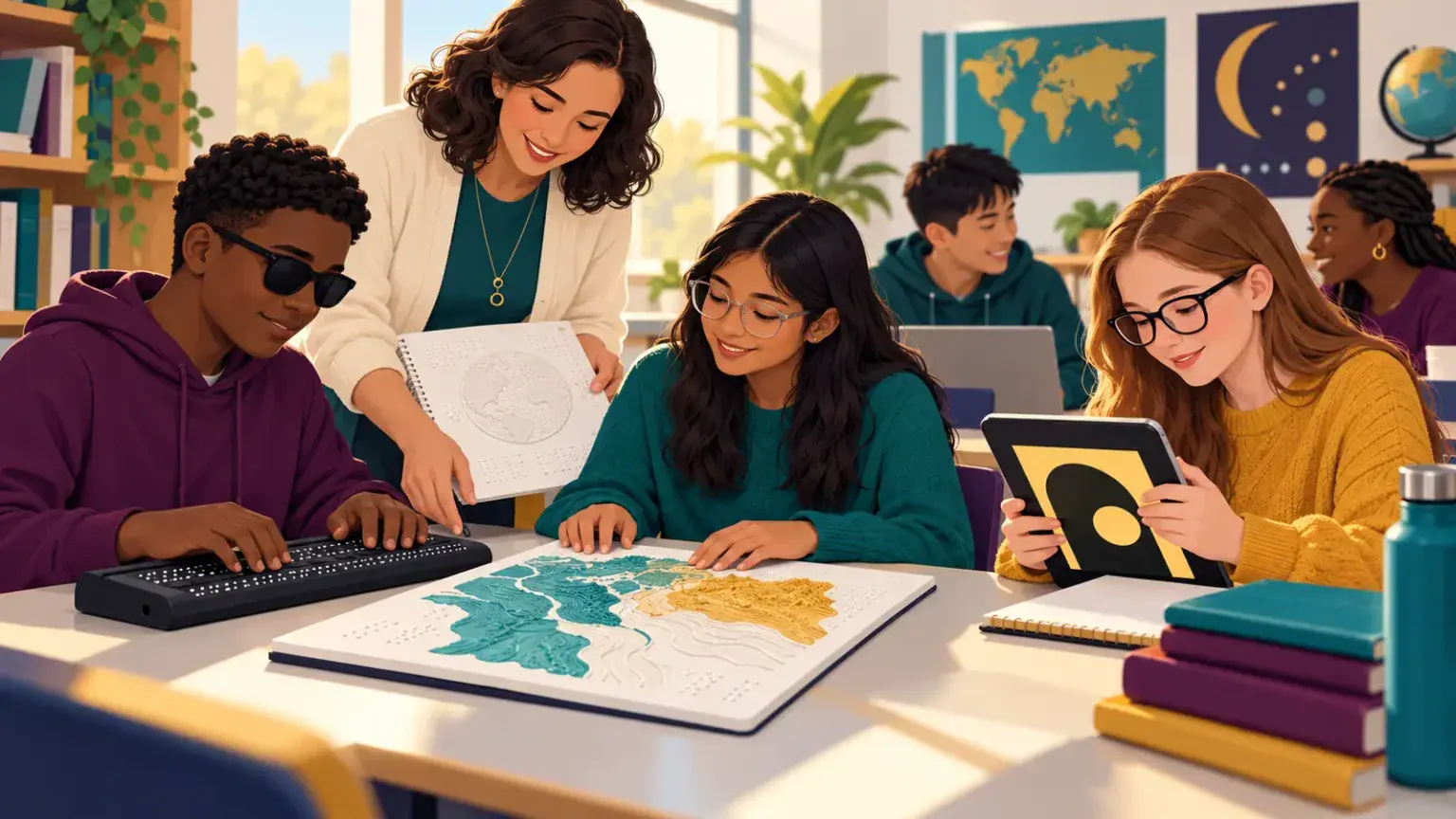
A student is not included simply because they sit in the same classroom. Inclusion means receiving information at the same time as classmates, having an efficient way to read and write, moving safely, joining practical lessons and clubs, and learning the disability-specific skills that make participation sustainable.
Start with current assessment
Ask the team to connect goals and accommodations to the child’s medical information, functional vision assessment, learning media assessment, assistive technology assessment, and orientation and mobility evaluation as appropriate. One visual-acuity number cannot determine whether a child should use print, large print, Braille, audio, tactile graphics, or a combination.
In the United States, IDEA says an IEP team must provide for Braille instruction and use unless an evaluation of current and future reading and writing needs shows it is not appropriate. Other countries use different rules, but the principle remains: literacy media should be decided through assessment, not assumptions about remaining vision.
Require materials at the same time
“Accessible later” is not equal access. The plan should name who converts or obtains textbooks, worksheets, slides, charts, diagrams, tests, and online platforms—and by what deadline. Specify formats for different tasks: refreshable Braille, embossed Braille, structured electronic text, large print with exact characteristics, audio, tactile graphics, or accessible digital math.
Check that headings, tables, links, alt text, forms, and reading order work with the student’s technology. A scanned image of a worksheet is not automatically accessible. Teachers need a process for last-minute materials, substitutes, and assessments.
Teach tools and concepts directly
Assistive technology is not useful because it appears on a desk. The child needs instruction, practice, maintenance, and a backup when it fails. Goals may cover screen-reader or magnification skills, keyboarding, Braille, tactile graphics, file organisation, self-advocacy, and choosing the right tool for a task.
The expanded core curriculum used in vision education also includes O&M, independent living, social interaction, recreation, sensory efficiency, career education, and self-determination. These are not optional extras to squeeze in after academic work; they support access to that work and life beyond school.
Plan movement and the physical environment
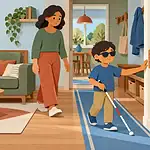
O&M services can address routes, spatial concepts, sensory information, available vision, mobility tools, and community travel. The student may need orientation before the first day, after room changes, or before a field trip. Keep walkways clear, announce furniture changes, manage glare and contrast where helpful, and describe visual demonstrations aloud.
Do not assign a peer to guide the student everywhere. Peers can be friends and collaborators; trained adults remain responsible for instruction and safety. For home carryover, see Teach Daily-Living Skills One Useful Step at a Time.
Write participation into every setting
Review science laboratories, physical education, art, lunch, transport, assemblies, emergency drills, clubs, and digital homework—not only reading lessons. Ask: What information is visual? How will the student receive it? What must be taught beforehand? How can the child take an active role rather than watch?
When visual clutter or lighting affects access, environmental adjustments may help; When Light and Visual Clutter Overwhelm Your Child offers practical starting points. Individual assessment should decide what applies.
Measure access, not just attainment
Good grades can hide slow access, heavy adult prompting, fatigue, or lost social time. Collect data on how promptly materials arrive, how independently the student uses tools, participation across subjects, travel confidence, task completion time, and whether accommodations actually work.
Invite the student to review the plan in an accessible format. Teach scripts such as “This file does not work with my screen reader,” “I need the tactile diagram before the lesson,” or “Please tell me who is speaking.” Help Your Child Make Real Choices Without Taking Over includes useful ways to build decision-making.
A strong plan names people, formats, timelines, instruction, and evidence. It moves the student from waiting for adults to improvise toward dependable access and growing control over learning.