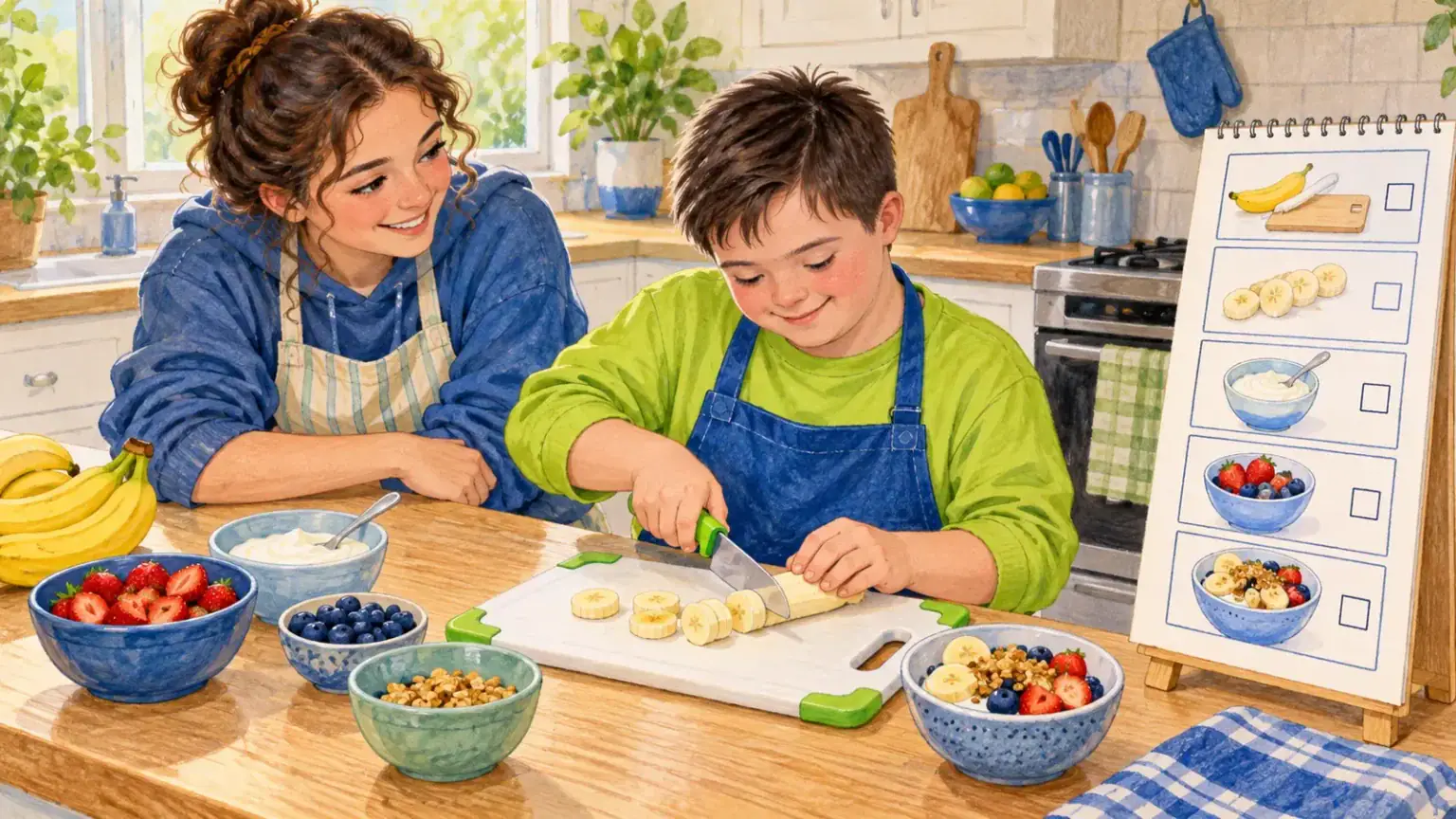
“Be more independent” is not a teachable instruction. A child with intellectual disability learns a daily-living routine more easily when the task is meaningful, broken into visible steps and practised with the right amount of help. Independence can also mean directing another person—not completing every movement alone.
Choose one task that matters now
Pick a routine the child wants or needs: making a snack, packing a bag, buying one item, showering or taking a bus with support. Avoid teaching several complex routines at once. Ask what would make the child’s day easier and consider safety, motor, sensory and communication needs.
Define success specifically. “Prepare cereal using the picture checklist, with an adult nearby for pouring” is clearer than “make breakfast independently.”
Watch before you teach
Invite the child to attempt the routine in the usual setting. Note what they do independently, after a visual cue, after a spoken cue and with physical help. Check whether tools or the environment create unnecessary barriers. A lightweight jug, labelled drawer or stable seat may improve performance more than extra instruction.
Make a task analysis
Break the routine into small observable actions. For cereal, that might be: get bowl; get cereal; pour cereal; close box; get milk; pour with help; put milk away; get spoon; sit to eat. The right step size depends on the learner. If “get bowl” is not yet reliable, split it further; if three actions are already fluent, combine them.
Represent the sequence with photos, objects, symbols or words the child understands. A visual list should support the task, not become another test.
Teach with a predictable help ladder
- Give the natural cue: “It is snack time.”
- Wait long enough for processing and initiation.
- Point to the next picture or object.
- Model the action.
- Give brief verbal guidance.
- Use physical assistance only with consent and when necessary for safety.
Not every learner needs this exact order. Some respond best to a model first. Use the least intrusive prompt that works, and record it so other adults are consistent.
Decide where to begin
With forward chaining, the child learns the first step while an adult completes the rest, then adds steps over time. With backward chaining, the adult completes most of the routine and the child performs the final step, experiencing completion immediately. Choose based on motivation and the task—not a belief that one method is universally better.
Fade support carefully
When a step is stable across several occasions, reduce one part of the prompt: gesture instead of words, point from farther away, or wait longer. If errors and frustration rise, restore the previous support. Removing help too fast is not independence; it is changing the task without access.
Practise in the real setting, then plan generalization. A child who can make cereal at home may need new cues in a relative’s kitchen. Teach safety rules directly and keep adult supervision for heat, knives, traffic, medication and money according to actual skills.
Respect age and dignity
Use age-respectful materials even when the learning step is early. Offer real choices about clothing, food and timing. Do not post intimate hygiene charts where peers can see them. Praise useful information—“You checked the picture and found the spoon”—instead of babyish applause.
Communication access is part of the skill. The child may need to ask for help, say “stop,” choose an item or report a problem using speech, sign, gesture or AAC. EdCaptain’s AAC guide explains why more ways to communicate should remain available. The family can also adapt the route-readiness framework when teaching community routines.
Measure the support, not just completion
Track which steps were completed and the prompt used. Review weekly: Is the routine meaningful? Is the child safer or more in control? An occupational therapist, special educator, speech-language professional or physiotherapist can help when motor, sensory, communication or learning barriers remain. The goal is reliable participation with the supports the person needs.