By EdCaptain editorial desk · Published
Your child points to a tiny triangle in the middle of the page: “You made one!” Look closely. One corner is only a place where two lines crossed, not one of the six dots you started with. In Sim, that difference decides whether a move ends the game.
Sim is a two-player paper game in which you try to avoid making a triangle with your own lines. This introduction is for ages 8–12, with a blank board and a practice round that keeps the important corners visible.
Prepare a page and two clear line styles
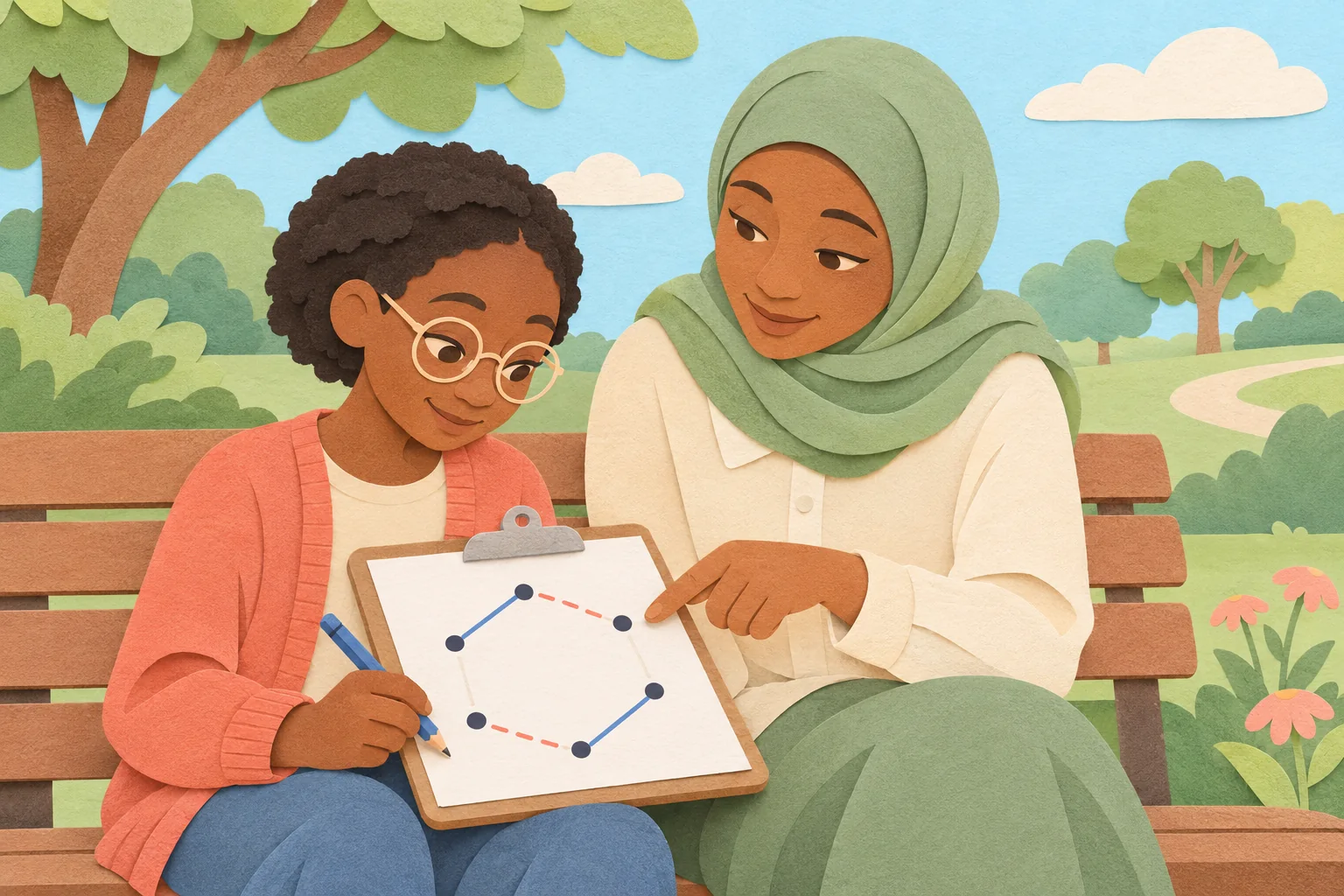
Use paper and two coloured pencils or pens. A ruler is optional. You do not need counters, scissors, an app or a special game set. Choose colours both players can distinguish; add different line styles as well, such as a solid line for one player and a dashed line for the other.
Draw a small sample of each player’s style beside the board. A dashed line still means one complete connection between its two dots—the little ink gaps are not breaks in the move. If the styles are hard to tell apart, change the materials or enlarge the page before playing.
The Sim section on page 13 of C. Wyszkowski’s university-hosted handout also distinguishes players with solid and dotted lines alongside colour. Here, the style cue makes the paper game easier to follow when colour alone is insufficient.
Print or copy the blank board
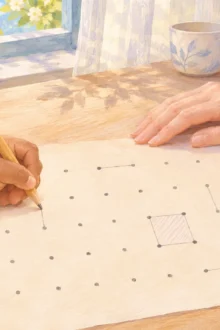
Print the six dots below, or draw six large dots around an imaginary circle. Label them A–F clockwise if the labels help you discuss moves. Keep them widely spaced so lines and their endpoints remain easy to trace.
●B
●C
●D
●E
●F
●
Check that all six dots are visible on your printout. Do not join the outside dots to make a hexagon before starting: those would already be game connections. If a dot is missing or the page is cramped, redraw it rather than asking a child to work around an unclear board.
The rules, one move at a time
The UC Berkeley GamesCrafters rules make the key boundary explicit: a losing triangle must have its three corners at three of the original six dots.
- Choose who starts. Each player keeps their own colour and line style for the round.
- Connect two dots. On your turn, draw one straight line between any two original dots whose pair has not already been joined. The dots need not be next to each other around the outside.
- Leave existing connections alone. Neither player may redraw, recolour or claim a pair already used by either person.
- Check your own lines. If your new line completes a triangle made entirely of your lines, with three original dots as corners, your opponent wins and the round ends.
- Pass the turn. If no such triangle was completed, the other player makes one move. A crossing does not give an extra move or create a new dot.
A triangle containing both players’ lines does not end the round. Nor does a small triangular shape whose corner lies at an unmarked intersection. You are checking connections between three original dots, not counting every triangle-like patch of paper.
Practise a triangle before playing for a result
On a spare copy, let one player draw A–B in their style. The other draws C–D in theirs. The first then adds B–C, and the second adds D–E.
Now pause. The first player already owns A–B and B–C. If they add A–C, their three connections form triangle A–B–C. Trace it slowly: A to B, B to C, C back to A. All three sides belong to the same player, and all three corners are original dots.
In this practice demonstration, deliberately draw A–C so everyone can see what ends a round. Then start the actual game on a blank copy. Say, “This was our example. In the game, you can look for a different unused connection before drawing.”
Check crossings by following the whole connection
As lines accumulate, trace from one labelled dot all the way to the other endpoint. Do not turn onto a different line halfway across the page.
If someone calls a triangle, ask, “Which three original dots are its corners?” Then check the three pairs between those dots and who owns each one. If a proposed corner is just a crossing, point to the six starting dots together and continue the game without blame.
Once the rule is clear, the interesting question is which unused connection to choose. You do not need to know a winning strategy to learn the rules accurately. Give everyone time to trace the three relevant pairs before moving on.
Offer help without choosing the move
Ask before giving advice: “Would you like help checking your possible line?” A player can point to two dots while a partner traces the existing connections that matter. The decision stays with the player.
If the board becomes confusing, pause and name the last connection aloud. Avoid adding a second line while explaining a first one. If a new line was genuinely unclear, agree what move was intended before continuing; do not quietly change ownership to rescue the result.
For children who want to explore, there are fifteen different dot-pairs on this board. Once a pair is joined, it is unavailable. That gives a useful way to check a proposed move, without promising that every round will last fifteen moves.
Adapt the challenge
Ages 8–9: begin with the practice sequence, use clear labels and check three endpoints together. Keep a fresh page available if crowded lines make the task tiring.
Ages 10–12: invite the child to explain why a proposed connection would or would not complete one of their triangles. They can compare two available moves without needing formal mathematical vocabulary.
Enlarge the board, use strong contrast, or let a child direct a partner who draws exactly the requested pair. Offer speech, pointing or the child’s usual communication method. A ruler may help with straight connections, but precise handwriting and speed are not the challenge. Keep pencil tips away from faces and use a comfortable surface.
End the round kindly
Either player can request a break or stop the activity. If you finish, trace the ending triangle once, then put the result aside. Ask, “What helped you tell a crossing from a corner?” rather than demanding a lesson about losing.
For another short line game with different rules, try Dots and Boxes. If competition is not welcome today, the cooperative paper maze gives you a shared goal. Sim is an activity to explore together, not a measure of intelligence or a guaranteed developmental exercise.
Sources and further reading
Read our editorial policy.