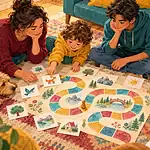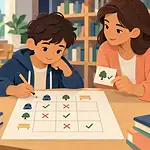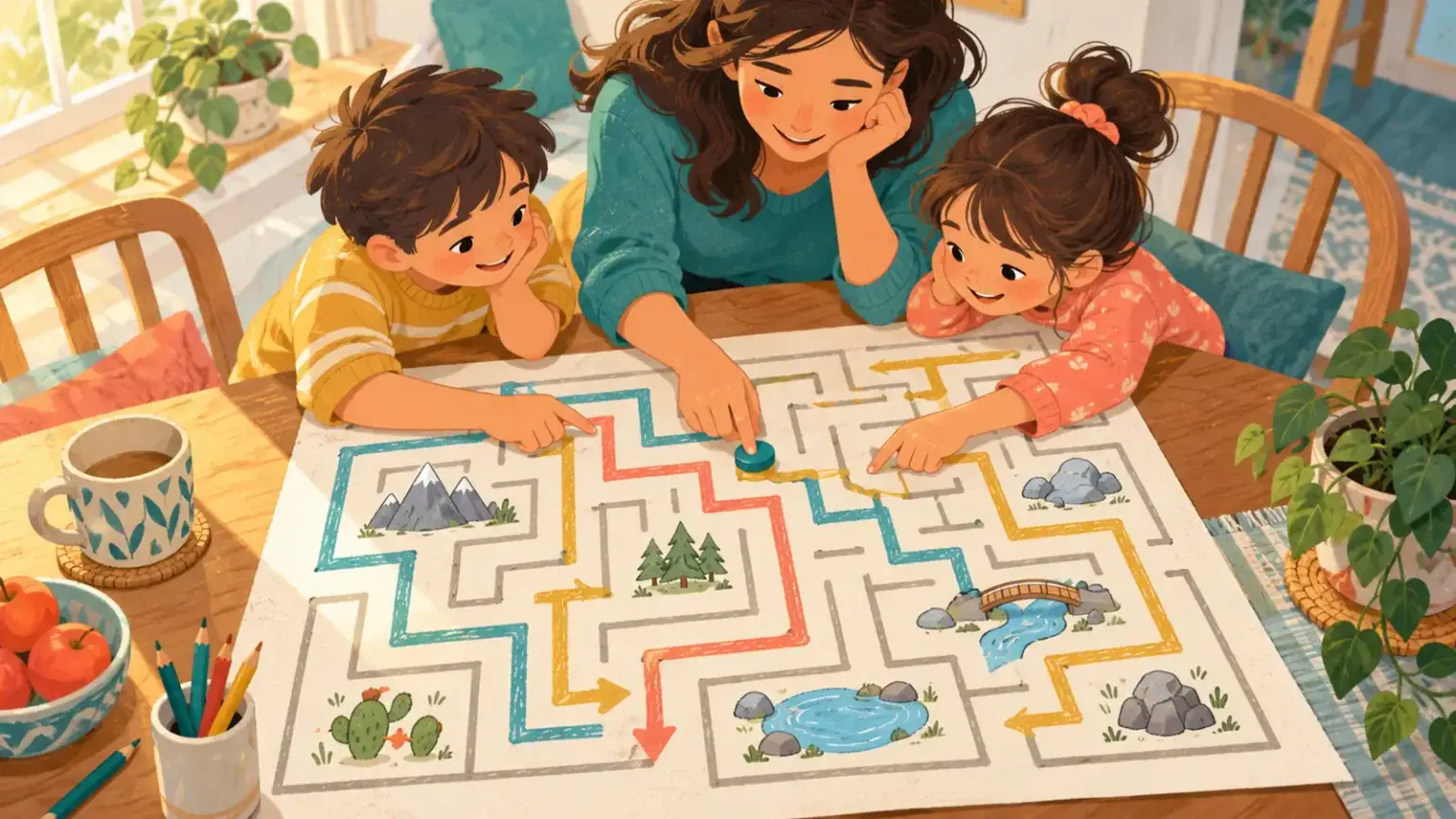
A maze usually asks one person to find the single correct path while everyone else waits. A cooperative maze can work differently. Players share one marker, discuss choices and discover that two or three routes can all reach the destination. The puzzle becomes an exercise in planning and communication rather than a race.
You do not need a maze generator. A sheet of paper, a pencil and a ruler are enough. Keep the first version small so the group can understand the rules before you add complexity.
Materials
- one sheet of paper or card;
- pencil, dark marker and optional ruler;
- a counter, washable marker or finger for tracing;
- three small destination pictures;
- optional transparent sleeve for reuse.
If small counters are unsafe for anyone present, use a large bottle lid under adult supervision, a finger or a drawn line. A player can also direct another person verbally, with eye gaze or through AAC.
Build several possible routes
- Draw a start circle on the left and a destination on the right.
- Add three branching paths. Make at least two reach the destination.
- Place a gentle obstacle on each route: a puddle, closed gate or sleepy animal.
- Add a helpful symbol nearby: boots, a bridge, a key or a quiet detour.
- Trace every route yourself before outlining the maze in marker.
Avoid traps that make the page impossible or require players to guess what the designer meant. The interesting choice is not “Can you read my mind?” but “Which route fits our plan?”
How to play together
Give the group one shared counter. On each turn, a player may move to the next junction or ask a question. Before moving, the group names what it notices: “The short route has water,” or “The longer route has a bridge.” A player can disagree without losing a turn.
If the group reaches a dead end, move back to the last junction and say what changed in the plan. Do not erase the first attempt. The visible route is useful evidence of thinking.
The cooperative story-path game offers another shared-counter activity. For a hands-on challenge with one unusual rule, try the Give-Only Puzzle.
Adjust the challenge
For ages 3–5, draw broad paths and use pictures rather than symbols that need explanation. Let the child choose between two directions. For ages 6–9, include a key or bridge that must be collected before a route opens. For ages 10–12, add a limit such as “use exactly two bridges” or ask players to compare the shortest and quietest routes.
Do not assume a harder maze is automatically better. Harvard’s executive-function resources describe games as opportunities for practice with attention, working memory and flexible thinking. Practice works best when the challenge is manageable enough for a child to stay engaged.
Make participation accessible
Use high contrast and thick lines for low vision. Enlarge the page or place it on a sloping surface. A child who finds drawing difficult can point while another player traces. A child who prefers predictability can inspect every symbol before play begins. Remove time limits and allow a pause at any junction.
For a child who dislikes being corrected, use language about the path: “That route closes here,” rather than “You went wrong.” There is no need to rank the players’ suggestions.
Reflect without turning it into a test
After reaching the destination, ask one optional question: “Where did our plan change?” “Which route would work for a wheelchair, bicycle or tired traveller?” or “Can we add another valid route?” Accept practical and imaginative answers.
Children can then redesign one section for the adults. That shift gives them authorship without requiring a perfect finished page. The American Academy of Pediatrics notes that play can support planning, language and cooperation, but this homemade maze is not a diagnostic tool or guaranteed developmental intervention.
Safety and storage
Keep scissors, laminating equipment and small pieces with an adult when needed. Do not use a real neighbourhood map or private address as the maze. Store the blank original and add different obstacles on copied versions, or slide it into a reusable sleeve.
A good cooperative maze is not the one with the most twists. It is the one that makes room for several people to notice, propose, reconsider and arrive together.