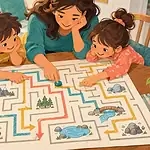
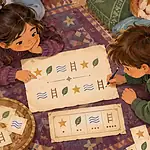
A logic-grid puzzle can look intimidating: names down one side, objects across the top and a list of clues that somehow leads to one answer. For a beginner, the best puzzle is small, concrete and fully testable. Three people, three items and three places are enough.
The aim is to practise keeping track of information and revising a guess—not to prove who is “good at logic.” Make the first grid together before asking a child to solve one alone.
Choose a friendly scenario
Use fictional or playful categories: three explorers, three backpacks and three picnic spots; three robots, three tools and three charging stations. Avoid real classmates, private information or stereotypes that make a child the punchline.
Write the answer first. For example:
- Amir has the blue backpack and visits the pond.
- Bo has the green backpack and visits the hill.
- Cleo has the red backpack and visits the garden.
This hidden answer key lets you test whether each clue is accurate.
Draw the grid
Create two simple three-by-three tables. Put names along the rows. Put backpacks across one table and places across the other. Leave room for a tick and a cross in each square. Print in high contrast and avoid tiny boxes.
Explain the marks: a tick means “this match is confirmed”; a cross means “this match cannot be true.” Do not introduce extra notation until the child understands those two symbols.
Write clues from easy to linked
- Start with one direct positive clue: “Bo carries the green backpack.”
- Add one direct negative clue: “Cleo does not visit the pond.”
- Add a linked clue: “The person at the garden carries red.”
- Add a final clue that makes the remaining match certain.
Use plain sentences. A clue should add information, not rely on a trick definition. After every clue, update the grid yourself. If two different solutions remain, add another clue. If the clues conflict, fix the puzzle before sharing it.
Solve in a calm sequence
Read one clue at a time. Mark the certain match, then cross out the other choices in that row and column. Ask, “What becomes impossible now?” When the child makes a guess, distinguish it from a deduction: “That could be true. What clue would confirm it?”
If the child is stuck, offer a graduated hint:
- point to the relevant table;
- reread the clue and underline its two categories;
- mark one certain cross together;
- show how a completed row leaves only one possibility.
A hint keeps the puzzle moving; it is not a failure. For other low-pressure challenges, see Puzzles and Brain Teasers and the cooperative story-path game.
Adapt the page
Use pictures alongside category words for emerging readers. Read clues aloud or provide text-to-speech. A child can point while another person records marks. Reduce the grid to two-by-two for a first attempt, or cover later clues so only one sentence is visible.
For ages 10–12, invite the child to explain a deduction in any format: speech, drawing arrows or moving category cards. Do not require a formal written proof unless that is the chosen challenge.
Let the child write the next puzzle
Give the child a blank answer key first. They choose the matches, then write four or five clues. The adult solves it aloud, showing honest reasoning and politely flagging any contradiction. This makes puzzle design visible as a process of testing and revision.
The Harvard Center on the Developing Child describes age-appropriate games as opportunities to practise executive-function skills. That does not mean a completed grid measures a child’s intelligence. Fatigue, reading demands, unfamiliar vocabulary and anxiety all affect performance.
Finish with one useful question
Ask, “Which clue unlocked the puzzle?” or “What would make this easier for a new player?” Then keep the answer key with the printable. A fair logic puzzle should have one defensible solution, readable clues and a path back from being stuck.