Children do not need a person to mock in order to be funny. A joke can grow from an impossible combination, a surprising ending, a sound-alike word or an ordinary object behaving dramatically. This activity gives the family a safe structure for experimenting without grading anyone’s sense of humour.
What you need
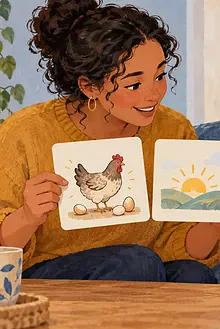
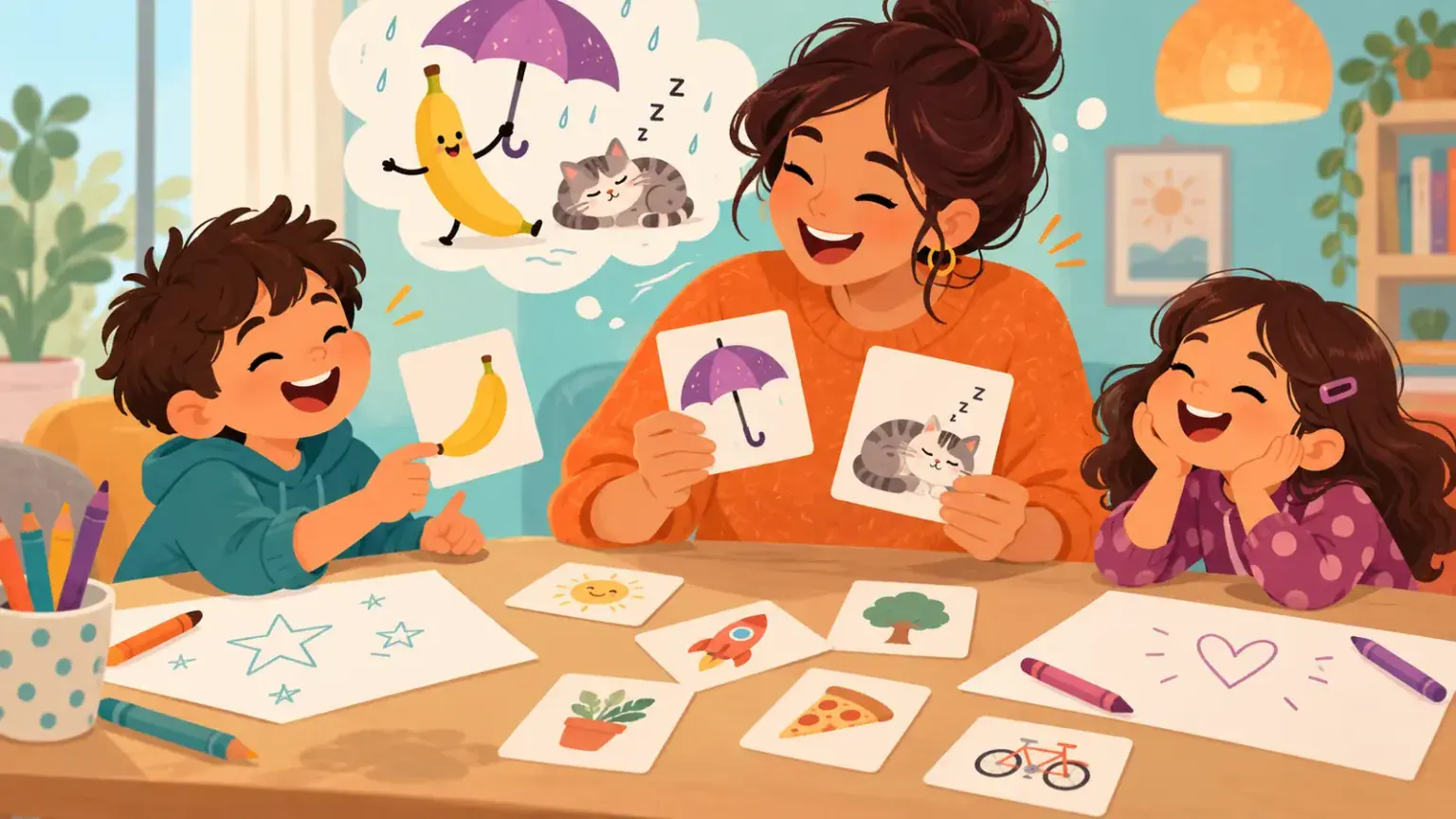
- 12–20 picture cards cut from packaging, magazines or hand-drawn
- Blank paper or a notes app
- Pencils, thick markers or an AAC device
- A bowl or bag for drawing prompts
- About 20 relaxed minutes
Use ordinary subjects—banana, umbrella, sleepy cat, bus, shoe, cloud. Avoid photos of real people in the family.
Set one clear rule
The joke can target an object, an imaginary character or the joke-maker’s harmless invented situation. It cannot target a person’s body, disability, identity, fear, accent, mistake or private information. Anyone can pass. This extends the principles in using humour without making a child the punchline.
Set up the prompts
Place cards face down. For children who need predictability, show the full selection first. Offer a smaller set for a child who becomes overwhelmed by choices. Make sure pictures are recognizable and can be named, pointed to or selected with the child’s usual communication method.
Play in five rounds
- Each person draws two cards.
- Say what is odd about putting them together: “Why would a banana need an umbrella?”
- Invent a setup and one surprising ending.
- Tell it in words, pictures, gestures or sound effects.
- Invite one kind suggestion, then keep or discard the joke.
Adults should model an imperfect first attempt. Children learn that jokes are made through revision, not delivered by people who are naturally “the funny one.”
Try these joke engines
- Wrong job: What if the shoe became a doctor?
- Unexpected rule: What is the one thing a cloud refuses to do?
- Three-beat list: two sensible answers and one surprising one.
- Sound switch: change one sound in a familiar word.
- Overreaction: an imaginary character treats a tiny problem as epic.
Make participation accessible
A non-speaking child can choose cards, trigger a recorded punchline, direct another person or use facial expression. A child with low vision can use real objects or tactile symbols. A child who takes language literally may prefer visual absurdity to wordplay. Nobody should lose a turn because their delivery is slower.
Coach without taking over
Ask, “Where is the surprise?” or “Can the joke work without naming your sister?” Avoid rewriting every line. If a joke hurts, stop and explain the boundary briefly, then help move the funny idea onto an imaginary target. The family is practicing judgment as well as creativity.
Add a gentle performance
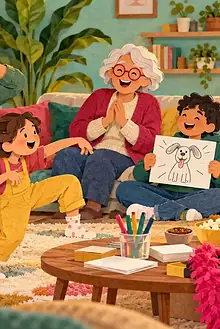
At the end, each person may share one joke. Passing remains allowed. No filming or posting without explicit agreement from everyone involved. A joke approved for the living room is not automatically approved for school or social media.
Reflect for two minutes
Ask which prompt created the biggest surprise, which format made participation easiest and whether any joke felt uncomfortable. Save only the jokes their creators want saved. Over time, build a family collection that shows creativity rather than embarrassment.
Variations for repeat play
On another day, use only sounds, create a three-panel comic, or let each person improve one shared joke instead of making separate ones. Teens may prefer writing captions for imaginary scenes or parodying a made-up advertisement. Keep the no-target rule and let creators decide whether their joke is performed, displayed or discarded. Variety keeps the activity creative without raising the social pressure.
If the family becomes stuck, choose one card and list five ordinary facts about it before adding one impossible fact. The contrast often creates a joke without forcing inspiration. Stop while the activity is still enjoyable; creative play does not need a finished product.