A shared activity can be lovely, but “everyone do the same thing” often asks too much of siblings at different stages. A three-year-old may want to pour and repeat; an eight-year-old may want a challenge; a twelve-year-old may want influence, privacy or the option to join later. A workable mixed-age week gives everyone a real role without turning the oldest child into an unpaid assistant.
- Set one invitation, then offer different ways in
- A five-day mixed-age plan
- Monday: Build one neighbourhood
- Tuesday: Make a family sound track
- Wednesday: Tell one story three ways
- Thursday: Run a mini investigation
- Friday: Choose-and-share
- Use roles, not age labels
- What to say when the plan unravels
- Sources and further reading
Set one invitation, then offer different ways in
Choose a loose 20–30 minute window and put out only the materials needed. Say, “This is our shared activity. You can do the simple version, make it harder, or watch for a bit.” Younger children may finish after five minutes. That still counts. Older children can arrive later or develop their own version.
Before Monday, make a small supply basket: paper, crayons, masking tape, cups, blocks, a sheet or towel, and a few safe household objects. Remove choking hazards when a child still mouths objects, and supervise water, scissors, climbing and food activities according to each child’s abilities.
A five-day mixed-age plan
Monday: Build one neighbourhood
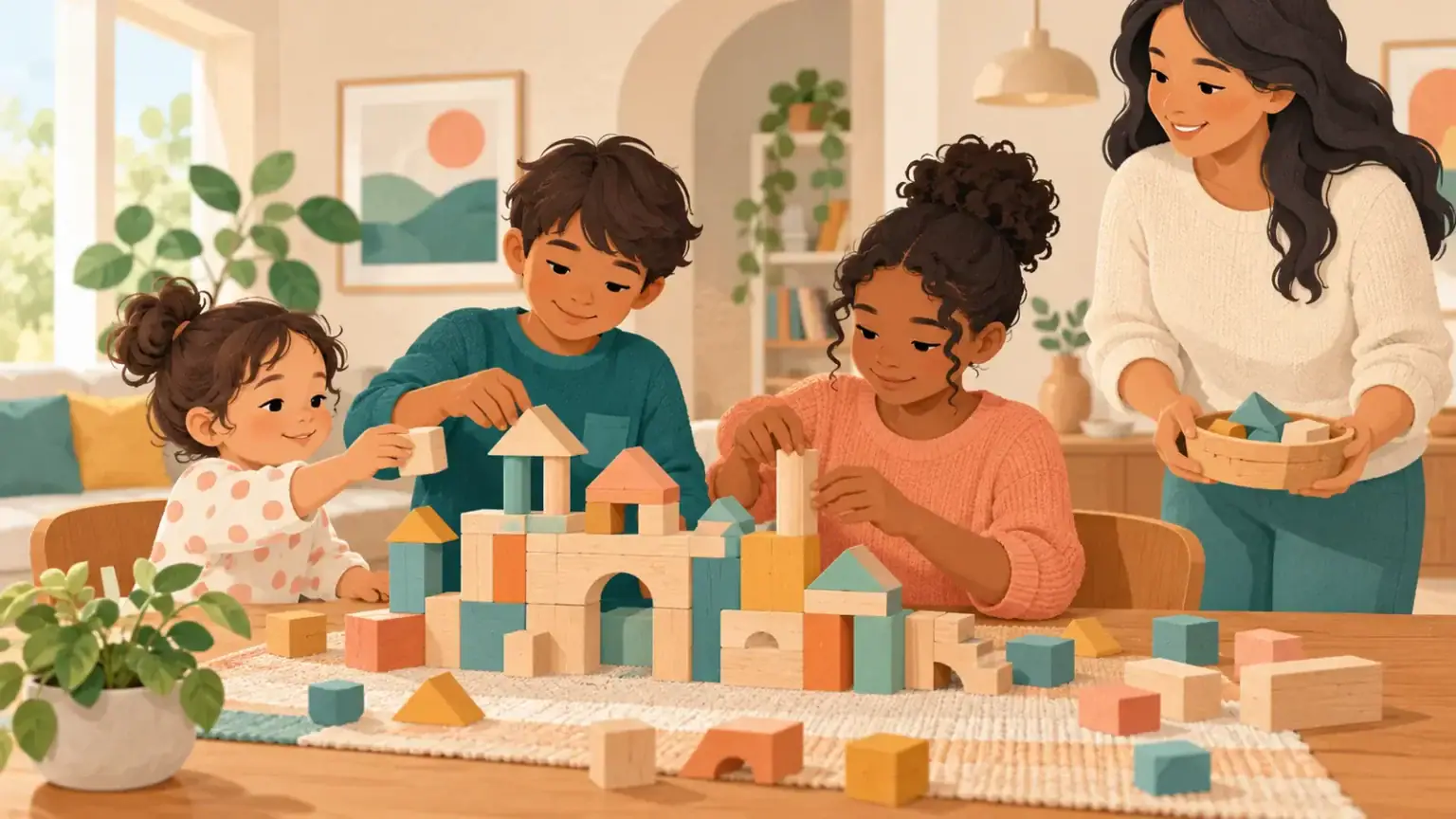
Use blocks, boxes or cushions. A preschooler can line up roads or stack low towers. A child aged 6–9 can add a bridge or invent a shop. An older child can draw a map, create a transport route or photograph the final build. The result does not need to look coordinated; the shared theme is enough.
Tuesday: Make a family sound track
Tap wooden spoons on cushions, clap patterns or use sealed containers as shakers. The youngest can copy one beat. School-age children can lead a call-and-response. An older child can choose the order or record a short audio clip if family rules allow. Keep the volume comfortable and provide a quiet job—such as choosing the next instrument—for anyone who dislikes loud sound.
Wednesday: Tell one story three ways
Start with: “A tiny door appeared under the table.” A younger child can point, act or add one word. A confident reader can write the next scene. An older sibling can sketch panels or introduce a problem. If turn-taking becomes tense, each child can create a separate ending and share only if they wish.
Thursday: Run a mini investigation
Ask which paper shape flies farthest, which object rolls down a cardboard ramp, or which ice cube melts first in shade and sun. Young children can place and observe. Older children can predict, measure and record. Avoid presenting the activity as a test; noticing “that one went sideways” is useful participation.
Friday: Choose-and-share
Each child selects one small activity for ten minutes: dance, drawing, a card game or a short walk. Others may join, adapt or take a quiet parallel option. A simple timer keeps one choice from taking the whole session.
Use roles, not age labels
Try roles such as collector, builder, tester, narrator, photographer or tidy-up DJ. Let children choose rather than saying, “You are the big one, so you help.” Rotate desirable jobs. When two children want the same role, duplicate it or use short turns instead of making seniority the rule.
If the week is crowded, borrow the lighter rhythm from this low-energy plan of ten-minute activities. For a broader menu using household materials, see the balanced weekly play plan. A child who needs extra warning may also benefit from a simple now-and-next board.
What to say when the plan unravels
“You both want the blue tape. I’m going to hold it while we find two jobs.” “You can build with us or make your own version beside us.” “Your body is telling us this is enough for today.” These phrases protect the relationship without insisting on cheerful cooperation.
At the end of the week, ask one question: “Which part should we keep next time?” Do not score fairness by equal minutes or matching products. A successful mixed-age plan creates overlapping chances to connect while respecting that siblings are different people.