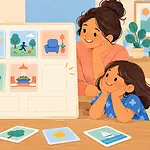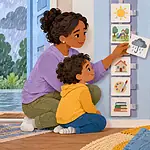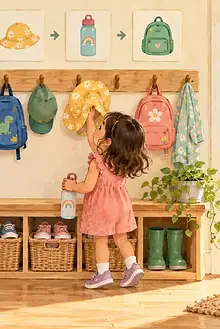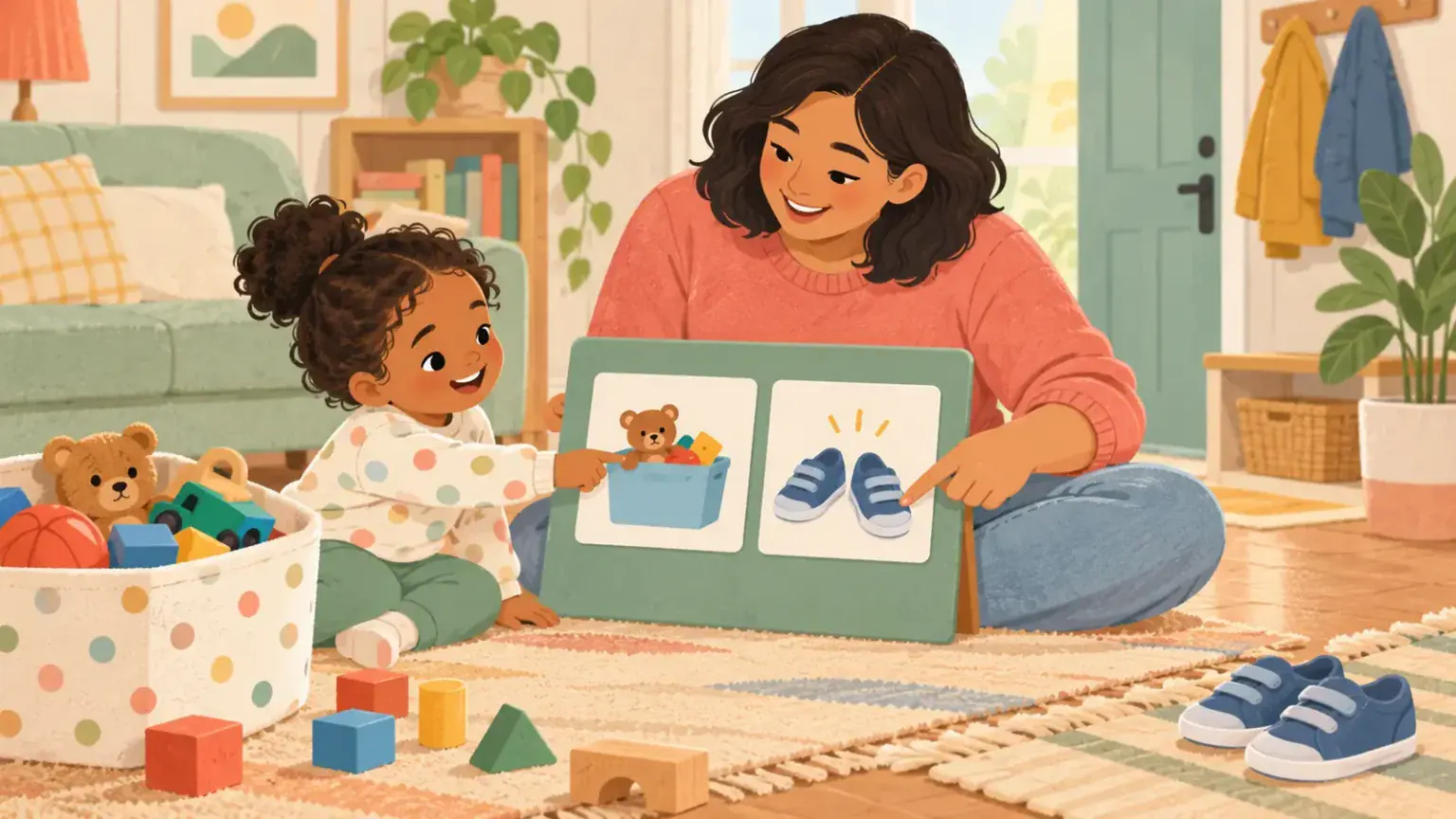
A child is deeply involved in building a tower, and the next step is putting on shoes. The adult has already called from across the room three times. By the fourth reminder, both people are braced for conflict. A now-and-next board can reduce some of that verbal traffic. It shows only two things: what is happening now and what follows.
The board is not a guarantee that a child will feel cheerful about stopping. It is not a sticker chart or a disguised bribe. Its job is narrower and more useful: make the sequence visible, then help the adult use fewer, clearer words.
Choose one transition, not the whole day
Start where the sequence regularly becomes muddled: toys to shoes, bath to pajamas, breakfast to teeth, or screen off to dinner. Do not begin with a ten-picture timetable if the child is new to visual supports. Two cards are enough to teach the idea.
Use photographs, simple drawings, objects, or symbols the child already understands. A photo of the actual shoe basket may communicate more clearly than an abstract icon. Put the “now” item on the left and “next” item on the right, or top and bottom, and keep that direction consistent.
Teach it when nobody is rushing
- Practise with two easy, familiar activities. Try “Now blocks, next snack” at a calm time. Point to each picture as you say it.
- Mark the finish. When the first activity ends, let the child move the card into a finished pocket, turn it over or cross it off with a reusable marker.
- Move immediately to the next card. The picture must match what actually happens, or the board will stop being reliable.
- Use it for the difficult transition. Give a brief warning, show the board and stay close enough to help with the first step.
Head Start guidance notes that children differ in how they respond to transitions. Some need more time, more than one warning or hands-on support with a multi-step task. The board does not replace that relationship; it supports it.
Keep “next” truthful
“Next” does not have to be a treat. It can be the ordinary next event: shoes, car, dinner or bath. If adults always place a highly preferred activity second, a child may reasonably understand the board as a deal: endure this to obtain that. Sometimes the next activity will be enjoyable; sometimes it will simply be necessary.
Useful language sounds like: “Now pajamas. Next story.” Or: “Now coat. Next bus.” Avoid adding a long lecture after the two clear phrases. If the child says no, acknowledge it without changing the meaning: “You wanted more play. The board says shoes are next. I’ll help with the first shoe.”
Adapt the board to the child
- For a child who does not yet connect pictures with objects, show the real object—such as the shoe—beside the card.
- For a child with low vision, use large, high-contrast images, tactile markers or objects of reference.
- For a child who processes language slowly, point, pause and allow time before repeating.
- For an older child, use two discreet words or phone reminders rather than preschool-style artwork.
- If a task has several steps, keep the two-card board for the transition and add a separate short sequence for the task itself.
When it still goes badly
Look beyond “the board did not work.” Was the child hungry, frightened, in pain, deeply fatigued or asked to stop without warning? Was the picture unclear? Did “next” change after the card was shown? Did the adult expect the child to complete a skill they have not yet learned?
Repair the system rather than escalating it. Shorten the first activity, add a warning, move the board into the child’s sightline, or provide direct help. For broader ideas, see EdCaptain’s guide to a routine chart a child can actually use and the after-school landing routine.
A useful now-and-next board becomes boringly dependable. It says what is happening, what follows and where the child can look when spoken instructions start to blur.