By EdCaptain editorial desk · Published
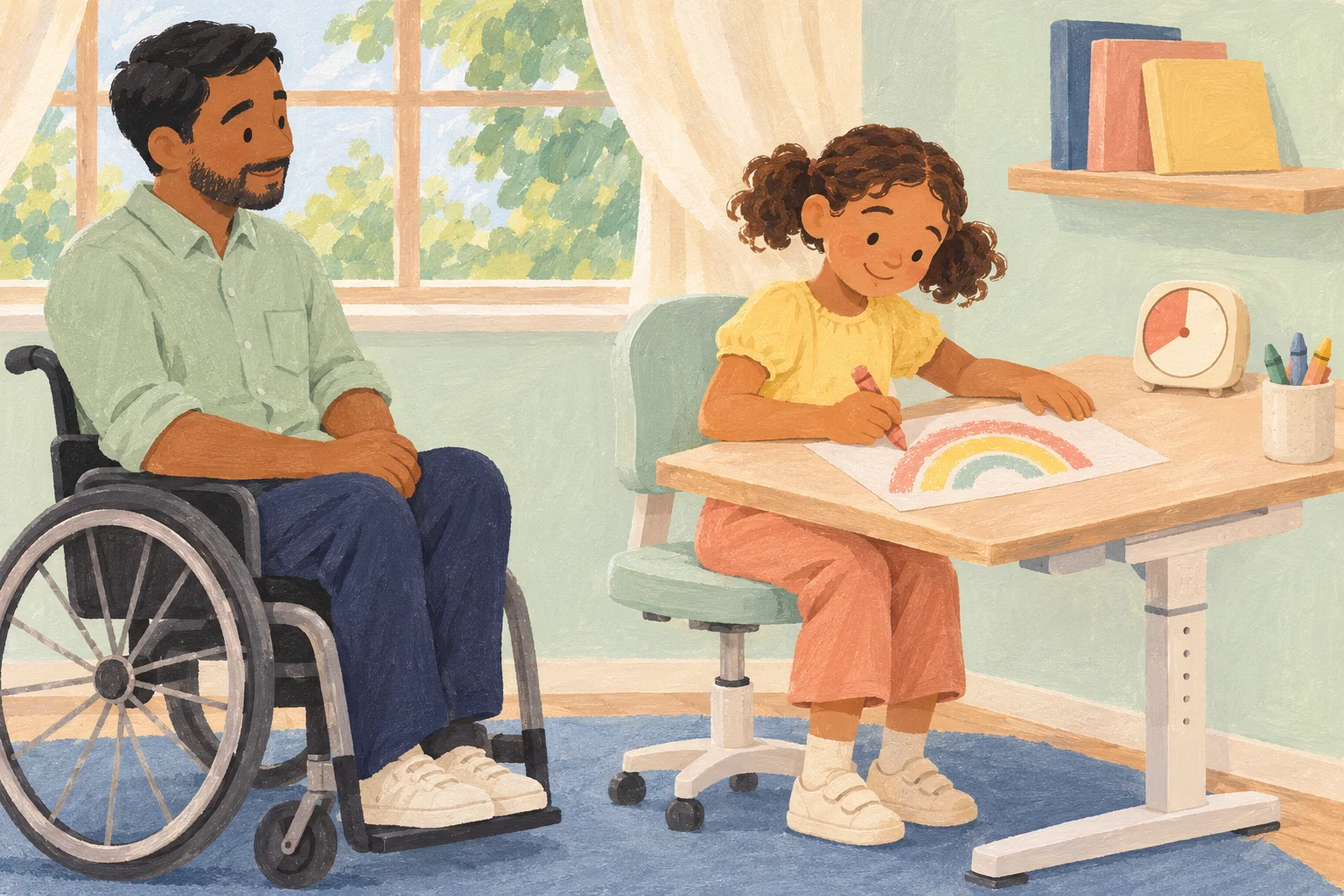
You put a timer beside the drawing paper. Your child keeps asking how long is left—or watches the shrinking section so closely that drawing stops. Has the timer helped, or simply made the deadline more visible?
For children aged 3–9, a visual timer can be one way to show time passing. It still needs explaining. Try it as a shared tool for one ordinary moment, with a clear agreement about the finish, rather than assuming the display will make a child ready to stop.
Decide what you want the timer to communicate
A countdown answers “how much time remains?” It does not explain what comes next, teach a missing skill or make a task comfortable. Before setting it, finish this sentence: “When the timer ends, we will…”
Be specific. “When it ends, we put the crayons in the pot together” differs from “all the tidying must be finished before it ends.” Choose one meaning and say it before starting. Avoid introducing an unexpected demand at zero.
The National Center for Pyramid Model Innovations’ transition guidance includes a timer among several options, alongside warnings and visual supports. It is an option to try, not a requirement for every family.
Check the tool before giving it a job
Use something you already have or can borrow before buying a specialist device. A disappearing coloured area, a simple digital countdown or an enclosed sand timer may offer different information. Do not assume your child understands any of them on sight.
Check the alarm beforehand, away from your child’s ears. If sound is unwanted, use a silent setting and agree how the adult will signal the ending. A ticking sound, changing light or busy app may also be distracting. Turn off unrelated notifications if using a device.
Put the display where the child can comfortably access it, without requiring constant watching. For low vision, consider readable size, contrast and glare. A visual display may be unsuitable for a blind child; discuss a familiar spoken, audible or tactile alternative using their existing access supports. Do not expect a tool to help simply because it is called visual.
Keep cords, loose batteries and small detachable parts inaccessible. Use an intact, age-appropriate device, supervise its use and avoid a breakable glass timer where it could be dropped or mouthed. The timer does not replace supervision.
Introduce it when the stakes are low
Leeds Community Healthcare’s guidance on understanding time recommends accessible supports, processing time and exploring duration in everyday activities. You can begin with a brief demonstration rather than the hardest departure of the day.
- Look at it together. Explain the changing part in familiar words: “This part gets smaller while time passes.” Show the finish without demanding an answer.
- Try a short, relaxed example. Set a brief interval while you both make marks on scrap paper. The purpose is noticing the display, not completing a picture or beating the clock.
- Say the ending in advance. For example: “When it finishes, we’ll put the crayons down and look at our marks.” Stay available to help.
- Follow that agreement. Name the end gently and demonstrate the next action. Allow processing time rather than immediately repeating the instruction louder.
- Ask what the experience was like. “Did seeing it help, or would you rather I told you?” Accept pointing, signing, a communication device or a brief response.
No particular interval is a developmental target. Choose a short demonstration your child can comfortably join, and stop if it is upsetting. You are checking the tool’s usefulness, not testing patience.
Move to one real routine
Pick a moment with some room to help: finishing a drawing before a familiar next activity, for example. Show the timer before it begins and name both the activity and the finish agreement. A now-and-next board can show the sequence while the timer shows duration.
Decide whether the countdown includes packing away or only the activity itself. Leave realistic time afterwards for the child to move, gather belongings or receive help. A timer cannot compress a difficult motor task into an adult’s preferred number of minutes.
Avoid secretly shortening the time, repeatedly restarting it as punishment or adding another task at the end. If the adult needs to change the plan, explain that honestly: “I set it too late. We need to start packing now; I’ll help.” Do not blame the child for a scheduling mistake.
For a fixed departure, prepare earlier. For a flexible home activity, discuss a workable stopping point before starting. Do not promise unlimited extensions, but do not make the display responsible for enforcing the boundary: the adult remains present and supportive.
Match support to the child
Ages 3–5: keep the explanation concrete and stay nearby. You can point once to the changing display, then return attention to the activity. If clock time means little, an event cue such as “after this page” may communicate more clearly.
Ages 6–9: involve the child in choosing placement, sound settings and the first routine to try. They may help estimate a realistic interval or explain what “finished” means. Keep the emphasis on planning rather than rewarding fast work.
Leicestershire Partnership NHS Trust’s school-journey guidance describes timers as potentially helpful for some autistic children while stressing that useful supports vary. A diagnosis does not tell you which display, warning or timing will suit this child today.
Keep it only if it helps
Over a few ordinary uses, notice whether the child understands the cue, needs fewer confusing reminders and can still enjoy the activity. Ask about the alarm, the moving display and the next task separately.
If watching the countdown seems upsetting or takes over the activity, put it aside and try another cue. You can keep a clear ending through a spoken warning, a picture sequence or a natural stopping point. Our visual goodbye routine offers an event-based alternative for leaving an enjoyable activity.
Never time eating, toileting, emotional recovery or a child’s access to comfort as a punishment. If transitions repeatedly cause major distress or safety difficulties, seek support from the child’s school or a relevant qualified professional. Record what actually happens rather than concluding that the child needs a louder alarm.
Sources and further reading
- National Center for Pyramid Model Innovations: helping children transition between activities
- Leeds Community Healthcare NHS: information for schools, including understanding time concepts
- Leicestershire Partnership NHS Trust: supporting journeys and transitions
Read our editorial policy and health information guidance.