Leaving for the library should not require a search party for two shoes, a hat and the water bottle. Yet ordinary departures often fail at the same physical points: supplies live in several rooms, the child receives five directions at once, and the adult expects independence before the environment supports it.
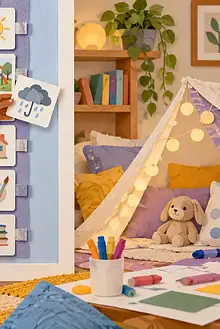
A get-ready station puts the safe, repeatable parts of leaving in one reachable place. A short picture sequence shows the order. The adult still checks weather, transport, medication, identification and other essentials.
Choose the smallest useful station
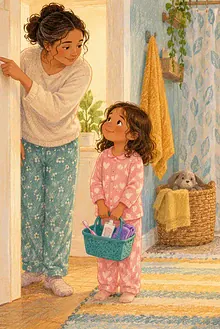
Use the area near the usual exit if it is safe. Add child-height hooks, a shoe basket, a seat or stable bench and one container for outing items. Secure furniture to the wall where needed, keep exits clear and store choking hazards, medicines, keys and cleaning products out of reach.
Do not stock every possible item. Too many choices slow the routine and create clutter. Keep the season’s everyday shoes, one or two outer layers and the child’s safe water bottle. Adults can add special equipment for a particular trip.
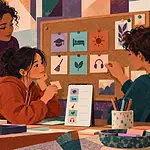
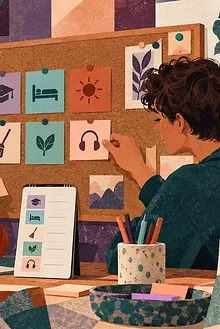
Photograph the real four steps
A useful sequence for a preschooler might be:
- toilet or nappy check;
- shoes;
- weather layer;
- water bottle, then adult check.
Use photos of the child’s own objects or simple pictures they understand. Put the cards at eye level and add a finished pocket. For a toddler, two steps may be enough. For a school-age child, a small written list can replace pictures.
Prepare before calling the child
The adult checks the destination, time, weather and transport first. Place only relevant options at the station. “Blue hat or yellow hat?” is manageable. “Go get ready” leaves a young child to solve several hidden decisions.
Give a transition warning while the child can still complete a play action: “Finish this tower, then get-ready station.” When it is time, walk to the station together and point to the first card.
Teach one job at a time
Model how shoes go in the basket or how the bottle returns after the outing. Practise when nobody is late. Offer the least help that keeps progress possible: point, demonstrate, start the zip or steady the shoe. Independence grows through repeated successful participation, not by removing support abruptly.
Praise the useful action: “You checked the weather picture and chose your coat.” Avoid praising speed alone; rushing can make fast children careless and slower children feel they have failed.
Keep adult-only checks adult-only
Young children should not be responsible for passports, allergy medication, car restraints, house security or deciding whether clothing is safe for extreme weather. They can participate—placing a comfort toy in a bag, for example—while an adult verifies critical items.
For public transport or crowded places, review the family’s safety plan before leaving. A station helps with preparation; it does not replace close supervision.
Adapt the station
- Use a chair, long-handled shoe aid or accessible hook for a child with limited mobility.
- Remove irritating labels and offer sensory-tolerable layers.
- Use high contrast, tactile labels or consistent locations for a child with low vision.
- Let a child who finds pictures difficult use the real object as the cue.
- Keep the sequence portable on a ring or phone for departures from other places.
Reset after returning
Build the return into the routine: shoes in basket, bottle to kitchen, coat on hook. The adult handles wet items, charging, washing and restocking. A two-minute reset prevents tomorrow’s station from becoming an archaeological dig.
If mornings are the main difficulty, combine the station with EdCaptain’s school-morning plan. For child-owned school preparation, use the school-bag packing routine.
The station succeeds when leaving requires fewer searches and fewer invisible instructions—not when a young child carries adult responsibility.