“Five more minutes” has been announced three times. The child is halfway up the climbing frame, the adult is late, and leaving now feels like a sudden theft of something wonderful. A visual goodbye routine cannot make every ending pleasant. It can make the ending less ambiguous.
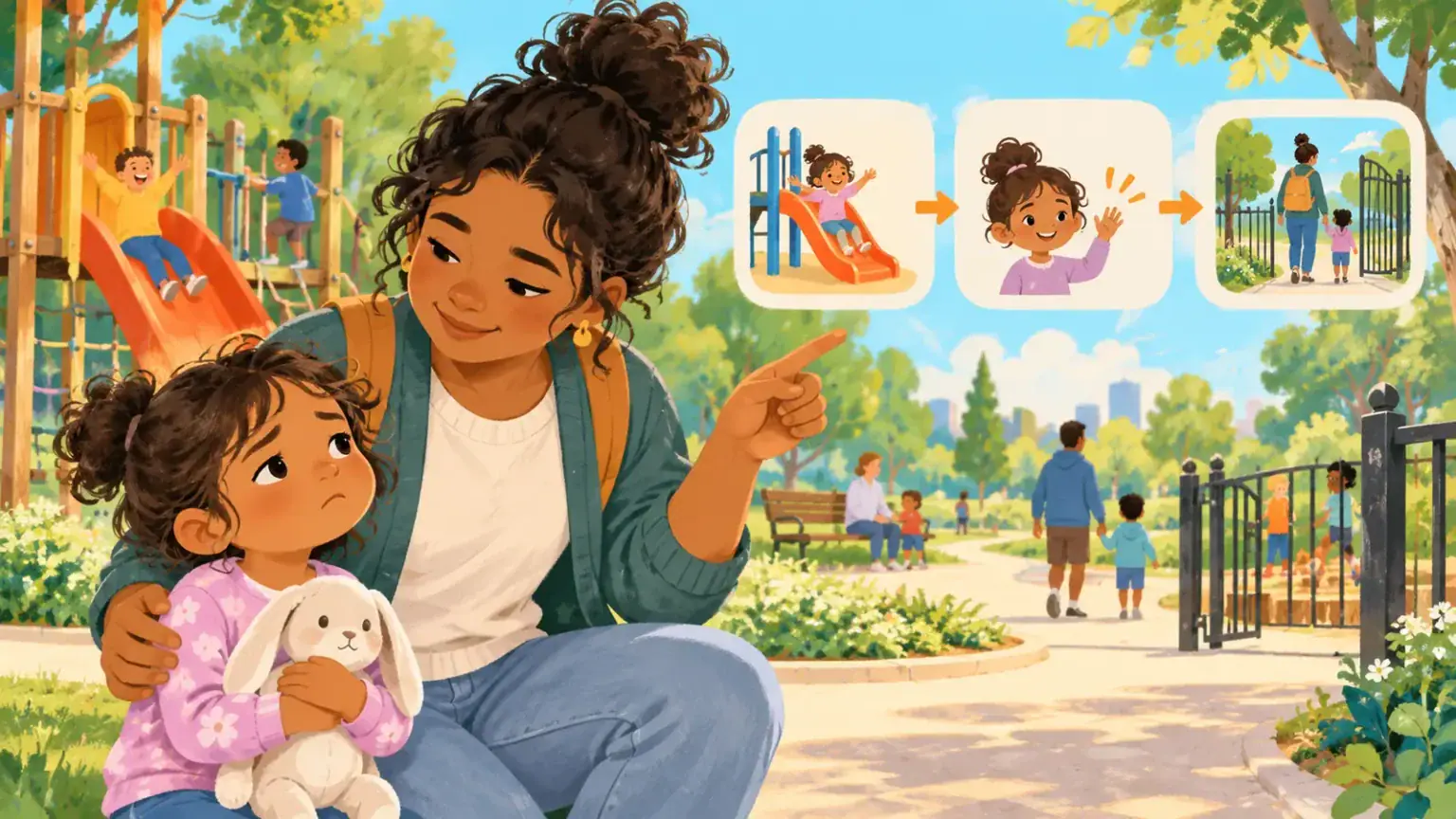
The most useful sequence is short enough to remember: last turn, goodbye, go. It works for a playground, a friend’s house, a game, water play or another strongly preferred activity.
Prepare the ending when you arrive
Show the three pictures before play begins. Say, “We will play, then you’ll choose one last thing, wave goodbye and walk to the gate with me.” If the departure time truly cannot move, be honest. Avoid “maybe later” when later is not available.
Let the child help choose the goodbye action: wave to the slide, take one photo, put a leaf in the nature basket or say, “See you next time.” The ritual marks the boundary; it is not a promise about exactly when the family will return.
Use warnings the child can understand
Clock minutes are abstract for many young children. Pair time with an event: “After two more pushes on the swing, I’ll show the last-turn card.” A timer may help if the child understands it, but the timer should support the adult’s words, not become a threat.
Give one or two planned warnings rather than a stream of anxious reminders. Get close, show the card and make sure the child has actually noticed. For a child absorbed in play or processing language slowly, a distant call may not register.
Follow the same three steps
- Last turn. Offer two realistic choices: “Last slide or last swing?” Do not offer a choice you cannot safely allow.
- Goodbye. Use the selected ritual. Name the feeling if useful: “You wish play could continue.”
- Go. Move toward the exit together. Give a job such as carrying the water bottle, finding the blue gate or holding the adult’s hand where required.
If the child asks for another last turn, point to the finished card: “The last slide is done. We are on goodbye.” Repeating the limit calmly is different from arguing.
Plan for safety
At a busy park, leaving safely outranks completing every visual step. Agree where the child stops, whether they hold a hand and what happens near roads or car parks. If a child runs, position the adult between the child and the hazard and seek professional support for persistent unsafe elopement; a picture strip alone is not a safety plan.
Never hide as a joke, pretend to abandon the child or drive away to force movement. Stay physically and emotionally present.
When the child is very upset
Use fewer words. Keep the boundary and help the body move safely: “You are angry. I am staying with you. We are leaving.” If possible, pause in a safe spot outside the play area rather than demanding an instant cheerful recovery.
Later, review the sequence without shame. Was the child hungry? Was the warning missed? Did the adult extend the time after the “last” card, teaching that the sequence was negotiable? Adjust the plan, then practise again.
Adapt without making the support childish
Some children prefer photos; others need objects, gestures or spoken cues. An older child may use a three-item phone checklist. A child with limited mobility may need extra transition time and an accessible route to the exit. A child who uses AAC should have access to messages such as “one more,” “finished,” “sad,” “help” and “when again?”
For another difficult transition, build a now-and-next board. For outings where access is the larger issue, use EdCaptain’s accessible family outing plan.
A good goodbye routine does not erase disappointment. It shows the child where the ending is, gives one meaningful choice and keeps the adult’s follow-through steady enough to trust.