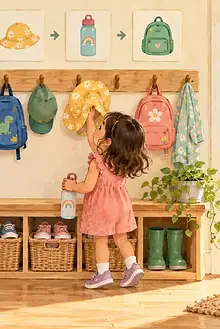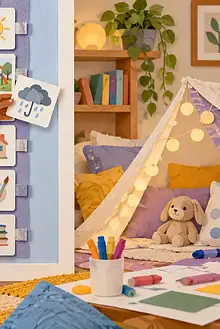
The first minutes after school often carry the whole day through the door: hunger, restraint, noise, friendship worries and a heavy bag. Asking detailed questions or demanding homework immediately may collide with a child who has no capacity left. A landing routine creates a predictable bridge between school and home.
- Start with observation, not a universal schedule
- Choose four anchors
- Offer two recovery routes
- Delay the school debrief
- Make the restart visible
- Build a realistic homework handoff
- Adapt by age and access need
- Create a rescue version
- Review after two weeks
- Coordinate across caregivers
- Sources and further reading
Start with observation, not a universal schedule
For one week, notice what your child needs first. Some seek food, some movement, some silence and some connection. The American Academy of Pediatrics notes that a healthy after-school routine may include snack, exercise, relaxation and study in the order that fits the child. The order is part of the design.
Choose four anchors
- Arrive: bag, shoes and essential school messages go to one place.
- Refuel: snack and water without turning the moment into an interrogation.
- Recover: movement, quiet or connection.
- Restart: one clear cue for homework, chores or the next activity.
Keep each anchor simple enough to work on an ordinary tired day.
Offer two recovery routes
Try: “Do you need outside movement or the quiet corner?” A younger child may run, swing or build. An older child may shower, listen to music or sit alone. Screens can be one option if the transition away from them is manageable; otherwise use them after the next anchor.
Delay the school debrief
Replace “How was school?” with a welcome: “I’m glad you’re home. Snack is ready.” Save questions for when the child’s body has settled. A child can share later during food preparation, a walk or bedtime. Silence on arrival does not automatically mean something is wrong.
Make the restart visible
Use a timer, picture card, music cue or written time. Give a short warning before the transition. A visual prompt should reduce adult reminders, not become another decoration; this guide explains why a routine chart may be ignored and how to teach its use.
Build a realistic homework handoff
Agree on where materials live, the first task and when help is available. The child may work immediately after snack or after movement; there is no single correct time. For persistent conflict, use the practical steps in building a better homework-starting routine.
Adapt by age and access need
- Preschool: toilet, snack, connection and free play may be the whole routine.
- Primary school: use pictures and a short choice between recovery options.
- Preteen: agree on a time window and give privacy without losing the restart cue.
- Teen: co-design around transport, sport, study and sleep; avoid monitoring every minute.
- Disability or sensory needs: include communication devices, medication, feeding and regulation supports where they are actually used.
Create a rescue version
On a hard day, reduce the routine to bag, food, essential care and one next step. Do not punish the child for needing the rescue version. If school demands regularly leave them unable to eat, sleep, communicate or recover, speak with school and relevant professionals about the underlying load.
Review after two weeks
Ask which part helps and where the routine stalls. Change one thing at a time. The purpose is not a perfectly compliant afternoon. It is a homecoming that restores enough capacity for the rest of family life.
Coordinate across caregivers
If a child goes to after-school care, a relative’s home or two households, agree on the few anchors that matter most rather than demanding identical routines. Share essential health information and the child’s most useful recovery cue. One home may offer outdoor play and another a quiet bus ride; both can support the same goal. Ask the child which transitions are hardest instead of making adults’ consistency the only measure.