Weekends can feel wonderfully open to adults and strangely uncertain to children. A visual plan can answer “what happens next?” without turning Saturday into a school timetable. The most useful version shows a few dependable anchors, leaves visible space and includes a way to represent change.
Materials
- A sheet of paper, magnetic board or reusable folder
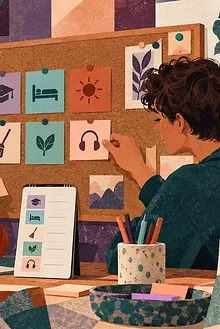
- Pictures, photos, symbols or written cards the child understands
- Removable tape, magnets or hook-and-loop dots
- One “change” card and one “not sure yet” card
Hand-drawn stick figures are enough. The schedule needs to be readable, not beautiful.
Choose the weekend anchors
Pick four to six events that are likely to happen: wake and breakfast, one outing or home activity, meal, quiet time, chores and bedtime. Do not add every snack and minute unless that level of detail genuinely helps the child. UNICEF suggests a light holiday rhythm rather than copying the full school day.
Build the board together
- Show the available cards.
- Place fixed events first.
- Offer one or two real choices.
- Add blank spaces for free play or undecided time.
- Review the sequence in simple words.
A young child can move one card. An older child can help choose the order or write their own card.
Show flexibility on purpose
Include a visible “plans can change” symbol from the beginning. If rain cancels the park, move that card and place the alternative while the child watches. Say what remains the same: “The park changed. Lunch and quiet time are still next.” Predictability does not mean pretending the day is controllable.
Use first–then for difficult transitions
When the whole board is too much, show only two cards: first grocery shop, then outdoor play. Remove or mark completed activities so the next step is easy to find. If the board is consistently ignored, use the troubleshooting in making a routine chart genuinely useful.
Protect unscheduled time
A blank space is not a planning failure. Children need self-directed play, rest and boredom that can grow into an idea. Label the space “choose” with a simple symbol if an empty square feels confusing. Avoid filling it automatically with lessons or errands.
Adapt for different ages
- Babies and toddlers: caregivers use the plan to protect meals, naps and calm transitions.
- Preschool: use photographs or clear pictures and only a few steps.
- School age: add small choices and a visible change card.
- Preteen: use time windows, shared responsibilities and protected private time.
- Multiple children: show common anchors plus separate choice cards rather than making one child’s activity the family default.
Avoid using the board as a threat
Do not remove a promised connection activity as punishment for unrelated behaviour. Do not point to the board instead of listening when a child is overwhelmed. A visual is a communication support, not evidence that feelings are invalid.
Try the plan for three weekends
After each weekend, ask what helped, what was too detailed and which change was hardest. Keep only the useful cards. If routines have been disrupted by travel or holidays, combine the board with this one-routine-at-a-time family reset. For weekday pressure, the school-morning plan uses the same principle of fewer decisions.
Make the board accessible
Place it where the child can see and reach it from their usual position. Use high contrast, uncluttered images, tactile objects or spoken review when needed. Photographing the board can help when the family leaves home, but a phone-only schedule may be unavailable when the device is charging or controlled by an adult. Choose the format that the child can actually consult, not the one that looks most polished.