- Make the space agreement first
- Gather a modest kit
- Five invitations for the week
- First visit: choose something worth returning to
- Second visit: play before adding more
- Third visit: try one change
- Fourth visit: let the story change the build
- Fifth visit: choose the next chapter
- A pause that helps you restart
- Adapt the invitation, not the child’s design
- Sources and further reading
By EdCaptain editorial desk · Published
A cardboard building is halfway made when it is time to clear the table. Your child wants to keep it; you need somewhere to eat. Instead of planning a different craft tomorrow, you could make room for several short returns to this one idea.
This flexible week is for children aged 3–8. It offers five invitations around a small, child-led build, with a plan for pausing and storing it. They need not happen on consecutive days, and there is no requirement to complete all five.
Make the space agreement first
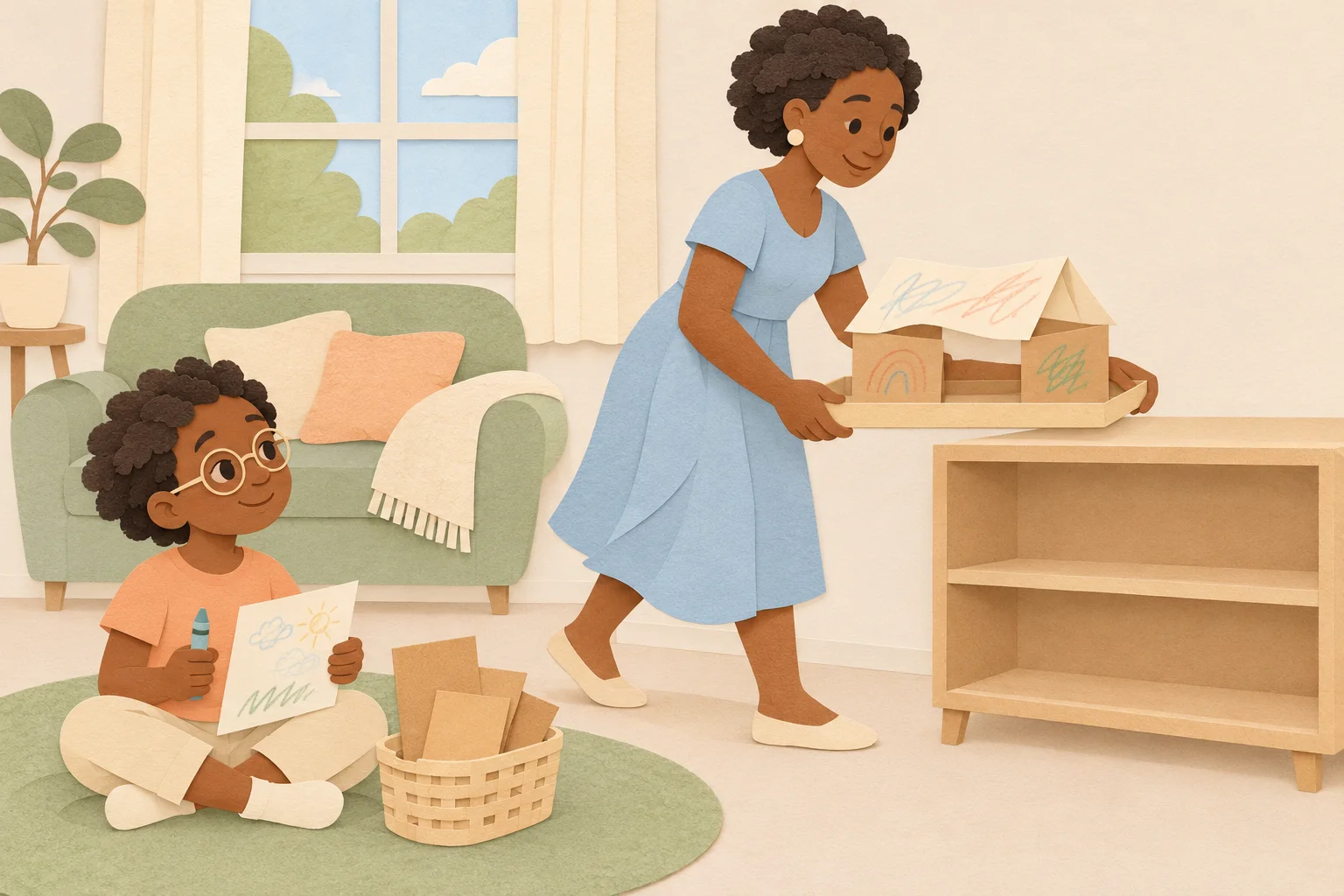
Choose a shallow, sturdy tray or a flat cardboard base that an adult can move safely. Agree where it can rest between sessions, away from heat, walkways and younger children who might pull pieces off. Keep the build small enough for that space. A protected patch of floor can work during play, but should not block a route through the room.
Try: “We can keep what fits on this base until our weekend check-in. Then we’ll decide what stays.” Promise only the storage you can actually offer. Do not quietly throw it away after telling the child it will be there tomorrow.
NAEYC’s guidance on tinkering and making recommends space for work in progress so children can revisit ideas over days. The plan below is one practical home application, rather than a prescribed programme or a promise of developmental gains.
Gather a modest kit
- A few clean, dry pieces of cardboard and one small open box, checked by an adult.
- Large paper pieces and chunky crayons or age-appropriate washable markers.
- A small amount of age-appropriate tape or glue, used according to its label.
- A basket for unused pieces and scrap paper for remembering ideas.
The adult removes staples, sharp edges, plastic packaging and cords before play. Make difficult cuts yourself away from the child, then put sharp tools out of reach. This plan needs no craft knife, hot-glue gun, electronics, magnets or tiny decorations in children’s hands.
Health Canada’s craft-safety guidance recommends age-appropriate supplies, close supervision, following labels and safe storage. Recheck the project before each return: damp cardboard, loose pieces or a torn edge may need removing. Keep craft materials away from food, and wash hands after use.
Build at miniature or tabletop scale. Cardboard is not a seat, climbing frame or a container to close around a person. An adult remains responsible for safe use, carrying and storage.
Five invitations for the week
First visit: choose something worth returning to
Offer the materials and ask what your child wants to make. A small pretend place, shelter or entirely unnamed arrangement is enough. Let them position a few pieces before attaching anything. If they want a model to copy, help them begin without making your version the standard.
Before stopping, ask which part should stay as it is. Put loose pieces in the basket and move the base to its agreed resting place.
Second visit: play before adding more
Bring the build back and ask, “What was happening here?” The child might make up a visitor, draw a paper character or simply rearrange the walls. Play can reveal what they want next; there is no need to decorate every surface.
Offer one practical kind of help: holding a piece while they tape it, or making an adult-only cut. Avoid adding a roof overnight to surprise them.
Third visit: try one change
Ask whether there is anything they want to change. Perhaps a paper character cannot fit through an opening, or a folded piece keeps falling. Let the child choose what matters. They can move, fold, remove or replace one part and try playing again.
Keep testing gentle and at the scale of the model. If there is no problem to solve, repeating yesterday’s play is a complete option.
Fourth visit: let the story change the build
Invite a new event: “Who might come here today?” Accept the child’s own plot—or no story. They might make a large paper sign, rearrange an entrance or describe something invisible. Do not require writing; marks, gestures, signs or a communication device can carry the idea.
If another child joins, ask before they alter an existing part. A separate piece beside the main build can hold a different idea.
Fifth visit: choose the next chapter
Look at what is there now. Ask, “What should happen to it next?” Options might include another play session, keeping one section, flattening reusable pieces or recycling damaged cardboard.
A private drawing or photograph, if the child wants one, can preserve a memory. Agree on the next storage decision rather than promising to keep everything forever. Ending does not require a polished model or a presentation.
A pause that helps you restart
At any visit, use the same short closing routine: choose what stays, put spare pieces away, remember one next idea, then let the adult move the build. The child can draw the idea, dictate it or choose not to record anything.
Leave a realistic warning before packing away and allow time for help. “We have to move this now; you can show me which side to hold” is clearer than starting to dismantle it while the child is still playing. Our guide to creative play with smaller clean-up offers more setup ideas.
Adapt the invitation, not the child’s design
Ages 3–5: offer a few large pieces at a time. The adult can hold, cut and carry; the child can choose a position, make marks or direct what happens. A flat arrangement is as valid as an upright building.
Ages 6–8: invite a quick sketch of the next change or a simple explanation of what happened when they tried it. Neither writing nor an independent build is required.
Use a stable, reachable surface and tools that fit the child’s grip. If sticky textures are unpleasant or attaching pieces is difficult, keep pieces movable or offer adult assistance with permission. Do not force touch or take over the decisions.
NAEYC’s process-art guidance values exploration and child choice over producing matching results. If interest fades, the weekly plan can end early. For a broader mix next week, use our balanced play plan. Returning to one idea is an option, not a test of persistence.
Sources and further reading
- NAEYC: planning for tinkering, making and works in progress
- NAEYC: process-focused art experiences
- Health Canada: arts and crafts safety
Read our editorial policy and health information guidance.