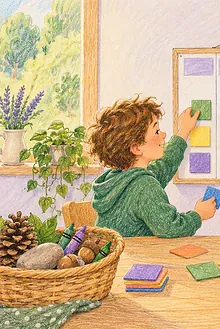
Some weeks contain illness, deadlines, disrupted sleep or simple exhaustion. Caregivers may still want moments of connection but cannot produce a craft table, a long outing or high-energy pretend play. Ten minutes can be enough for a real shared moment—provided it is not sold as a cure for stress or a test of good parenting.
The key is preparation once, then easy starts. Put a book, paper, crayons, rolled socks, two cups and a scarf in one basket. Keep it out of reach if any item is unsafe for a younger child.
Monday: sock-ball target
Place a laundry basket nearby and toss or roll three pairs of clean socks. Children can move the target, invent points or try from a seated position. Keep the floor clear and never use hard balls indoors. The caregiver can participate from a chair by returning the socks.
Tiny version: three rolls each. Accessible variation: bring the target closer, use a ramp made from cardboard or let the child direct another player.
Tuesday: two-page story
Choose a familiar book and read only two pages slowly. Ask the child to pick one picture to talk about, act out or change. If reading aloud is difficult, describe pictures together or use an accessible audiobook while following the page.
Tiny version: one picture. Older-child version: each person reads or invents one paragraph.
Wednesday: draw the sound
Sit by a window or in a safe outdoor place for one minute. Listen. Then make lines or shapes for the sounds: a long line for traffic, dots for rain, loops for birds. There is no correct picture. A child who does not draw can choose colours, point or record sounds with adult help.
Tiny version: notice three sounds without drawing.
Thursday: scarf transformation
Use one scarf or safe piece of fabric as a cape, river, picnic cloth or puppet blanket. The child chooses what it becomes. Avoid wrapping fabric around the neck, covering a baby’s face or using long loose fabric near stairs and equipment.
Tiny version: one transformation and one sentence of story.
Friday: three-question check-in
Ask: What was one hard thing? What was one okay thing? What should we do for five minutes this weekend? Children may answer with words, drawings, gestures or AAC. Adults can pass too. Do not force disclosure or use the answers as an interrogation.
Tiny version: choose between “quiet company” and “silly company.”
Make the plan easier to use
- Keep the basket in one known place.
- Choose a predictable window, such as after snack, but skip it when care needs are more urgent.
- Use a visible ending: one final toss, one last page, materials back in basket.
- Let children repeat a favourite instead of completing the weekly set.
- Do not ask an older child to run every activity for younger siblings.
UNICEF offers screen-free ideas across age groups, while Head Start recommends ordinary household materials and environments responsive to the child’s interests and need for quiet. Neither requires turning the home into a classroom.
When “low energy” needs more than a plan
If exhaustion is severe, persistent or accompanied by hopelessness, inability to manage basic care, thoughts of self-harm, or concern for anyone’s safety, seek timely professional and practical support. Activities are optional; food, medicine, sleep, safe supervision and help from trusted people come first.
On a somewhat better week, expand the basket into EdCaptain’s balanced weekly play plan. If the whole household needs lighter structure, the school-holiday rhythm shows how to use a few anchors without filling the day.
A short activity succeeds when it fits the people who are present. Ten calm minutes, three tosses or one shared page can be complete in itself.