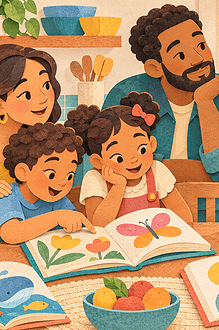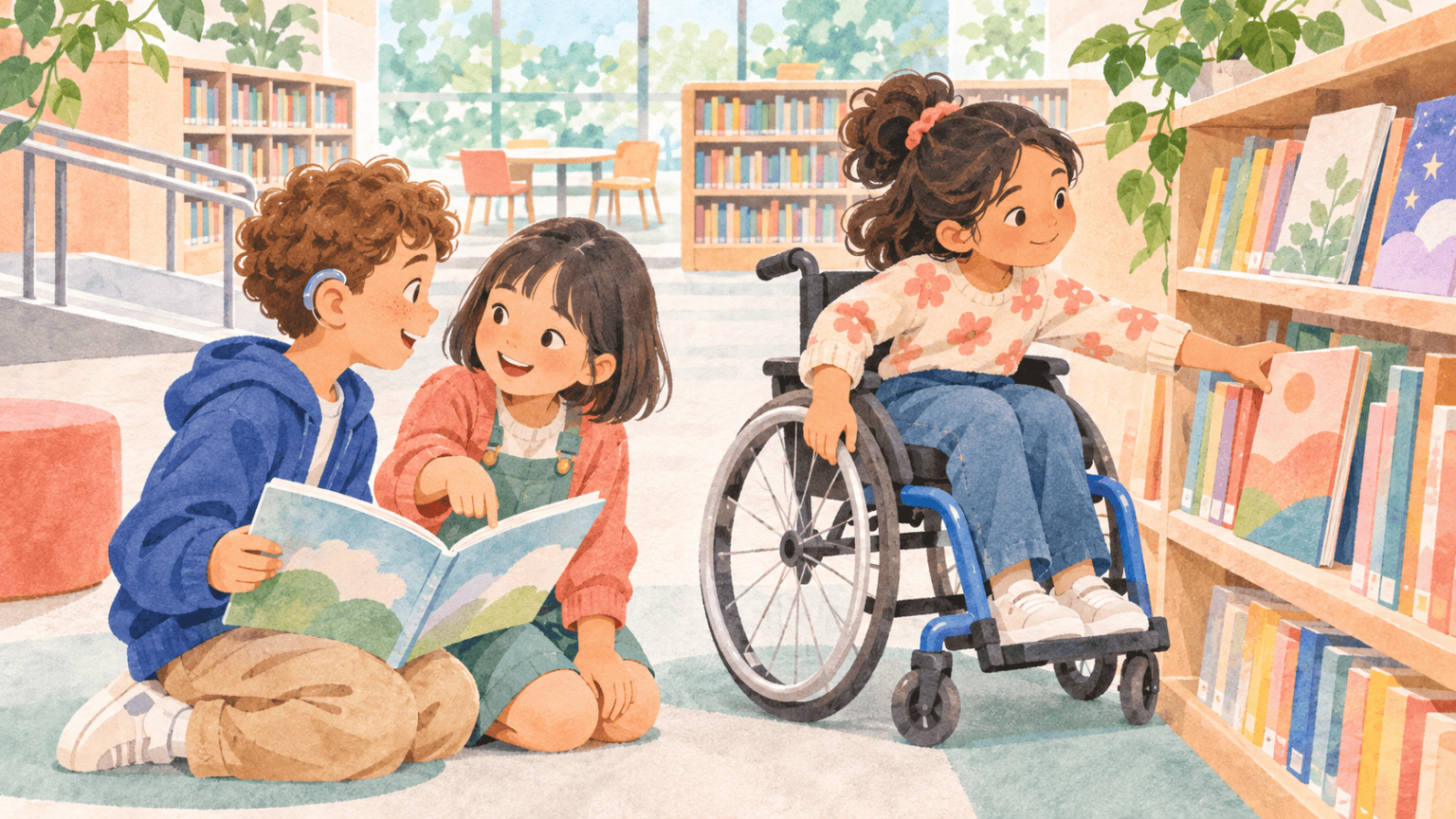
A book can include a disabled character and still offer a narrow message: the character exists only to inspire others, teach kindness or overcome a body. A stronger choice gives the character preferences, relationships, humour, mistakes and a life beyond the plot’s lesson.
Look for a person, not a symbol
Read the description and a few pages. Can you name something the character wants that is not “to be normal” or “to prove everyone wrong”? Do they influence the story, or do other characters make every decision? A disabled child can be adventurous, ordinary, grumpy, funny, talented or unsure without representing every person with the same disability.
- The character participates in family, school or community life.
- Support and access are shown without shame.
- Friends have mutual relationships rather than rescuing the character.
- The ending does not require a cure for the life to be valuable.
Check whose perspective shapes the story
Author and illustrator biographies may identify relevant lived experience, but identity alone does not guarantee quality and absence of a public disclosure does not prove a lack of experience. Use it as one piece of context. Reviews from disabled readers, librarians and specialist organizations can reveal stereotypes that a general review misses.
The Library of Congress disability-awareness guide offers titles with positive representation and everyday participation, while its accessible-reading catalogues show how first-person experiences and disability joy can appear across genres. Lists are starting points; preview the individual book because language and standards change over time.
Notice the language without demanding one universal rule
Some communities prefer identity-first language, such as “disabled person,” while others prefer person-first language or use both. Respect the language used by the character or community represented. Be cautious with pitying phrases, casual insults and descriptions that treat mobility aids, communication devices or support people as tragic burdens.
Historical books may use language that is now dated. If the book has other value, name the context rather than repeating the term casually. For a present-day read-aloud, choose language that children can use respectfully now.
Check the pictures as carefully as the words
- Look for accurate positioning and use of mobility or communication equipment.
- Notice whether the character is always isolated at the edge of group scenes.
- Check that facial expressions are varied, not permanently sad or heroic.
- See whether accessible environments are part of ordinary life.
- Reject images that use a visible disability as a visual joke or surprise.
Representation also includes disabilities that are not immediately visible. A book should not imply that someone must “look disabled” to need access, rest or support.
Choose a format the child can access
A good story is not inclusive if the intended reader cannot use it. Look for large print, ebooks with adjustable text, high-contrast pages, alt text, braille, audio, captions or symbol support as appropriate. EdCaptain’s guide to accessible reading for blind and low-vision children can help families plan format choices.
Read beyond “disability week”
Include disability-inclusive books across mystery, humour, fantasy, sport, family stories and nonfiction. A child should encounter disabled characters during ordinary reading, not only when adults want to teach empathy. Avoid asking a disabled child to explain or validate a book for the group.
If a story prompts a question, answer simply and avoid guessing about a real person’s body or diagnosis. EdCaptain’s article on spotting stereotypes in media offers a transferable question: who gets to act, decide and change?
Use a three-question family check
After reading, ask: “What did this character care about?” “What helped or blocked their participation?” and “What would change if the environment were designed differently?” These questions keep attention on a full person and on access, rather than turning the character into an object of pity.