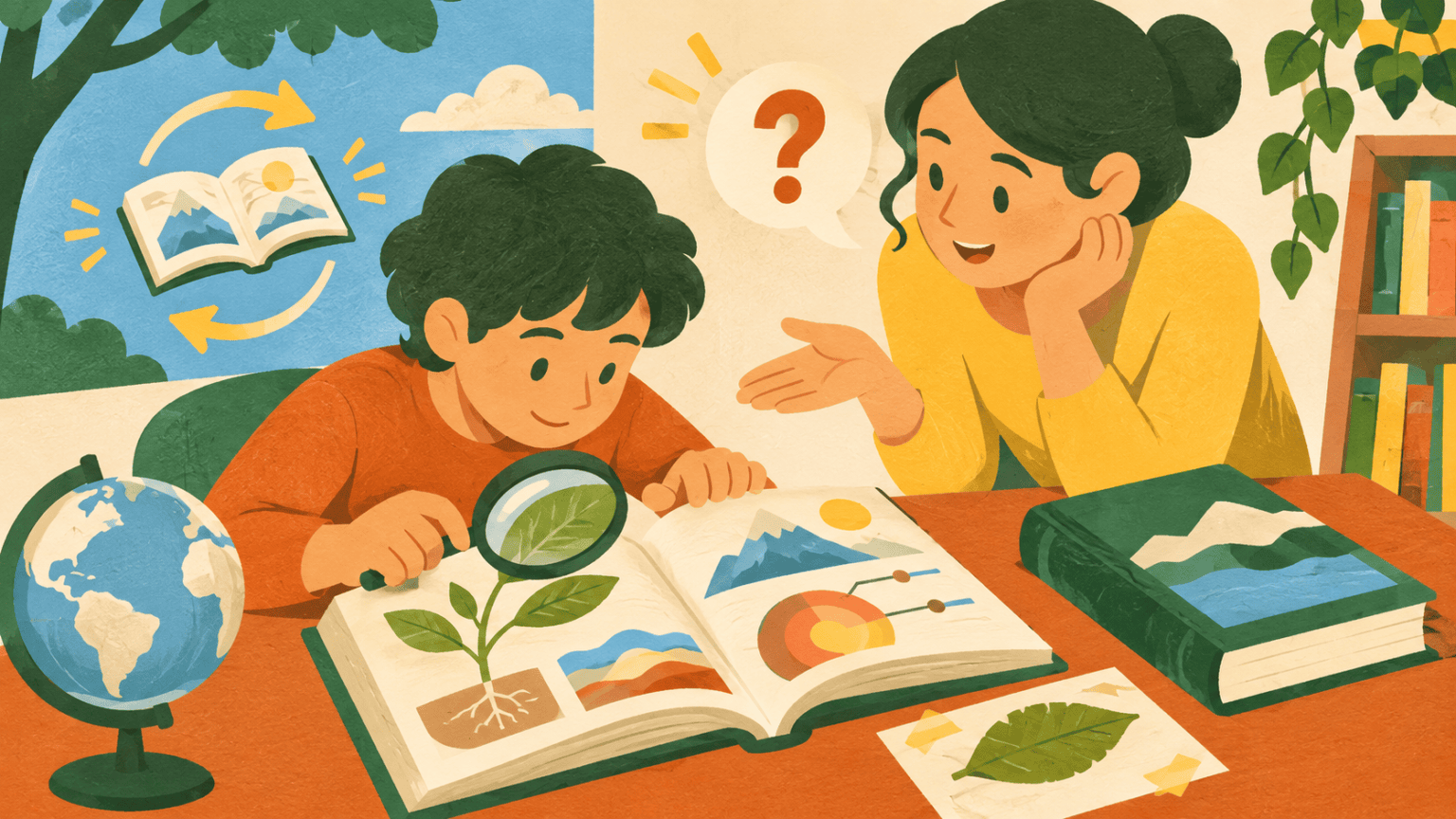
A strong nonfiction book does more than deliver facts. It helps a child notice where information comes from, compare ideas, use diagrams and return with a new question. The best choice is not always the book with the most facts or the brightest cover; it is one the child can navigate and interrogate.
Begin with a real question
Ask what the child wants to know: how bees communicate, why bridges stand, what happened in a historical period, or how the body heals. A specific curiosity makes it easier to compare books. For young children, choose a focused subject with clear photographs or illustrations. Older children can handle wider scope if the structure remains visible.
The Institute of Education Sciences recommends accurate informational books connected to children’s interests, with rich features and repeated discussion. Interest matters because children are more likely to reread and notice detail when the subject already invites questions.
Check the information trail
- Find the author and illustrator biographies.
- Look for a bibliography, source notes, image credits or expert consultation.
- Check the publication or revision date for fast-changing topics.
- Notice whether uncertain or debated points are presented honestly.
- Confirm that quotations and statistics have an identifiable source.
A bibliography does not guarantee accuracy, but it allows checking. For science, health, technology and current affairs, compare one key claim with a recent primary or authoritative source. A book can still be useful when a detail is outdated if the family names and corrects it.
Read the page design as part of the argument
Captions, maps, timelines, labels and diagrams should clarify the main text. Check whether a child can tell which caption belongs to which image. Decorative spreads can be attractive but confusing if facts float without sequence or scale.
Try one page aloud. Define no more than two or three essential new words at a time. A glossary is helpful when it explains terms in child-friendly language rather than merely repeating the sentence. For a child who uses text-to-speech, check whether headings, captions and image descriptions are accessible; EdCaptain’s guide to text-to-speech reading support explains what to test.
Watch for false certainty and missing perspective
Good nonfiction separates observation, evidence and interpretation. History books should identify whose records survive and whose voices may be missing. Nature books should avoid giving animals human motives as though those motives were measured. Health books should not turn normal variation into a rigid deadline or promise a universal result.
- Choose one sentence that sounds important.
- Ask, “How could the author know this?”
- Find the source note or compare another reliable source.
- Look for a date, place or group that limits the claim.
- Write one question the book does not answer.
This is not about distrusting every author. It teaches that reliable information leaves a trail and that knowledge can become more precise.
Plan for purposeful rereading
On the first reading, follow the child’s curiosity. On the second, use a feature such as the timeline or map. On a later visit, compare a diagram with a real object, local observation or another book. The IES shared-reading guidance recommends varied books, conversation and purposeful rereading rather than racing through titles once.
EdCaptain’s guide to building reading comprehension through real life offers ways to connect information to cooking, journeys and everyday problem-solving.
Match depth to the child, not a marketing age
A younger child may enjoy a detailed book when an adult selects a few pages. An older child may need a visually simple introduction to an unfamiliar subject. Choose a book that allows participation now and room to grow. Avoid using a quiz score as the only sign of understanding; drawings, models, questions and explanations can show what the child took from the text.
Use a small library, not one “perfect” authority
Pair books that approach the same subject differently: a photo essay, diagram-rich explanation and first-person account. Comparing them exposes choices about evidence, language and perspective. The goal is not to collect facts passively, but to help the child become an active reader who can ask what a book shows, how it knows and what remains open.