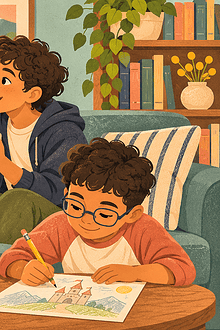
A family audiobook has to work for more than one listener. The youngest person needs enough support to follow it, older listeners need something worth noticing, and the adult needs to know what is coming. A familiar title is not automatically a good audio match: narration, pacing and listening context can change the experience.
Choose for the listening situation
Decide whether the book is for a 20-minute school run, a long journey, quiet drawing time or bedtime. Short chapters and a clear plot are easier when listening is interrupted. A complex cast, frequent time shifts or heavy world-building may work better when the family can listen in longer stretches.
- Check the total running time and chapter length.
- Confirm whether the app keeps the family’s place reliably.
- Look for offline access before travel.
- Turn off autoplay so a different title does not begin unexpectedly.
If listening happens in a car, the driver should set up playback before moving. EdCaptain’s guide to setting up family audio without distracting the driver applies equally to audiobooks.
Listen to the sample together
A narrator’s speed, accent, character voices and sound effects can delight one child and overwhelm another. Play the sample through the speakers or headphones the family will use. Ask simple questions: “Can you tell who is speaking?” “Do the music and effects help or distract?” “Would you want to hear another five minutes?”
For children who process speech slowly or are learning the language, an adjustable playback speed can help. Slower is not always clearer because stretched audio may sound unnatural; test small changes. A print or ebook copy can support names, maps and unfamiliar words, but it is optional.
Preview content beyond the age label
Publisher age ranges are broad. Read a full synopsis and check for themes that matter to your family: bereavement, violence, discrimination, frightening creatures, family separation or romance. Consider not only whether a topic appears, but how intensely and how long it lasts.
When a story includes a difficult theme, decide whether shared listening creates a useful chance to pause and talk. A child who becomes distressed should be able to stop without losing a privilege. EdCaptain’s article on helping a child after frightening audio offers a calm response plan.
Keep listening active but relaxed
- Before starting, name the main characters and setting.
- Pause at natural breaks rather than testing after every scene.
- Invite one prediction or observation.
- Let children draw, build or move quietly if that helps attention.
- Recap the last chapter before the next session.
The American Academy of Pediatrics notes that audiobooks can support vocabulary, story structure and engagement. They are a valid way to experience a book, but they do not replace a beginner’s need to practise decoding print. Families can value both without ranking one as “real” reading and the other as cheating.
Make access work for everyone
Check whether the platform offers sleep timers, bookmarks, transcripts or synchronized text. A child with hearing loss may need captions or a print copy; a blind or low-vision listener may benefit from accessible library services and simple controls. Public libraries often provide licensed audiobooks without a separate subscription.
Use a one-chapter trial
Borrow or sample before purchasing when possible. After one chapter, ask what each person understood and whether they want to continue. If the choice does not work, changing books is useful information, not a failure. The aim is a shared story the family can inhabit together—not finishing every title selected by an algorithm.
Sources and further reading
- HealthyChildren: Reading and Audiobooks for Children
- IES: Toolkit for Reading Comprehension and Engagement
Share the choice next time
After finishing or stopping, let each listener name one feature they would keep and one they would change: the narrator, length, humour, complexity or theme. Use those observations to choose the next sample together. This builds a family listening profile without letting a platform’s recommendation system decide what follows.