You do not need a garden, a forest or expensive instruments to notice weather. A safe window, sheltered doorway or balcony can offer changing light, clouds, wind, sound and temperature. A small observation pack keeps tools together so the activity can begin in two minutes and end without becoming homework.
Choose one reliable observation spot
Pick a place an adult has checked. Windows should have secure guards where needed; children should not lean out. Balconies need close supervision and locked access when not in use. Never observe lightning from an exposed area, and do not ask children to handle glass thermometers or climb for a better view.
If outdoor access is difficult, observe entirely from inside. Notice moving branches, rain on glass, clothing people wear, shadows on a wall or sounds from outside.
Pack only what you will use
- A clipboard or firm recycled cardboard
- Plain paper and thick pencils
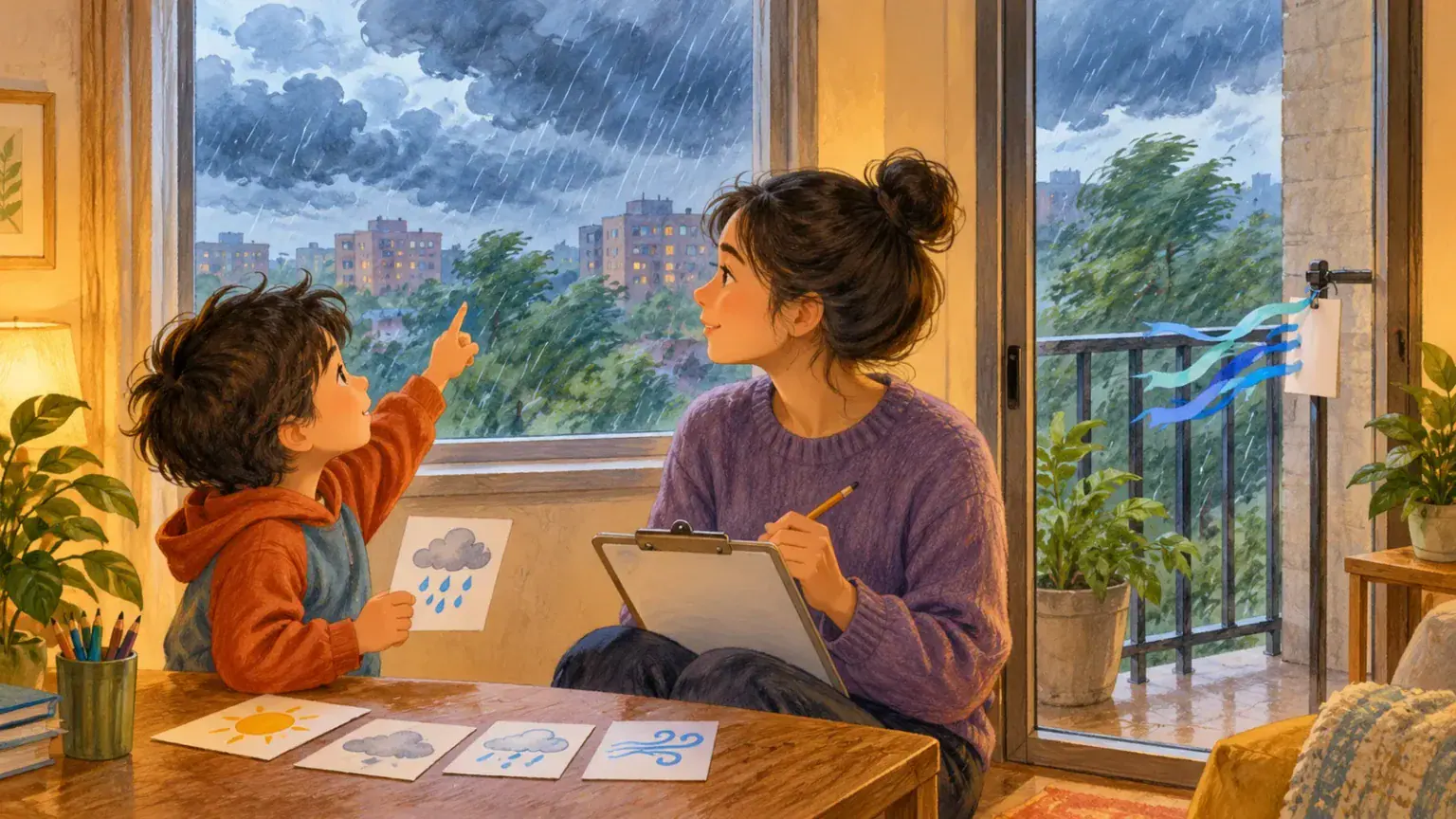
- Four cards: bright, cloudy, rainy and windy
- A ribbon fixed securely to a short card—not tied to a railing or left as a loose cord
- A simple thermometer designed for safe household use
- A timer if one is already available
- A transparent sleeve for yesterday’s observation
Skip complicated charts at first. The pack is for noticing and comparing, not producing perfect data.
A five-minute observation
- Look and listen quietly for thirty seconds.
- Choose or point to a weather card.
- Notice one change: “The shadow moved,” “I hear harder rain,” or “The ribbon is still.”
- Record by drawing, marking a symbol, dictating, photographing the sky without people, or using AAC.
- Compare with a previous day and finish with one question to revisit.
For younger children, name what is observable rather than explaining atmospheric science. School-age children can estimate, then check, temperature or count how often a cloud covers the sun in a short interval. Teens may design a consistent scale or compare an official local forecast with what they observe.
Let uncertainty stay visible
Weather changes. If the card says “sunny” and rain begins, that is not a wrong answer; it is new information. Say, “Our observation was true at 9:10. What changed?” This makes revision ordinary rather than embarrassing.
Harvard’s activities guide describes games as age-appropriate practice for attention, working memory and self-regulation. A weather pack may offer those opportunities, but it is not an assessment and does not guarantee an outcome.
Adapt for sensory and mobility needs
A child sensitive to glare can observe from shade. Someone distressed by thunder can use the pack on calm days or focus on indoor light and clothing choices. A child with low vision might attend to temperature, sound or air movement; a Deaf child might track movement, light and vibration. Use the child’s usual access tools.
For limited stamina, split the activity: choose a card now and record later. A child who dislikes handwriting can make one mark, move a clip, or speak into an adult’s notes. The activity remains valid when the recording method changes.
Leave nature where it is
The pack does not require collecting leaves, insects, nests or stones. Observe from a respectful distance and avoid feeding wildlife. If a child wants a keepsake, draw or photograph the observation instead.
Keep a humane record
Review the pages after a week and ask what the child wants to notice next. Do not grade spelling, drawing or forecast accuracy. Keep images free of neighbours and identifying details. Recycle pages the child does not want; a growing folder is optional, not the point.
Adapt EdCaptain’s small-space nature week, and read help children enjoy wildlife without disturbing it.
Choose questions that can wait
Good observation questions remain open: “Does this shadow reach the chair every afternoon?” or “Which direction does rain hit the glass?” Write them on a card and return another day. If the child loses interest, leave the question unanswered. Curiosity does not need a completed chart, and adults do not need to supply a scientific explanation they have not checked.