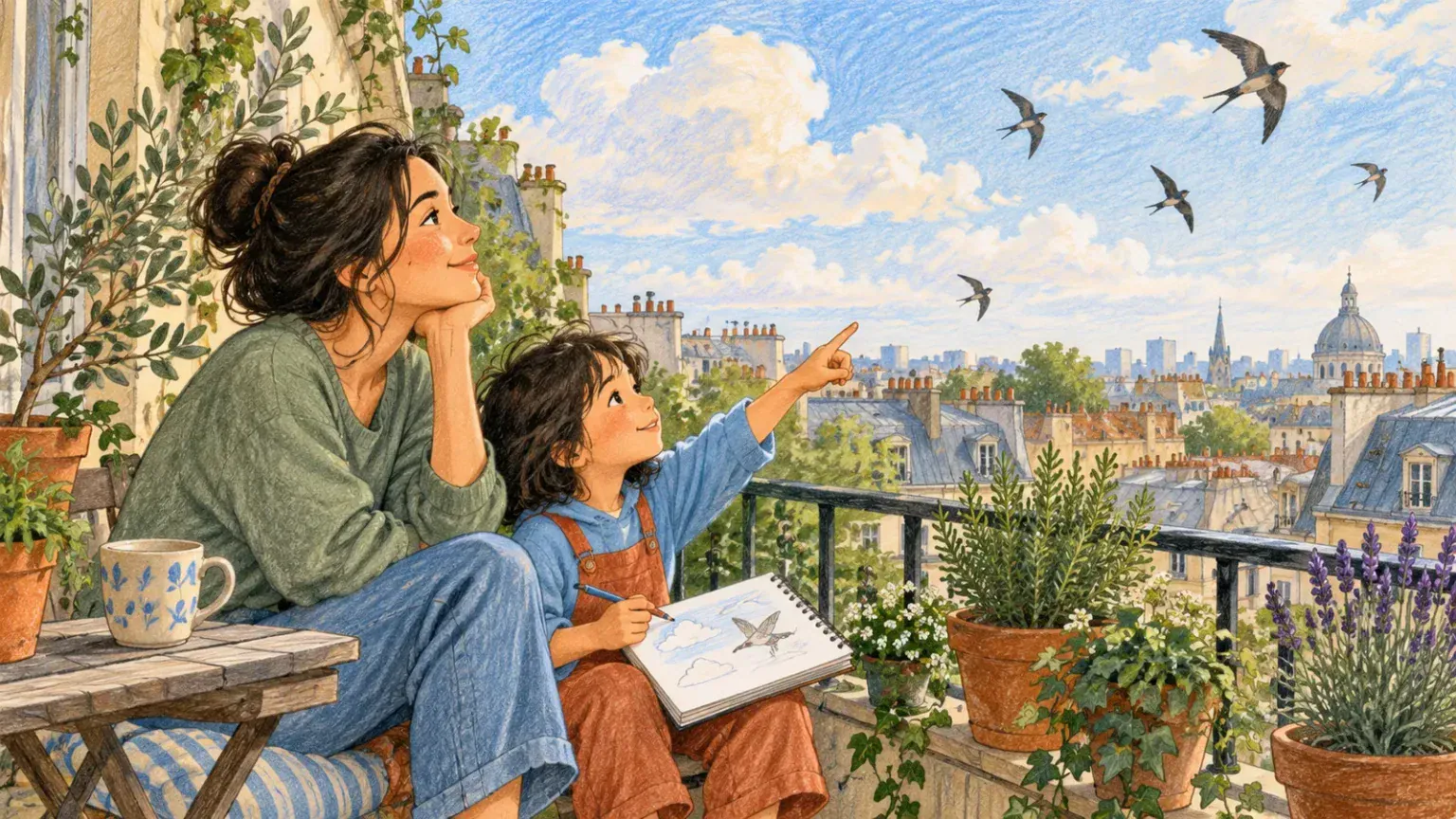
Nature play does not require a forest, a car journey or permission to pick living things. A balcony, doorstep, pavement tree or view from a window can support a week of careful noticing. The plan below uses the same small place repeatedly so children can spot change: a shadow moves, a bird returns, a leaf uncurls or a cloud alters the light.
Choose the observation spot
Pick a place where an adult can supervise safely. On balconies, keep furniture away from railings and never allow climbing. Near roads or shared driveways, mark a clear boundary and hold hands where needed. Check heat, cold, air quality and weather. Teach children to look before touching; unknown plants, insects and animal waste should be left alone.
Bring a pencil, scrap paper, a firm book to lean on and water to drink. Do not require a “nature journal.” A few marks, a photo taken by an adult or a spoken observation are all valid records.
Monday: Find five colours
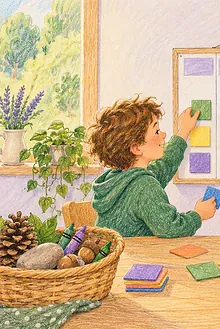
Look for five colours in the sky, walls, plants, stones, lichens or light. Young children can point and match crayons. School-age children can compare shades—olive, lime, blue-grey—or notice which colours are human-made. Older children can create a small palette of colour swatches. Leave plants and stones in place; the aim is observation, not collection.
Tuesday: Make a sound map
Sit for two minutes and place a dot in the middle of the page for yourself. Add marks around it for sounds: a bird above, traffic to the left, wind behind. Children who dislike unexpected sound can watch from indoors, wear comfortable hearing protection or choose a shorter interval. Ask, “Which sound was near? Which was far?” rather than asking everyone to be silent for a long time.
Wednesday: Follow one shadow
Trace the shadow of a pot, railing or stick with chalk where permitted, or draw it on paper. Return later and compare. Do not look directly at the sun. A younger child can stand on their own chalk outline while an older child predicts the direction of movement. If the day is cloudy, compare bright and dim patches or watch a reflection instead.
Thursday: Watch one living visitor
Look for a bird, ant, spider or flying insect without chasing, feeding or handling it. Notice how it moves and where it pauses. A child may invent a respectful “field name” and sketch its path. If no animal appears, examine a plant bud, moss patch or weather pattern. The activity still works.
Friday: Make a tiny place map
Draw the observation area from above. Preschoolers can place shapes for “door,” “pot” and “tree.” Children aged 6–9 can add a route and a key made of pictures. Older children can mark shade, sound or where rainwater travels. Compare Friday’s map with Monday’s memories: what do you notice now that you missed before?
Keep the week light
Ten attentive minutes are enough. On a difficult day, look through the window and name one change. The ten-minute low-energy plan has other compact ideas, while the balanced weekly plan can help you mix nature noticing with movement, making and rest. If changing weather disrupts the plan, use the approach in showing an unexpected change on a visual schedule.
Make participation accessible
A child can observe seated, use binoculars only with supervision, dictate notes, take an audio recording or choose between two prompts. For low vision, focus on texture, temperature and sound without touching unknown substances. For limited speech, offer picture choices such as bird, plant, sky and vehicle. Do not turn observations into a quiz.
At the end, ask: “What should we look for next week?” Repeated attention to a modest place can make it interesting. The value lies in curiosity and shared noticing, not in the size of the landscape.