- Start with a wall, not a theatre to build
- Put only these materials in the folder
- Design for the outline you will actually see
- Agree three moments, not a script
- Rehearse a short entrance and ending
- Fix the stage problem before adding detail
- Let roles fit the children
- Keep the pack ready for another story
- Sources and further reading
By EdCaptain editorial desk · Published
A beautifully coloured paper bird can become an unrecognisable blob on the wall. The shadow does not show the red feathers or the carefully drawn eye. It shows the outline—and that changes how you prepare a puppet story.
This shadow-story pack for ages 6–12 keeps the materials small: two simple characters, a few story cards and an adult-managed flashlight. The aim is a brief performance you can repeat or change, with no requirement to speak, memorise lines or entertain an audience.
Start with a wall, not a theatre to build
Choose a plain pale wall and a clear place to sit facing it. Keep enough room light to see faces, materials and the route out. You can reduce competing light a little, but do not black out the room or make anyone stay in darkness they dislike.
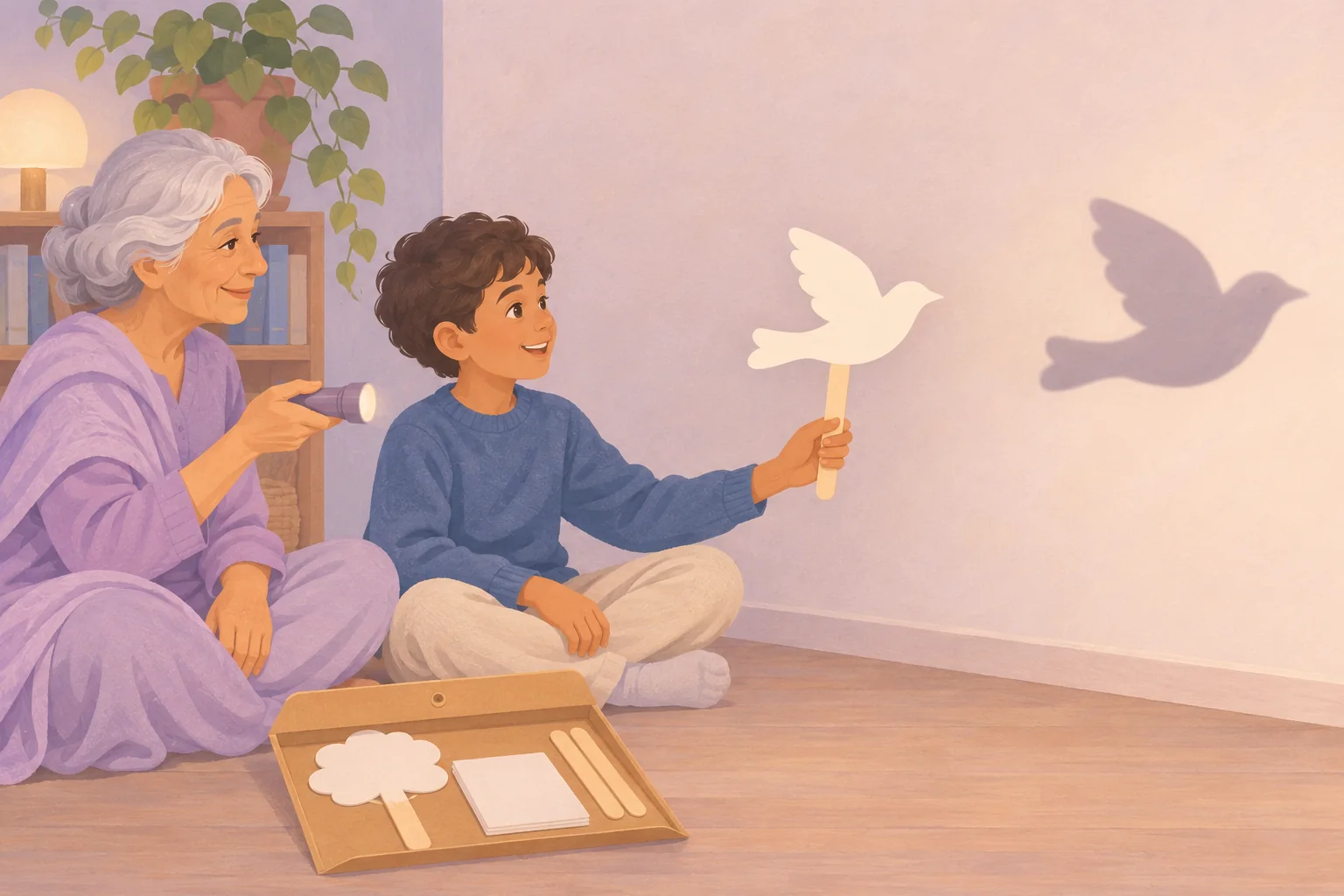
Use a modest battery-powered LED flashlight that stays cool in normal use. An adult checks its condition and securely closed battery compartment, operates it and handles all battery changes. Keep loose batteries out of the play pack. Do not use candles, lasers, hot lamps or flashing modes. Point the light at the wall, away from eyes, reflective surfaces and anyone entering.
Questacon’s shadow-puppet activity warns that some lights get hot and calls for adult setup. A wall also avoids the extra supports and hanging fabric of a homemade screen. Sit or stand comfortably; no climbing on furniture to reach the projected picture.
Put only these materials in the folder
- Two large paper or thin-card silhouettes with different outlines.
- Two broad, smooth craft-stick handles with rounded ends.
- Paper tape for an adult to attach the handles securely.
- Three small drawing cards and one blank card for a new idea.
- A flat folder or shallow box with a separate space for the puppets.
Keep the flashlight in its normal safe storage place, with a note in the folder saying where the adult can find it. If preparing new puppets, add paper, pencil and age-appropriate scissors for supervised use. Adults handle difficult cuts; skip craft knives, pointed skewers, split pins and tiny decorations.
The Ballard Institute and Museum’s paper-shadow workshop, recommended for ages six and up, uses simple household materials and does not require a separate fabric screen. Here, broad handles replace sharper alternatives.
Design for the outline you will actually see
Let the child choose two characters with noticeably different shapes: perhaps a bird with a broad beak and a tree with a round canopy. Draw large forms without thin legs, delicate feathers or narrow branches that will tear. A plain shape is easier to handle than an elaborate cut-out.
Tape each handle to the back, leaving enough exposed below the shape for a comfortable grip. Check for rough edges or splinters and replace damaged handles. There is no need to cut eye holes or add moving joints in the first pack.
Before making more characters, project one. Put the puppet between the light and the wall, with its broad face towards the wall. Check whether a seated viewer recognises it. Turn it sideways briefly: its shadow becomes much narrower. Return it to the useful position and let the child practise that orientation.
Agree three moments, not a script
On the cards, draw a beginning, a change and an ending. For an original little story: a bird reaches a tree; a gust makes it difficult to land; the bird finds a sheltered branch. The drawings are reminders that stay beside the performers, not things to project.
Ask, “Which part would you like to control?” One person might move the bird, another hold the tree, and an adult manage the light. A narrator is optional. Wing movements, a pause and a final landing can tell the story without dialogue. Avoid turning fiction into a lesson about a particular child’s behaviour.
Rehearse a short entrance and ending
- Check the space. Clear the floor and choose comfortable positions. The adult aims the light before puppets enter.
- Test the outline. Hold one character in the beam. Adjust its angle until its shape reads clearly.
- Find the edge. Move it slowly in from the side of the lit area, then back out. Agree where it waits offstage.
- Play the three moments. Use the cards to remember what changes. Pause between events so the viewer can follow.
- Make the ending visible. Let the bird settle, then bring the puppets out of the beam. There is no need for a bow.
- Reset together. Turn up the room lighting before anyone moves to collect materials.
Try one run lasting a minute or less. Ask whether the child wants to repeat, change something or stop. The adult keeps the light steady rather than chasing the puppet around the room.
Fix the stage problem before adding detail
If a character becomes huge, move it nearer the wall while leaving the light in place. Questacon explains that an object nearer the light casts a larger shadow. If two shapes merge, separate them or let only one enter at a time. If a hand dominates the picture, try holding the handle lower or moving the puppet in from the side.
A coloured drawing on opaque card will not appear as coloured detail in its shadow. Work with the silhouette instead of promising that extra colouring will solve the problem. For a separate investigation of size and direction, see our shadow laboratory; this pack’s job is to keep a short story readable.
Let roles fit the children
Ages 6–9: begin with one moving character and an adult-held setting. Offer a single action such as arriving or hiding. Let a familiar sequence stay familiar.
Ages 10–12: invite the child to plan entrances, direct another performer or tell the same event from a different character’s viewpoint. More puppets are optional, not a sign of a better performance.
Keep handles within comfortable reach. A partner can move a puppet under directions given by speech, pointing, signing or AAC. For a child who cannot readily see the shadows, offer the safe physical shapes to explore and describe the action; they can direct or narrate without being tested on visual recognition. Watching, listening and passing are all valid choices.
Keep the pack ready for another story
Ask one practical question: “Could you tell when the bird landed?” Let the child decide what to change. Lay puppets flat, protect projecting parts and store cards separately so tape does not catch them. Adults inspect handles and attachments before the next use.
Our low-mess art-pack guide can help when making replacements away from home. Keep favourites rather than refilling the folder after every show. An unfinished story can wait on its cards.
Sources and further reading
- University of Connecticut, Ballard Institute and Museum: shadow-puppet workshops — materials and paper-shadow performance.
- Questacon: Shadow Puppets — light setup, outlines and shadow size.
Read our editorial policy.