A boredom pack stops working when it becomes a museum of forgotten worksheets or another job for the adult. For school-age children and teens, the useful skill is not merely choosing from a box. It is noticing what helps, retiring what does not, and rebuilding the pack within clear limits.
Define the pack’s job
Choose one purpose: “something to start when I want an idea,” not “a cure for every complaint.” Boredom can be uncomfortable and still leave room for daydreaming, rest or self-directed play. The pack is an option, not a demand to stay productive.
Agree on size, storage and budget. One shoebox, pouch or drawer is enough. State which household materials may be replenished and which need an adult’s permission.
Begin with four lanes
- Make: paper, pencils, recycled card and a prompt such as “design a tiny room.”
- Solve: a reusable puzzle, deck of cards or child-written riddle.
- Move: three safe movement cards suitable for the space and neighbours.
- Pause: a book, music choice, breathing card or permission to do nothing.
Do not overload each lane. Two choices are enough for the first week. Use age-appropriate materials and keep hazardous tools, magnets, batteries and small pieces away from younger children who share the home.
Give the child the maintenance role
- Once a week or month, empty the pack onto a clear surface.
- Sort each item into used, still curious, rest or retire.
- Check damage, missing pieces and safety.
- Refill only the lane that is empty or stale.
- Write one new prompt, then close the pack.
An adult holds the safety and spending boundaries. The child decides preferences. Ownership does not mean buying supplies or entertaining siblings.
Write prompts that open rather than command
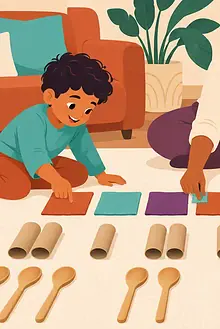
Try “Find three uses for a paper tube,” “Make a rule for a game with five cards,” or “Create a playlist for a ten-minute reset.” Avoid school-like tasks presented as a trick. Teens might choose photography, sketching, a mini repair, music, journaling or a self-designed strength challenge.
Harvard’s activities guide describes age-appropriate games as opportunities to practise attention, working memory and self-control. The American Academy of Pediatrics highlights play and simple materials. A boredom pack may offer practice and enjoyment, but it is not a treatment for low mood, attention difficulties or school problems.
Make access ordinary
Use pictures, large print or tactile labels. Keep tools within comfortable reach. A child can record prompts by voice, use AAC, ask an adult to write, or choose from two cards. If decision-making is tiring, leave one familiar “default” activity in the pack.
When the pack is not the answer
Do not redirect every bid for connection to the box. Sometimes “I’m bored” means “I want you,” “I am lonely,” “This is too hard,” or “I need a break.” Respond to the need before offering choices. Persistent loss of interest, withdrawal or distress deserves attentive conversation and, when appropriate, qualified support.
Keep it sustainable
Borrow, rotate and reuse before buying. Retire damaged items and recycle only when appropriate. The best measure is not how often the pack is used; it is whether the child can approach it without pressure and change it when it no longer fits.
For a broader choice structure, see the child-led weekly choice board. For screen-free waiting, use the portable waiting pack.
Use a fair refill rule
Agree that one item enters when one item leaves, or set a small monthly refill envelope. Free options—library books, reused card, copied family recipes, household repair tasks and child-written prompts—can keep the pack fresh. Do not tie refills to grades, behaviour or finishing every old activity. The maintenance habit should support agency, not become another reward chart or source of waste.