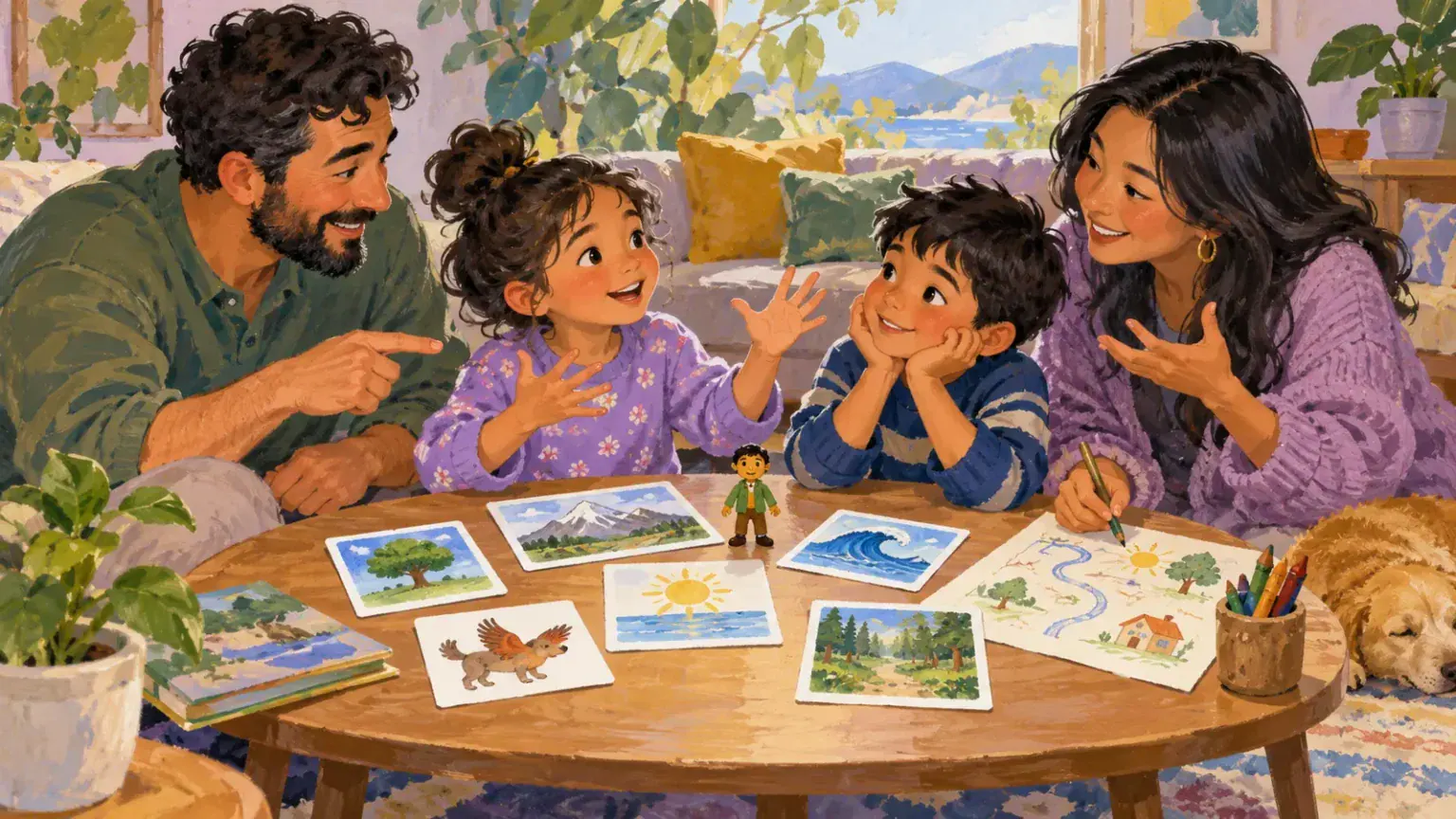
A family storytelling pack does not need a “main” language. It can hold the words, gestures, signs, sound effects and communication systems people actually use. A child might begin in one language, borrow a phrase from another, point to a picture and finish with a sound. That is a story—not a failed translation exercise.
Build the pack from familiar life
Collect eight to twelve simple picture prompts: a bus, cooking pot, rain cloud, dog, shoe, grandparent, key, market, tree or blanket. Draw them or cut large, clear pictures from clean packaging. Add blank cards for family-specific ideas. Avoid children’s photographs unless everyone pictured agrees and the pack remains private.
Include a small cloth, two safe figures, paper and drawing tools. For a child using AAC, add copies only if that fits their existing communication plan; the pack sits alongside their usual system, not replaces it.
Invite, do not examine
Spread out three pictures and ask, “Which one starts today’s story?” Follow the choice. Useful prompts include:
- “Then what happened?”
- “Show me where they went.”
- “What sound belongs here?”
- “Would you like a word, picture or gesture?”
- “Should I tell the next part in my language?”
Avoid “What is this called in the other language?” unless the child enjoys it. Correcting grammar every turn changes play into performance. If meaning is unclear, try, “I think the dog is hiding—is that right?” and accept correction.
Make room for language mixing
Write family words on card backs in the scripts people use. Add pronunciation cues only when wanted. A child can dictate while an adult writes; a relative can record an audio version outside the pack if privacy and device use are agreed. No language needs to appear on every card.
The American Academy of Pediatrics describes pretend play as a setting for cooperation, communication and language. Harvard’s guidance emphasises back-and-forth interaction and age-appropriate independence. These sources support rich opportunities, not vocabulary tests or promises of accelerated development.
Try four story structures
- Three-card journey: choose a character, place and surprise.
- Same picture, two stories: each person gives the rain cloud a different meaning.
- Pass the pause: stop after one action and let someone point to the next card.
- Family remix: begin with a familiar routine, then add one imaginary change.
Older children can add motives, viewpoints or an ending told by another character. Younger children can repeat a favourite sequence. A child who prefers predictability can keep the same cards while changing one detail.
Keep participation safe and voluntary
Do not use the pack to pressure a child to disclose school problems, migration experiences or family conflict. Fiction can remain fictional. Let a child pass, watch, or choose a silly ending. If relatives laugh at an accent or mistake, stop and reset the rule: every family language and communication style deserves respect.
Refresh without discarding the child’s voice
Every few weeks, ask which cards should stay, rest or be replaced. Keep favourites so the pack feels recognisable. Store written family details privately. A pack becomes richer through shared use, not by owning more materials.
For emotion words, see multilingual emotion cards. For a wordless option, try the wordless sequence-card story puzzle.
When relatives want a translation
Ask the child first: “Would you like me to explain, or should the story keep going?” An adult can summarise without correcting: “The character is looking for home.” If the child does not want translation, relatives can respond to tone, pictures and action. This protects the child’s authorship and prevents one family language from becoming the language that always has to justify itself.
Keep a blank card for a word that has no easy equivalent. The family can draw, gesture or describe it rather than forcing a neat translation.