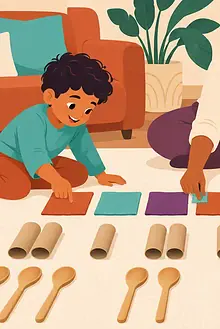
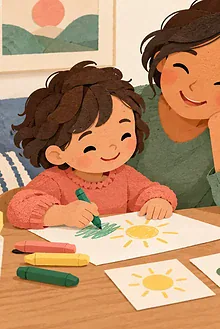
One activity pack can work for siblings of different ages, but not if “fair” means giving everybody the same task. A preschooler may want to move pieces and invent a story. An older child may enjoy planning, writing or changing rules. The pack works when those contributions belong to the same game without making one child the teacher, referee or babysitter.
Choose a shared mission
Start with a goal that can be completed in many ways: build a bridge for a toy, create a town from paper shapes, rescue three pretend animals, or design a route across the table. Avoid a worksheet with one right answer. A shared mission leaves room for talking, moving, drawing and building.
Play can offer practice with planning, language, cooperation and emotional regulation, according to the American Academy of Pediatrics. That does not mean siblings must cooperate beautifully. The pack should make repair and separate participation possible when energy or interests diverge.
What to put in the pack
- Large paper shapes or index cards
- Painter’s tape for an appropriate surface
- Chunky washable pencils or crayons
- Two or three large toy figures
- A die with dots or homemade action cards
- A cloth for defining the play area
- Three blank “change the game” cards
Choose materials for the youngest child who can reach the pack. Remove small pieces when a younger sibling mouths objects and follow age and safety information. Store scissors and staplers with the adult.
Offer parallel roles, not a hierarchy
For a bridge mission, one child can test what fits underneath, another arrange supports, and another draw a sign. For a story mission, a younger child can choose the character, an older child can dictate a challenge, and everyone can add an action. Say, “Choose a role, swap it, or invent another,” instead of assigning the oldest child to help everyone.
If one child wants to work alone, place two sheets side by side and connect them at the end. Parallel play still counts. Harvard’s age-based resources recognise that adult involvement and children’s independence change over time; siblings do not need identical participation.
Three rules that fit on one card
- People may join, watch or take a break.
- Ask before changing someone else’s part.
- If the mission stops being fun, pause and choose: repair, separate or pack away.
Keep rules about process rather than who is “good.” If arguments begin, describe the conflict: “You both want the same card.” Offer workable options. Do not force an apology while everyone is upset.
Adjust challenge without ranking children
Add complexity to the role, not status to the child. A younger player might match colours while an older player makes a repeating pattern. One child might roll once; another can decide how to use the result. A child with limited fine-motor control might direct placement, use larger pieces or choose between two options. A nonspeaking child can point, use eye gaze, signs or usual AAC.
Close with a two-minute reset
Take a photo only if everyone agrees, return pieces to labelled pouches, and let each child name one part to keep or change. Retire activities that repeatedly cause competition. The goal is not to prove siblings can share everything; it is to provide a structure where several kinds of participation are legitimate.
For a longer rhythm, use the mixed-age sibling weekly plan. After difficulty, the sibling repair script can help once everyone is calm.
If one child dominates the mission
Pause and reduce the number of decisions available at once. Give each child a protected area or turn, but do not require equal speaking time. An older sibling can have a more complex private challenge while the shared goal continues. If the same imbalance repeats, run two linked activities instead of insisting the pack must unite everyone. Cooperation is an invitation, not a measure of sibling love.