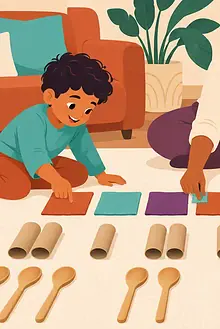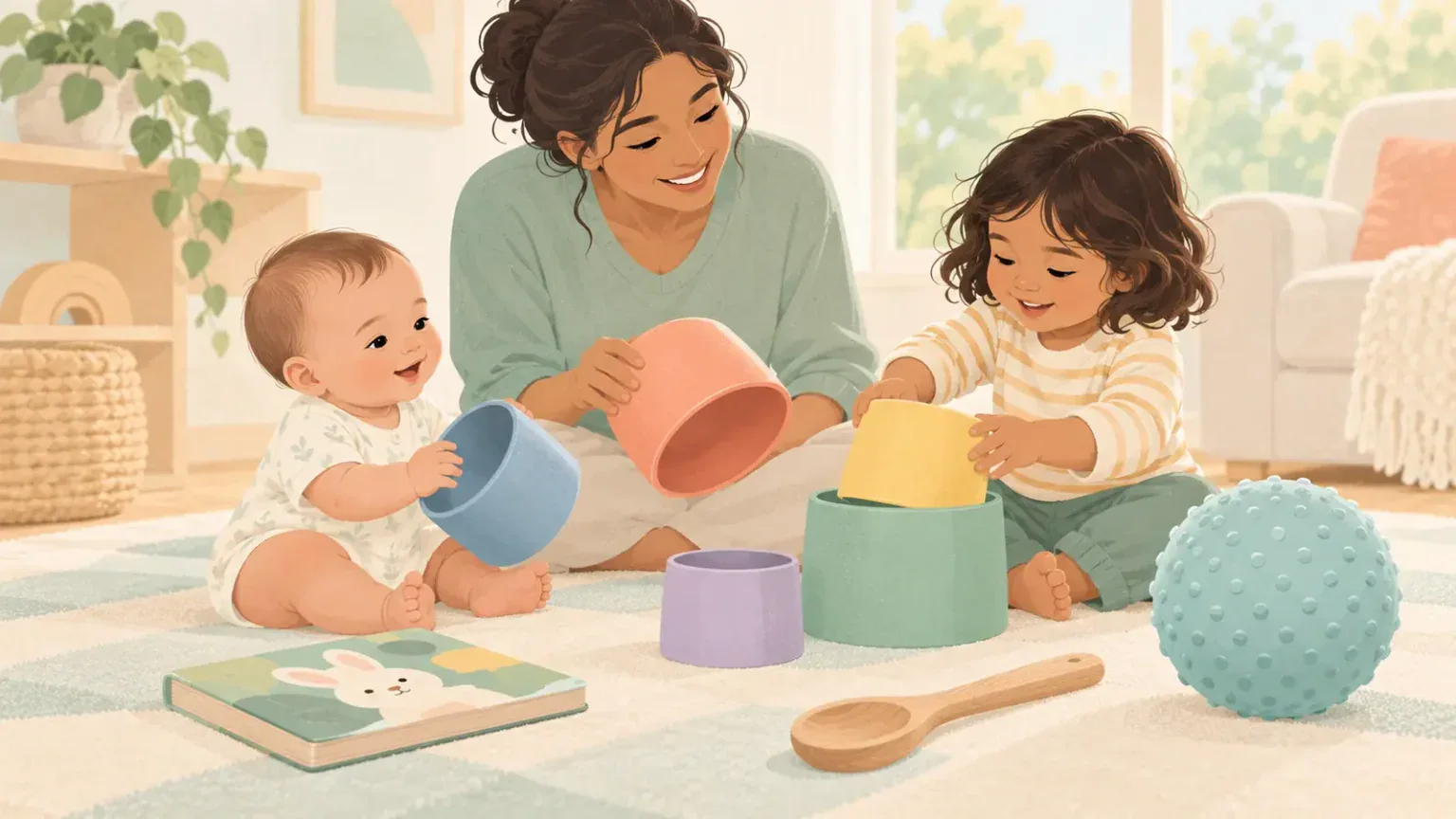
A useful play pack for a baby or toddler does not need many pieces. It needs a small number of sturdy things that can be explored repeatedly—and an adult who checks what has changed since last time. Babies mouth, bang, squeeze, drop and pull. Toddlers test lids, seams and every interesting edge. That is not “wrong” play; it is why the pack must fit the child who will actually use it.
Start with the child, not a shopping list
Notice what your child currently does. Do they reach and grasp, transfer objects, fill and empty containers, carry things, or copy simple actions? Choose four to six objects that invite those actions without tiny accessories. The American Academy of Pediatrics notes that simple items such as containers, wooden spoons, blocks and shape sorters can support exploration, while caregiver presence matters more than elaborate electronics.
A pack for a six-month-old will look different from one for a two-year-old. Age labels are a starting point, not a substitute for watching how your child uses an object.
A practical pack
- Two large nesting cups with no cracks or removable decorations
- A short, solid wooden or silicone spoon
- A washable fabric square with firmly finished edges
- A large textured ball made for the child’s age
- A sturdy board book
- A wide container with no cord, hinge pinch-point or detachable lid
Skip beads, counters, marbles, loose bells, water beads, deflated balloons, high-powered magnets and anything containing an accessible button or coin battery. The US Consumer Product Safety Commission explains that products intended for children under three must not present small-part choking, aspiration or ingestion hazards. Household objects still need a real-world safety check.
Run the five-point audit every time
- Size: Is every piece far too large to fit in the child’s mouth? Check broken pieces too.
- Strength: Pull seams, handles and glued decorations gently. Remove anything loose, cracked or brittle.
- Power: Exclude loose batteries and magnets. Battery compartments should be secure and require a tool.
- Cleanliness: Wash according to the material and dry fully. Retire items that cannot be cleaned after heavy mouthing.
- Context: Look for an older sibling’s tiny bricks, coins, craft pieces or snack remnants before putting the pack down.
Play together without performing a lesson
Sit close enough to respond. Offer one or two objects, pause, and follow the child’s attention. Tap two cups, hide the spoon partly under the cloth, or place the ball in the container. If the child repeats an action, let repetition be the activity. Harvard’s play guidance describes playful back-and-forth as an opportunity to practise attention and self-control; it is not a promise that one activity will produce a milestone.
For limited reach or movement, place objects on a non-slip surface and bring choices into comfortable range. For sensory sensitivity, offer one familiar object beside one new option. Stop if the child turns away, becomes distressed or needs care.
Store it as safely as you use it
Keep the pack where an adult controls access. Wash and audit it after illness, visitors, and whenever older children use the space. A dated note inside—“checked: seams, cracks, batteries, magnets”—makes invisible safety work easier to remember.
For a broader rhythm, see EdCaptain’s balanced weekly play plan. Try the printable picture scavenger hunt later with age-safe objects and supervision.
When to retire an object
Remove an item immediately if it develops a crack, sharp edge, loose seam, exposed filling, sticky surface or change in shape. Do not repair a baby toy with ordinary glue, tape or a makeshift fastener and return it to mouthing use. Follow recalls and manufacturer instructions for purchased products. If you are unsure whether an object is appropriate, choose a simpler purpose-made alternative or ask a qualified local professional rather than testing it with the child.