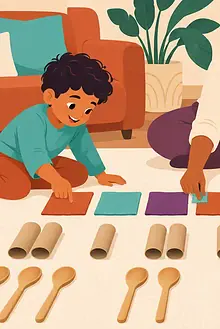
There are days when a caregiver needs to lie down, sit quietly or conserve energy but children still need connection and safe activity. A low-energy play pack cannot replace supervision or another responsible adult when one is needed. It can reduce setup and decision-making during a short, manageable period.
Prepare the pack on a better day. The goal is not to keep a child entertained for hours. It is to offer a few bounded activities that work beside the sofa, bed or chair without requiring constant fetching, judging or cleanup.
Decide when the pack is appropriate
Use it only when the caregiver is alert enough to supervise the child and environment. It is not suitable when the adult is unconscious, heavily sedated, acutely unwell, unable to respond in an emergency or caring for a child who needs closer support than they can provide.
If supervision is not adequate, contact another trusted adult or appropriate service. Do not place an older child in charge of siblings by default.
Choose a clear play boundary
Set up one mat, tray or low table within the caregiver’s sight and reach. The boundary shows where materials stay. Remove breakables, medicines, hot drinks, cords and choking hazards from the area.
Use a shallow lidded box with four labelled pockets:
- draw or sticker;
- match or puzzle;
- tell a story;
- quiet connection.
Pack activities that almost reset themselves
Examples include a small notebook with chunky crayons, reusable picture matching cards, a three-piece story sequence, a fabric texture square, a simple printable maze and a “choose one question” card. Avoid glitter, liquids, modelling compounds that need close monitoring and projects with many tiny parts.
The cooperative story-path game can be shortened to eight squares. The small memory games include options that can be adapted with a few visible objects.
Use an honest opening script
Say: “My body needs a quiet rest. I can stay with you here and help a little, but I cannot run or set up a big activity. You can choose drawing or story cards.” This names the limit without asking the child to care for the adult emotionally.
Do not promise unlimited time. Give a simple endpoint: after one story, when the timer ends or when another caregiver arrives. If the adult’s condition changes, stop the activity and seek help.
Structure the session
- Child chooses one pocket.
- Adult checks that the materials fit the child and setting.
- Activity stays on the mat or tray.
- Adult joins with small comments, choices or shared looking as capacity allows.
- Both return pieces before opening another pocket.
- Either person may end the session.
A child can play parallel to the adult without performing. Silence is acceptable. Connection might be the adult noticing one drawing detail or listening to one sentence.
Adapt by age and ability
For ages 3–5, use large pieces and direct supervision. For ages 6–9, add a choice card and simple independent instructions. For ages 10–12, invite the child to design a puzzle or read beside the adult, but do not make them responsible for monitoring the caregiver.
Use high contrast, tactile pieces, larger grips or partner-assisted choices. A child who needs movement may require a different plan with another adult; do not insist that quiet seated play suits every body.
Reset the pack later
When energy returns, check missing pieces, sharpen pencils and replace used pages. Ask the child which activity worked and what felt boring or frustrating. Keep reliable favourites and remove anything that created more work than it saved.
The American Academy of Pediatrics highlights simple materials and shared attention in play. Harvard’s resources describe playful activities as practice opportunities, not guaranteed interventions. A low-energy pack supports a particular family moment; it does not cure stress, illness or developmental concerns.
For a planned week of brief ideas, see the ten-minute low-energy activity plan. The pack’s value is more immediate: fewer decisions, a safer boundary and permission for both caregiver and child to do less.