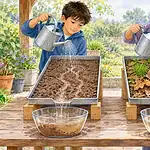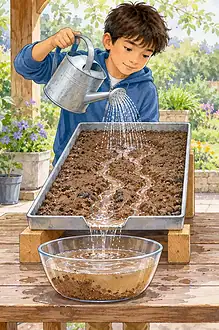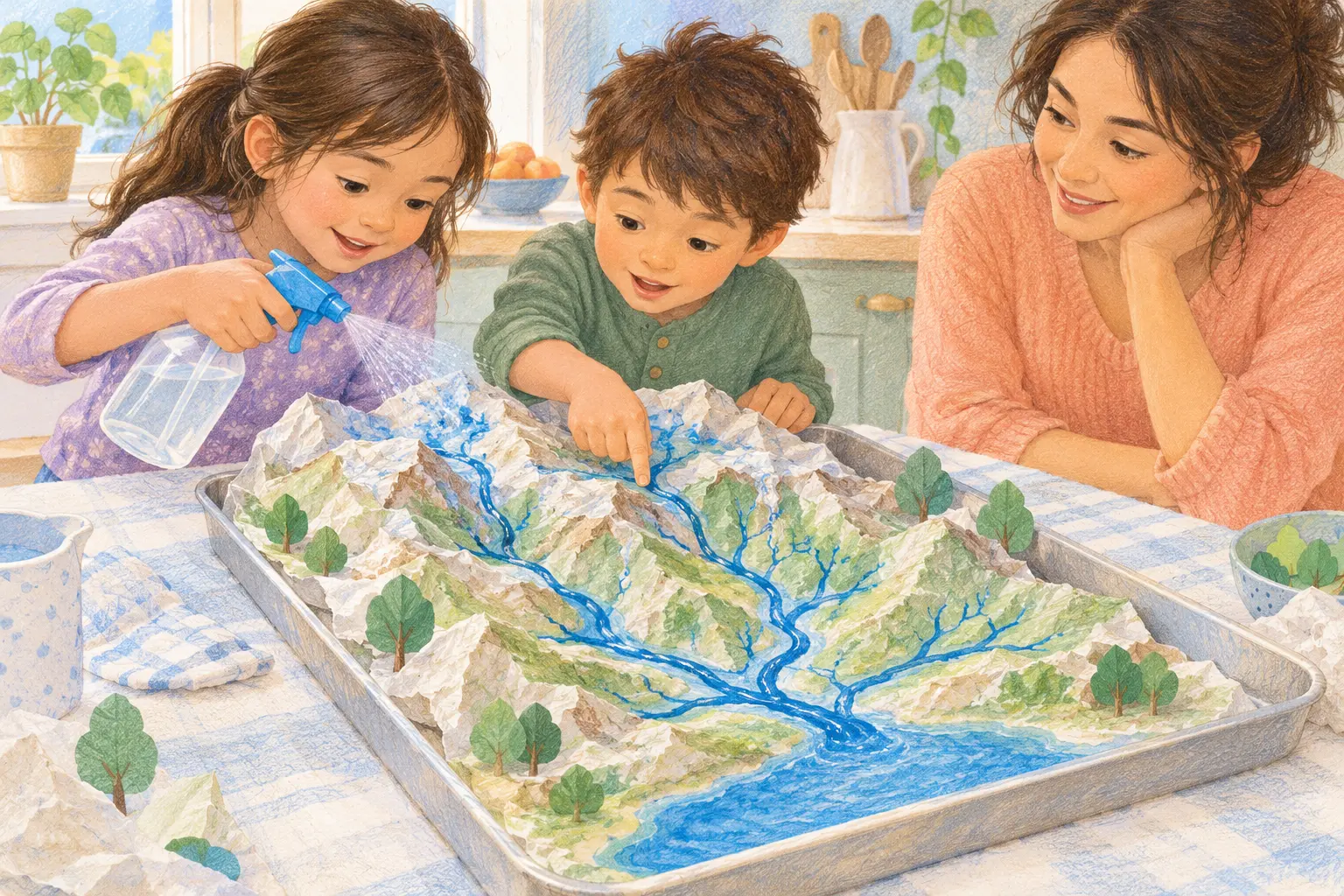
Water that falls on a hill does not stay inside a neat drawing of a river. It moves downhill across land, gathers in channels and connects places that may look separate on a flat map. A crumpled-paper watershed makes those connections visible with a small amount of clean water and no pretend pollutants.
You will need
- Thick scrap paper or a reused paper bag
- A waterproof tray
- Washable blue marker or a little food-coloured water
- Spray bottle, dropper or teaspoon
- Towels
- Optional sticky notes for towns, farms or parks
Protect the work surface and use only a small amount of water. Food colouring can stain, so an adult should decide whether plain water is better. Keep the model away from electrical equipment, and wipe spills promptly.
Shape the land before adding water
- Crumple the paper gently, open it without flattening it and place it in the tray.
- Identify high ridges and low valleys. Predict where water will collect.
- Draw several short blue lines in valley folds, leaving gaps so runoff can reveal the connections.
- Add paper labels for a road, garden, wetland or neighbourhood if you want to discuss land use.
- Mist the highest areas evenly or add measured drops. Watch from the side as well as above.
Follow one drop with a finger held just above the surface. Where does it join another flow? Which ridge separates water travelling to different outlets? The land area draining toward one common outlet is a watershed. Its boundary follows higher ground, not necessarily a visible fence or road.
Run a careful second trial
Photograph the dry model and the wet paths. Let the paper dry, then alter one feature: raise a ridge, add a small sponge “wetland” or place a strip of porous fabric on a slope. Repeat with the same amount of water. Compare where water slowed, spread or changed direction. This is a model of flow, not a test proving how a real wetland or engineered system will perform.
Discuss runoff without adding pollution
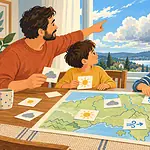
Ask what rainwater might pick up from real surfaces: loose soil, litter, oil residue, fertiliser or animal waste. Do not put those materials into the activity. Use clean picture cards beside the model and move them along the observed route. That keeps the demonstration safe while showing why actions upstream can affect water downstream.
Pair this model with a rain-gauge weather log to compare light and heavy rainfall. The water-cycle paper model adds evaporation and condensation, while a clay contour map shows how maps represent height.
Adapt for age and access
- Ages 6–9: find the highest and lowest places and narrate a drop’s journey.
- Ages 10–12: outline the watershed boundary and compare two outlets.
- Teenagers: annotate land uses and propose a testable change to reduce rapid runoff.
- Accessible participation: use a large high-contrast tray, a dropper with an easy-grip bulb, tactile ridge lines or a partner who describes the moving water.
Read the pattern cautiously
The first route may reflect a crease in the paper more than a realistic valley. Sprayed water may behave differently from intense rainfall. Paper does not absorb and release water like soil, vegetation or rock. Name those limits before making a conclusion. A useful statement is: “On this model, water crossed the labelled road and joined the lower channel.”
End with a local question
Look at a public map and ask where rain near your home, school or park is likely to travel. Do not assume the paper model captures drains, pipes, groundwater or all local terrain. Official watershed and flood maps are better sources for real decisions. A useful final sentence is: “Our model suggests water follows low paths, and we would need local information to know the exact route.”
After the activity, let the paper dry and recycle it if local rules allow. Pour clean water onto soil or into an indoor drain, not into a storm drain with craft residue. Store photographs without identifying a child’s exact home location.