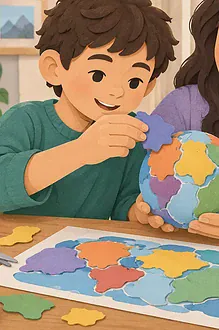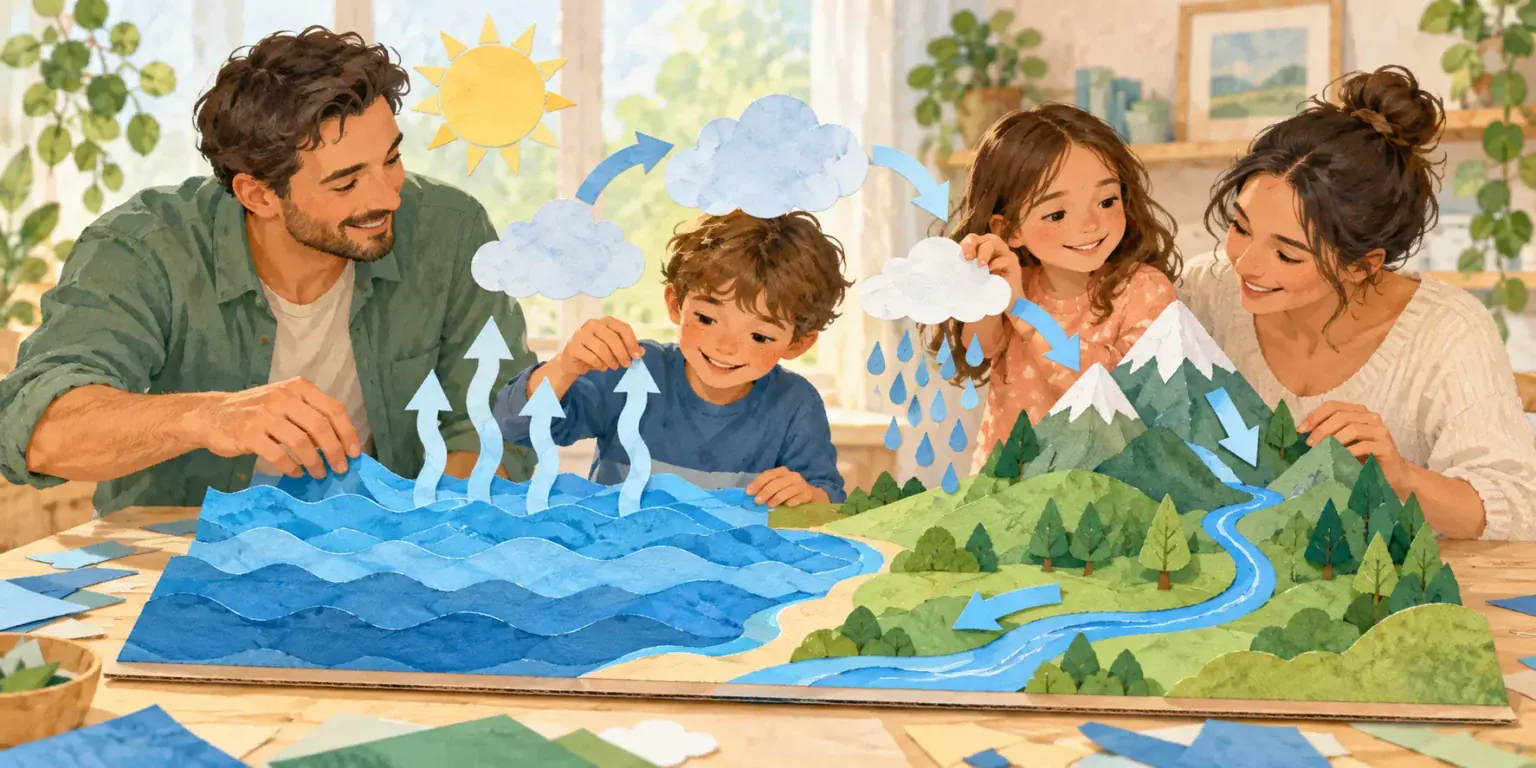
The familiar water-cycle circle is useful, but real water does not travel around one tidy loop. It can remain in an ocean, freeze in ice, soak into soil, move through plants, run into rivers or return to the atmosphere. A three-dimensional landscape helps children tell several possible journeys.
Materials
- Cardboard base and coloured paper
- Paper or card for mountain, cloud and water shapes
- Glue or tape, scissors and pencils
- String or removable arrows
- Optional cotton used sparingly for clouds
Adults handle difficult cutting. Keep small craft pieces and string away from toddlers, and avoid aerosol glitter.
Build Earth and atmosphere
- Create an ocean or lake on one side of the base.
- Fold a mountain and add a river flowing downhill.
- Add soil, plants and a simple underground layer.
- Stand clouds above the landscape using folded card tabs.
- Make removable arrows for water moving upward, across, downward and over land.
- Place arrows only while explaining a specific process; rearrange them for another journey.
Name processes through evidence
Evaporation moves liquid water into the atmosphere as water vapour. Transpiration adds water vapour from plants. Cooling can lead water vapour to condense into droplets. Precipitation returns water from clouds. Runoff moves across the surface, while infiltration moves into soil and groundwater.
The paper model does not actually evaporate or rain. Ask children to point out which parts are symbols and which processes would need real measurements or observations.
Tell more than one water story
Move a small blue token through the model. One story may go from ocean to atmosphere to cloud to rain to river. Another may begin as soil water, move through a plant and return through transpiration. A third may remain frozen for a long period. There is no required starting point.
Investigate a local connection
After rain, observe a safe outdoor area from a sheltered place. Where does water collect? Which surfaces allow infiltration and which produce runoff? Add a removable symbol to the model for a roof, drain, garden or paved area. Do not go outside during lightning, flooding or fast-moving water.
Adapt by age and ability
Ages 3–5 can move a token and use simple words such as up, cloud, rain and river. Ages 6–9 can label processes and tell two paths. Ages 10–12 can include groundwater, storage and human use. Use large tactile pieces, Velcro arrows or spoken descriptions. Children who cannot cut can plan the landscape, choose arrow positions or narrate the journey.
Questions that prevent oversimplification
- Can evaporation happen over land as well as ocean?
- Can rain fall while water elsewhere is evaporating?
- Where might water remain for a long time?
- Which parts of the model are not to scale?
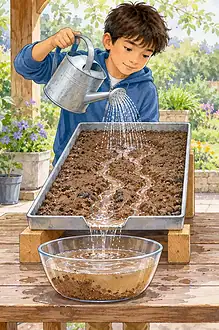
Measure real precipitation with the family rain gauge, map land shape with the clay contour model, or observe capillary movement in the walking-water experiment.
Use a covered mini-observation
Place equal shallow amounts of water in two transparent containers, cover one tightly and leave one open in a secure indoor spot away from children and pets. Mark the starting level and observe over several days without tasting the water. This is not a complete water cycle, but it can prompt questions about evaporation, condensation on a cover and why rates vary with temperature, airflow and surface area.
Add only observations supported by the containers to the model. If droplets appear on the cover, ask where the water was before and what changed. Avoid saying water “disappeared”; it may have moved into the air or condensed elsewhere. Clean the containers afterwards, especially if standing water has collected. For a shorter session, mist a clear lid lightly and watch droplets join and move, explaining that the spray represents water already condensed rather than a cloud forming from scratch.