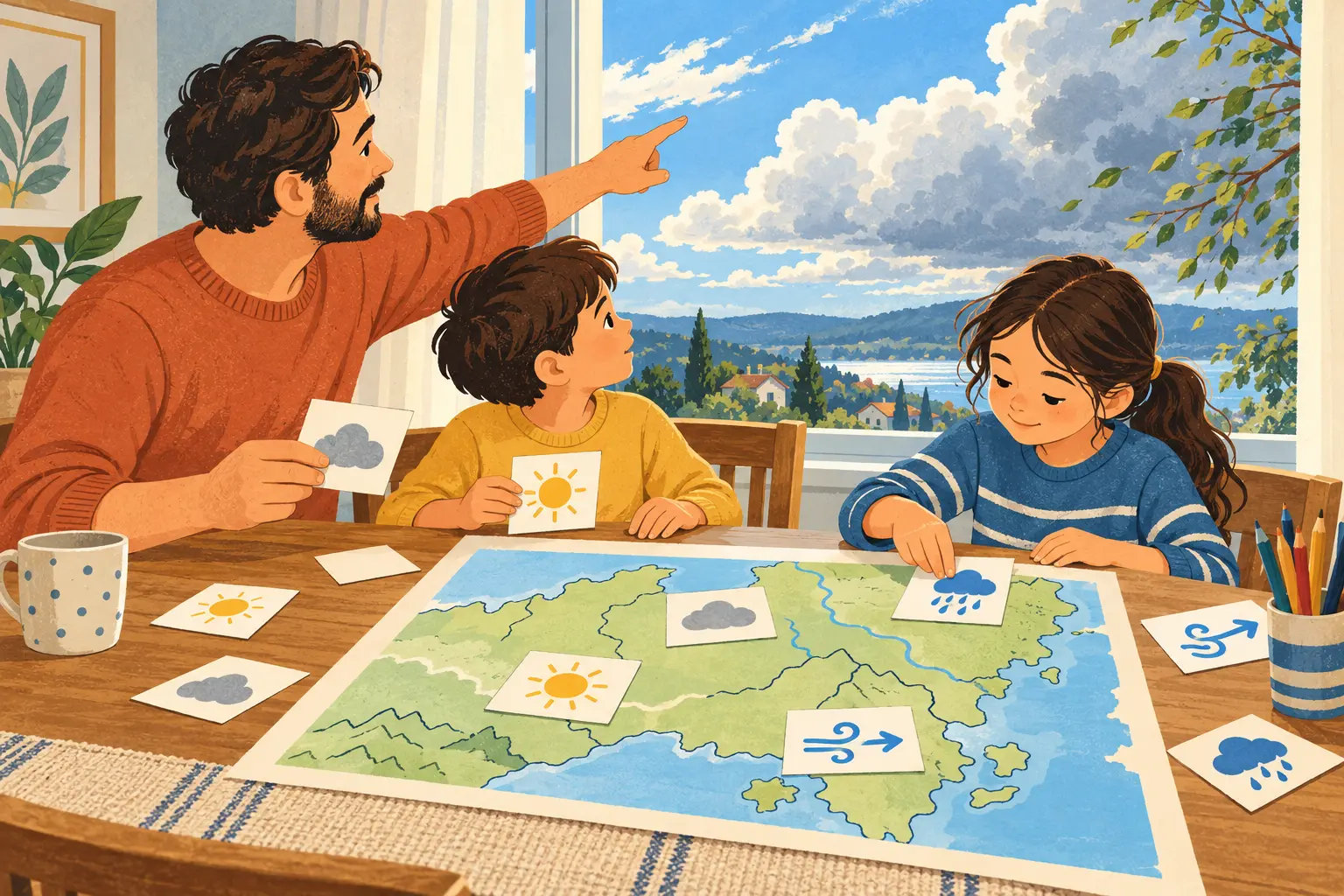
A weather map compresses many observations into small symbols. Children do not need to decode every mark to use one thoughtfully. By learning a few features, comparing them with what is outside and explaining uncertainty, a family can make a cautious forecast for the next part of the day.
Prepare a small weather desk
- A current official weather map for your region
- Paper and coloured pencils
- A view of the sky from a safe place
- Optional thermometer, homemade rain gauge and compass
Use an official national meteorological service for decisions involving storms, heat, flooding or travel. This activity is for learning, not replacing warnings. Observe from indoors during hazardous weather and never go outside to watch lightning.
Start with four readable features
- Cloud cover: many station plots use a circle whose shading represents how much of the sky is covered.
- Wind: a line or “barb” can show the direction the wind is coming from; extra marks may indicate speed.
- Pressure: maps may connect areas with similar air pressure using curved lines.
- Fronts and precipitation: colours and shapes can mark boundaries or areas of rain, snow or other weather. Always check that map’s legend.
Different providers design maps differently. Do not transfer a meaning from one legend without checking. Choose only two or three symbols on the first day and make a mini key in your own words.
Make a “now, evidence, next” forecast
Divide a page into three sections. Under now, record what you observe: cloud amount, wind, temperature or rain. Under evidence, copy relevant symbols from the official map and note the map time. Under next, write one modest prediction such as, “Cloud may increase this afternoon,” plus a confidence word: low, medium or high.
Check again later. Did the forecast fit? If not, ask whether the map was old, the system changed direction, local terrain affected conditions or the prediction was too broad. Forecasting improves through comparison and revision, not by pretending certainty.
Turn symbols into a family game
- Make matching cards: one symbol and one plain-language meaning.
- Have one player act as the weather presenter for thirty seconds.
- Hide an observation card and ask which map clues would support it.
- Compare maps from two times and circle what changed.
- Invite older children to explain why a single station cannot represent a whole region.
Children aged 6–9 can focus on cloud, rain and wind. Ages 10–12 can compare timestamps and directions. Teenagers can examine pressure patterns, forecast confidence and how model output differs from direct observation. A child who does not enjoy drawing can sort cards, dictate a forecast or operate the timer.
Connect weather with place
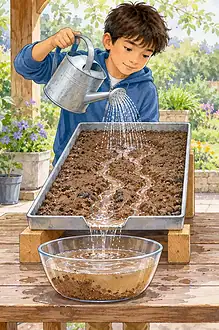
Use the homemade rain gauge and weather log to collect a local record. A bird’s-eye mapping activity can introduce symbols and keys, while the water-cycle model helps discuss where atmospheric water comes from and where it goes.
Separate three kinds of statement
Ask the presenter to label each sentence as observation, inference or action. “The station circle is mostly shaded” is an observation. “Cloud may increase” is an inference. “We will take waterproof clothing” is an action. Separating them helps children see that evidence supports decisions without guaranteeing an outcome.
Use forecasts safely
A family prediction should never overrule an official alert. If an authority issues a severe-weather instruction, follow it. Children may also feel anxious about storm symbols; explain that maps help people prepare and that adults are responsible for safety decisions. Avoid dramatic language, and make a simple plan for where to check reliable updates.
Finish by saving the map time and your forecast. Review it later without scoring anyone as right or wrong. Identify one strong clue, one uncertain clue and one thing you would check next. That short reflection is more valuable than an exaggerated prediction based on a single icon.