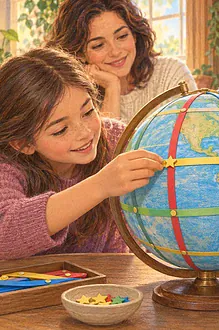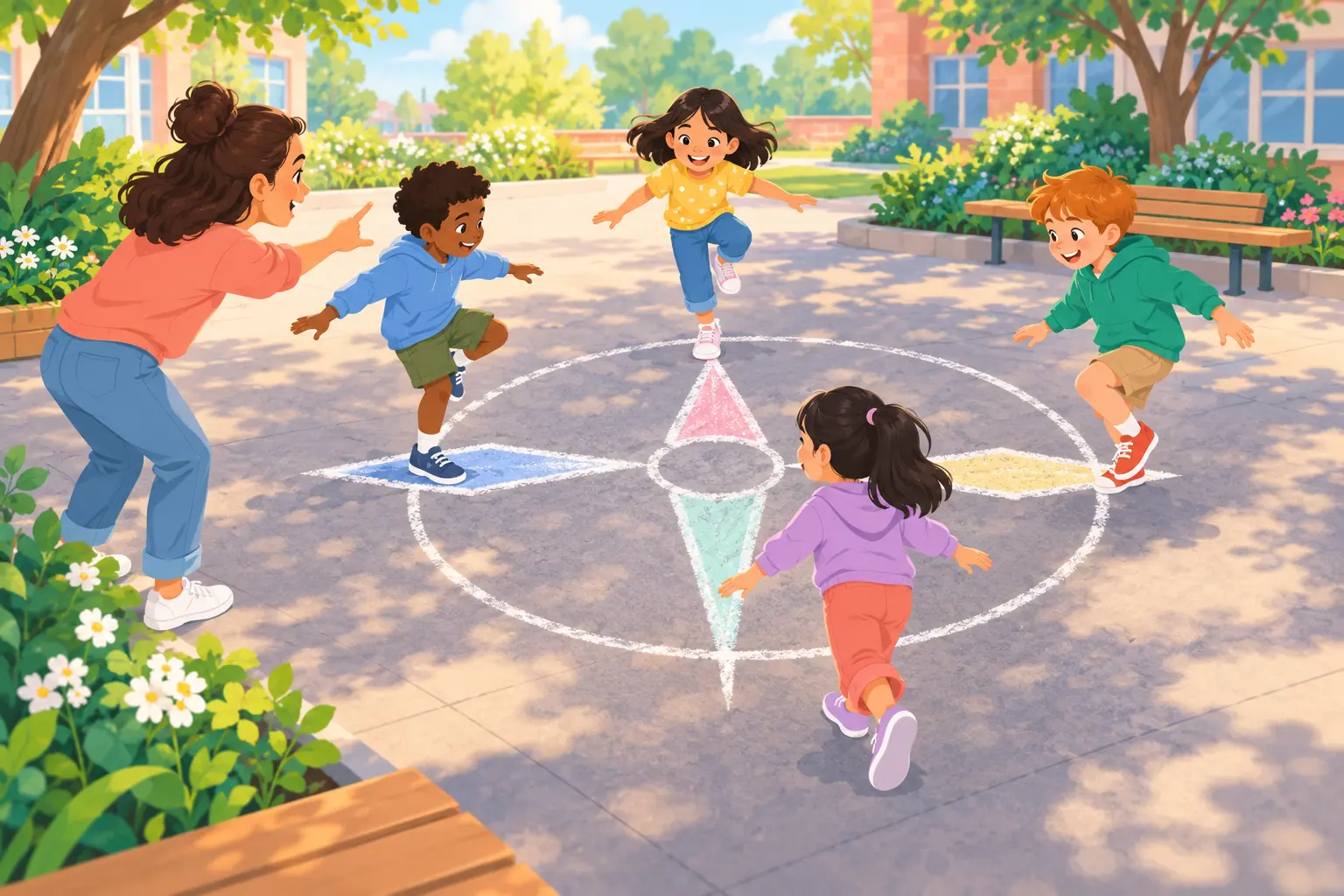
North, south, east and west become easier to remember when children can turn, step and point instead of only looking at arrows on a page. In this game, your family makes a large compass rose, aligns it with the real world and uses it for quick movement challenges. The goal is not speed. It is to connect a direction word with a consistent direction in space.
Materials and setup
- Chalk outdoors, or four sheets of paper and tape indoors
- A simple compass or compass app used by an adult
- Four objects to place at the main directions
- Optional action cards
Choose a level, uncluttered space away from traffic, stairs and slippery surfaces. Use the compass to identify north, then place the other directions opposite and at right angles. If you use paper indoors, tape it securely so it cannot slide. Explain that a compass points towards magnetic north; for this family game, that is close enough to establish a consistent reference.
Play the basic round
- Stand in the centre and face north together.
- Name each direction while turning: north, east, south, west.
- Call one direction. Players step or roll a soft ball toward it.
- Add a movement: “Tiptoe east,” “reach toward south,” or “clap while facing west.”
- Pause after several calls and ask how players worked it out.
For preschoolers, start with north and south only, then add the other pair. Keep instructions short and allow children to copy an adult. School-age children can follow two-step routes such as “two steps north, one step west.” Older players can stand in different starting positions so that they learn directions do not change when their bodies turn.
Make it a map game
Place a toy, picture or household object at each direction. Give clues: “The scarf is west of the cup” or “Start at the leaf, travel south, then east.” Children can draw the layout afterward, adding a compass rose to the page. Remind them that north is often placed at the top of a map, but it does not have to be. The compass rose tells the reader how the page is oriented.
Link the experience to a smaller room-map treasure hunt. Children can first move through the route, then represent the same turns from above. A clay contour activity adds the idea that maps can show height as well as direction.
Inclusive variations
- Point, look, tap a switch or hold up a coloured card instead of stepping.
- Use textured direction markers for a child who benefits from touch.
- Let a child give the calls, operate the compass or check the sequence.
- Play seated by placing direction cards around a table or wheelchair.
- Reduce sensory load by removing the race element and using one instruction at a time.
Notice, correct and reflect
If a player chooses the wrong direction, return to north and reason it out rather than eliminating anyone. Ask: “What is opposite east?” “If we rotate the whole paper, does north in the room change?” “How could we show direction to someone who was not here?” Finish by inviting each child to invent one clear clue for another player.
Directions describe relationships, not a child’s worth or ability. Repeated short rounds work better than a long test. You can revisit the compass rose during a walk, on a weather map or while tracing water through the water-cycle model.
Take the directions outdoors
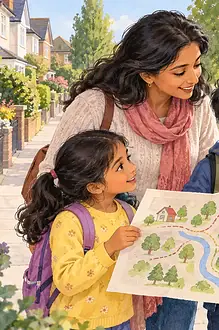
On a supervised walk, pause at two safe landmarks and identify north before checking the compass. Ask which way the route continues and which direction points back toward the starting place. Children can sketch two arrows afterward. Keep the task general and never share a child’s exact route or routine publicly. The purpose is to transfer direction language, not to test independent navigation.