By EdCaptain editorial desk · Published
“If rivers put fresh water into the sea, why is the sea salty?” It is a good challenge to the usual water-cycle picture. The arrows show water moving, but often leave out what the water carries.
A useful first answer is: rivers carry small amounts of dissolved salts from the land. Water also leaves the sea by evaporation, while those dissolved salts stay behind. Seafloor processes add dissolved material too, and other processes remove some of it. The ocean’s saltiness reflects that long natural history and continuing exchange.
For children aged 6–12, separate three questions: where the salt comes from, why river water is different, and what happens when water evaporates. There is no need to taste river water or collect seawater to investigate the ideas.
Begin with “fresh does not mean empty”
Ask your child what they think freshwater means. They may reasonably imagine water containing nothing except water. Explain that freshwater can contain dissolved salts and other minerals, but generally at much lower concentrations than seawater. Clear water can still contain things we cannot see.
Try: “Freshwater is not the same as salt-free water. A river can carry a little dissolved salt without being salty like the sea.” This also gives you a chance to separate freshwater from drinking water: neither clarity nor the word “fresh” proves that water is safe to drink.
Keep the discussion separate from tasting. Use your family’s usual safe drinking water for drinking, and never sample a stream, sea, puddle or experiment to decide what it contains.
Follow the material from land to sea
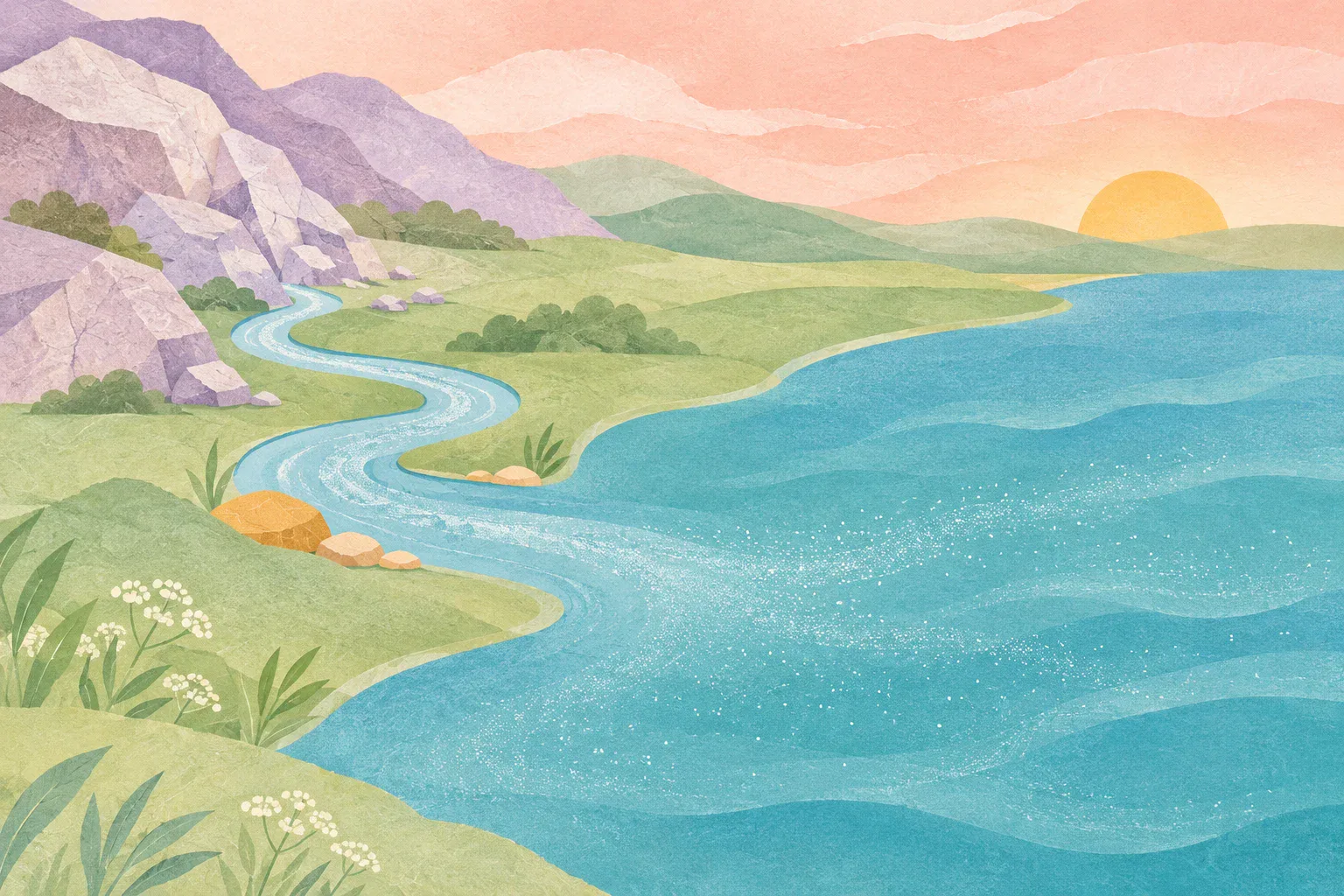
Rainwater interacts with rocks as it moves over and through land. Weathering releases dissolved mineral components, including charged particles called ions. Streams and rivers can carry these onward. Your child does not need to learn ion names before understanding that water transports material too small to see.
For an older child, explain that sodium and chloride are important ions in seawater and also the components of ordinary table salt. The ocean contains other dissolved salts as well; it is not simply a giant bowl of kitchen salt dissolved in water.
NOAA’s explanation of ocean salt sources includes both rocks on land and openings in the seafloor. Water circulating through hot rock beneath the seabed exchanges dissolved material with it. Mention this second route without suggesting that a child should heat rocks or reproduce a deep-sea vent.
Why doesn’t the river become just as salty?
Rivers receive freshwater from their catchments and carry dissolved material along as they flow. The water passing a riverbank is continually being replaced. The Woods Hole Oceanographic Institution guide explains that freshwater input is large compared with the small amounts of salts being added.
When river water enters the sea, it can make nearby surface water less salty. That does not contradict the fact that rivers also deliver dissolved salts: they deliver water and dissolved material together, in a mixture much less salty than seawater.
Avoid turning this into “all rivers are fresh and all lakes are fresh.” Natural waters differ, and some lakes are very salty. The question is about the amount of dissolved salt relative to the water, not just the name of the water body.
What leaves when water evaporates?
Evaporation changes liquid water into water vapour in the air. Dissolved salts do not leave with that vapour. If water leaves a sample this way, the salt that remains is mixed into less liquid water: the concentration increases. Evaporation does not manufacture new salt.
NOAA’s Sea Water guide explains how evaporation and freshwater inputs affect salinity, the name for salt concentration. This helps answer a common follow-up: sunlight does not pour salt into the sea; evaporation changes the water side of the mixture.
Try a dry paper explanation
Use this short model if your child wants to see the difference between adding salt and removing water. You need scrap paper, a pencil and a clear tabletop. Draw eight large blue water symbols and two large yellow salt symbols on separate pieces, or have an adult prepare them. Keep pieces large and use letters or different textures as well as colour if helpful.
- Make the starting mixture. Put all eight water pieces and both salt pieces together. The symbols stand for a mixture; real dissolved salt is not floating around as visible paper-sized lumps.
- Show evaporation. Move two water pieces to a separate space representing the air. Leave both salt pieces in the mixture.
- Compare before explaining. Ask, “Did we add any salt? How much water is left?” There is the same salt represented among fewer water pieces.
- Show freshwater arriving. Return the two water pieces as an imagined freshwater input. Ask how the balance changes when water is added rather than removed.
- Name the limit. These invented counts are not the ocean’s salt concentration. The paper shows only one relationship; it does not reproduce rivers, mixing, seafloor reactions or the whole water cycle.
For ages 6–9, narrate “same salt, less water” and let the child move or point to the pieces. For ages 10–12, ask them to distinguish a change in salt amount from a change in concentration. As a variation, restore the starting arrangement and add one salt piece instead: that changes the salt amount, unlike the evaporation round. A child can direct another person’s hands, dictate the explanation or use tactile symbols.
Does the ocean get saltier forever?
Salt enters the ocean, but dissolved material is also removed through natural processes, including incorporation into sediments and use of some components by organisms. NOAA’s river-and-ocean explanation describes this balance. Avoid the image of an endless salt shaker with no way for material to leave.
Ocean saltiness also varies from place to place. A single diagram or your paper pieces cannot show every region or predict a beach’s water. The helpful conclusion is: “We have explained some sources of salt and why removing water changes concentration. We have not modelled the whole ocean.”
If your child wants a real dissolving investigation, use the separate salt-dissolving and drying comparison, including its safety and storage steps. To place evaporation and rain in a wider picture, explore the paper water-cycle model.
Sources and further reading
- NOAA Ocean Service: where ocean salts come from.
- NOAA Ocean Service: why rivers and the ocean differ in saltiness.
- Woods Hole Oceanographic Institution: freshwater, rocks and ocean salinity.
- NOAA JetStream: evaporation and variations in salinity.
Read our editorial policy and review methodology.