By EdCaptain editorial desk · Published
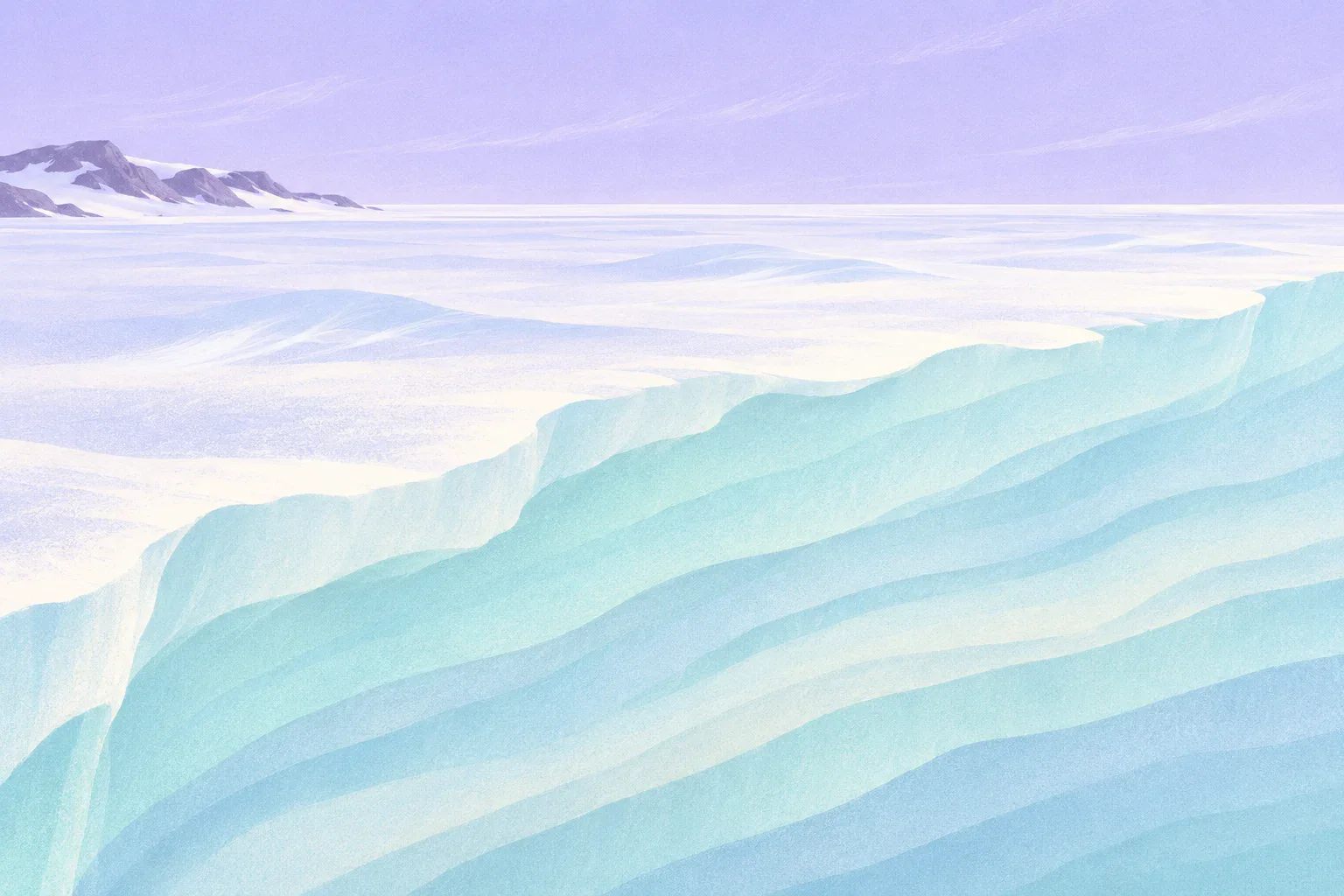
“That cannot be a desert. Look at all the snow!” A child looking at Antarctica has spotted a real puzzle. If desert means hot sand dunes, the label seems impossible. Even after hearing that deserts are dry, the ice still needs explaining.
The key is to separate water already stored as ice from new water arriving as rain or snow. Much of Antarctica receives very little new precipitation, especially in its interior. Its great ice sheet includes snow accumulated and compressed over thousands of years. Those two facts can both be true.
This guide is for conversations with children aged 6–12. It uses pictures, questions and paper rather than ice experiments or a test of how long anyone can stand the cold.
Find out what “desert” means to your child
Ask, “What would you expect to see in a desert?” They may name sand, camels, heat or very few plants. Treat those as clues from familiar pictures, then introduce the feature that matters here: a desert receives very little precipitation over time. It does not have to be hot or sandy.
Explain precipitation as water arriving from the atmosphere, including rain and snow. Snow counts. Otherwise, a child may conclude that Antarctica qualifies only because snow is somehow excluded from the total.
Try: “Cold tells us about temperature. Dry tells us about how little new rain or snow arrives. A place can be cold and dry together.” The NASA Space Place introduction to Antarctica makes this distinction between an icy landscape and low precipitation.
Why the ice does not settle the question
A photograph shows what is there when the camera takes the picture. It cannot, by itself, tell you how much snow fell that year. A thick layer may reflect a long history, rather than a recent storm.
The British Antarctic Survey’s overview explains that Antarctica’s ice sheet formed through the accumulation and compression of snow and frost over thousands of years. Existing layers and the rate at which new material arrives are different things to describe.
You can use an everyday comparison: a shelf full of books does not tell you how many books arrived this week. Some may have been there for years. Ask, “What would we need to know before we could say lots of books were added recently?” The same reasoning helps with ice: the amount present is not automatically evidence of a large recent input.
Keep the comparison limited. Books do not behave like ice, and the shelf cannot explain glaciers. It simply separates “how much is here” from “how much arrived during a particular time.” Avoid saying Antarctic ice never melts or that the continent has stopped changing.
Antarctica does not have one identical climate everywhere
A useful correction should not become another oversimplification. The interior is much drier than many coastal areas. The Australian Antarctic Program’s weather guide describes these regional differences. Most precipitation is snow or ice crystals, but rain is observed near the coast.
Say “much of Antarctica, particularly the interior” when explaining the very dry conditions. Do not tell a child that snow never falls there, that rain is impossible, or that every location receives the same amount.
For an older child, add a measurement caution. A centimetre of loose snow is not the same amount of water as a centimetre of rain. Reports may describe snow as its water equivalent: the water represented by the snow, rather than the depth of the fluffy layer. Do not compare those two types of measurement as though they were interchangeable.
A photo-caption check to do together
You need: one Antarctic landscape photograph in a library book or on one of the linked institutional pages, scrap paper and a pencil. An adult opens the webpage and reads the original caption. View the picture at its source; there is no need to download it, post it online or copy it into a project.
Choose a picture with a stated location. If its date or place is missing, note that gap. Set the image large enough to inspect, and divide the paper into “We can see” and “We would need to check.”
- Describe before explaining. Invite two observations, such as “There is a white surface” or “Rock is visible.” Keep guesses about recent snowfall out of this first list.
- Read the caption. Check where the photograph was taken. Is it inland or near the coast? Does the caption actually identify fresh snowfall, or are you adding that explanation yourself?
- Test a claim. Offer this deliberately invented caption: “This picture proves that lots of snow fell here this year.” Ask whether one photograph supplies that evidence. Put annual snowfall in the “need to check” column.
- Use the source text. Read the relevant paragraph about low precipitation or regional differences. Ask what extra information the text provides that the photograph cannot.
- Write a better caption. Try: “This Antarctic landscape contains snow and ice. Its appearance alone does not tell us how much new snow arrived this year.” Add a specific location only if the source identifies it.
Finish by asking, “What would help us answer the snowfall question?” A record from a named place over a stated period is more useful than another impressive picture. You do not need to find or calculate a complete climate record during this short activity.
Make the reasoning accessible
For ages 6–9, use the book-shelf comparison and the words “already here” and “arriving now.” An adult can read the source and write down the child’s spoken caption. Ask the child to explain how a place can have old ice and little new snow.
For ages 10–12, ask which information is missing: location, time period, precipitation measure or all three. As a variation, compare a coastal image with an inland one, checking the captions rather than ranking dryness from appearances.
Describe the photograph aloud, enlarge it or let your child dictate and direct the activity. If a visual comparison is inaccessible, read the two source statements about stored ice and low precipitation, then decide whether they contradict each other. The reasoning does not depend on seeing fine details in a picture.
Leave room for the next question
A child may ask whether blowing snow means it is snowing. Wind can lift snow already on the surface; the Australian Antarctic Program distinguishes this from new precipitation. A still photograph may not tell you which process you are seeing.
Connect that question with the family weather-map guide, where symbols need a legend and a timestamp. The rain-gauge and weather-log activity introduces repeated local observations, with its own safety instructions. A short home record is useful practice; it cannot establish the long-term climate of your neighbourhood or Antarctica.
Sources and further reading
- NASA Space Place: Antarctica, low precipitation and accumulated ice.
- British Antarctic Survey: the ice sheet and differences between coast and interior.
- Australian Antarctic Program: precipitation, regional weather and blowing snow.
Read our editorial policy and review methodology.