A child can enjoy writing, drawing or building until someone asks to see it. Suddenly the page is “not ready,” the model needs one more change, or the whole thing goes in the bin. The problem is not always high standards. Sometimes showing the work feels like showing a vulnerable part of the self.
The answer is not to force a grand reveal or insist that the work is amazing. Children need practice deciding what “ready enough” means, choosing a safe audience and learning that useful feedback does not erase ownership.
Separate making from sharing
First confirm that private work is allowed. A diary, unfinished sketch or experimental song does not have to become public simply because an adult is proud of it. Ask permission before photographing, posting or sending a child’s work to relatives.
Then explain the difference between privacy and avoidance. “You can keep some things just for you. When school or teamwork requires sharing, we can make that step smaller.” This respects boundaries without letting fear decide every time.
Agree on a definition of done
Before the child begins, choose a stopping rule appropriate to the task. For example: the story has a beginning, middle and end; the model stands for ten seconds; the poster contains the three required facts. Write the rule down. When the rule is met, optional polishing gets a time limit.
A timer can help, but use it as a boundary around the task rather than a threat. “You have fifteen minutes for changes, then we will save this version.” For a young child, use one final-check question: “Is anything missing that stops us understanding your idea?”
Use an audience ladder
Do not leap from hidden to public. Let the child select a sequence:
- Show one small part to a trusted person.
- Show the full piece without receiving comments.
- Ask for one kind of feedback.
- Share with a small group.
- Present or publish when the task genuinely requires it.
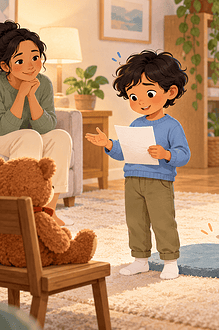
The child can also choose the format: read it aloud, let someone read silently, display it without standing beside it, record a video, or ask a partner to introduce it. Accessible participation matters more than a single “confident” style.
Ask what kind of response is wanted
Before looking, ask: “Do you want me to notice what I enjoy, help you solve one problem, or simply witness it?” This prevents an enthusiastic adult from turning every sharing moment into an editing session.
When feedback is invited, be specific and limited. “The opening made me curious” is more credible than “This is perfect.” If the child requests help, begin with their aim: “What do you want the reader to understand?” Then offer one suggestion and let them decide what to use.
Make revision normal, not endless
Show drafts from ordinary adult life: a shopping list with a crossed-out item, a message edited for clarity, or a recipe adjusted after tasting. Explain that revision improves communication; it does not prove the first attempt was a failure.
Model stopping too. Say, “I could keep changing this, but it now does what it needs to do.” Children who only see polished adult products can assume competent people never produce rough work.
Watch the language around talent
Labels such as “our little artist” or “the clever one” may sound positive, but they can make ordinary mistakes feel like threats to identity. Notice choices, persistence and learning: “You tried three ways to balance the roof,” or “You changed the order so the explanation was clearer.”
Do not use siblings or classmates as a benchmark. Sharing should reveal an idea, not establish a ranking.
When to seek more support
Perfectionism deserves extra attention when it causes frequent tears, lost sleep, missed deadlines, repeated school avoidance, self-insults or refusal to try anything uncertain. Talk with the teacher to understand what happens in class, and consult your child’s healthcare professional if distress is persistent or interfering with daily life.
Related EdCaptain guides include helping a perfectionist child, receiving feedback without shutting down, and specific, honest praise.